
In This Article
There’s a particular kind of modern misery that goes like this: you’re sitting in a lay-by on the A1, you’ve just been rear-ended by someone who is now — with absolute brass neck — insisting the whole thing was your fault. You have no proof. They have a very convincing story. Your insurance company has a very long queue. Sound familiar?
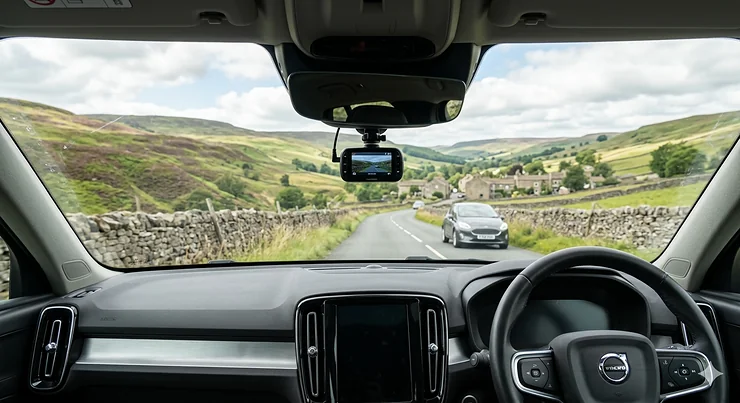
This is precisely what a dash cam is for, and in 2026, they’ve become about as standard on British roads as a cup of tea and an apologetic wave. This dash cam buying guide exists to cut through the noise, the spec-sheet gobbledygook, and the sheer overwhelming volume of options so you can find the right camera for your car, your budget, and your daily commute.
A dash cam, for the uninitiated, is a small camera mounted to your windscreen that records continuously while you drive. The footage is saved to a microSD card in a loop — older clips get overwritten by newer ones unless something triggers an emergency save, which the G-sensor handles automatically when it detects sudden movement or impact. Some cameras record the front only; better ones cover front and rear; the premium tier adds interior or cabin views too.
Three trends have converged to make dash cam footage genuinely valuable for UK drivers in 2026. First, insurance fraud — staged accidents and so-called “crash for cash” scams — remain prevalent on British roads, and dash cam footage is the most reliable defence against false claims. Second, the expansion of mobile phone detection cameras means footage disputes between drivers and automated enforcement systems are increasingly common. Third, pothole damage claims are on the rise, and timestamped video with GPS speed data is exactly the kind of evidence councils struggle to argue against.
This dash cam buying guide covers seven real products currently available on Amazon.co.uk, with honest analysis, practical advice for British conditions, and none of the spec-padding that makes most buying guides feel like reading a user manual in a second language.
Quick Comparison: 7 Best Dash Cams on Amazon.co.uk
| Camera | Resolution | GPS | Parking Mode | Best For | Price Range |
|---|---|---|---|---|---|
| VIOFO A229 Pro | 4K+2K | ✅ | ✅ (hardwire) | Performance/enthusiasts | £££ |
| 70mai A810S | 4K+1080P | ✅ | ✅ (hardwire) | Best value dual 4K | ££ |
| Nextbase 622GW | 4K front | ✅ | ✅ | British drivers, all-rounder | £££ |
| Garmin Dash Cam Mini 3 | 1080p | ❌ | ✅ (app) | Discreet/simplicity | ££ |
| Nextbase 422GW | 2K front | ✅ | ✅ | Budget-conscious families | ££ |
| VIOFO A229 Plus | 2K+2K | ✅ | ✅ (hardwire) | Night driving, value dual | ££ |
| Vantrue E1 Pro | 4K front | ✅ | ✅ | Solo front, ultra-compact | ££ |
What this table makes immediately obvious is how dramatically the mid-range has improved. Two years ago, 4K was a premium luxury; today, 4K front cameras are available at mid-range prices and represent the best-value step up for evidence quality. If you’re still running a 1080p camera from 2021, the footage quality gap has become genuinely significant — particularly for reading number plates in the dark or at distance. The Garmin Mini 3 is the exception here, and deliberately so: it trades resolution for a size and simplicity that many drivers simply want.
💬 Just one click — help others make better buying decisions too! 😊
✨ Don’t Miss These Exclusive Deals!
🔍 Take your road safety to the next level with these carefully selected dash cams. Click any highlighted product name to check current pricing and availability on Amazon.co.uk. Whether you’re after bulletproof 4K evidence or a discreet plug-and-forget camera, there’s a pick below for you.
Top 7 Dash Cams for UK Drivers: Expert Analysis
1. VIOFO A229 Pro — The Enthusiast’s Choice
If you’ve spent more than five minutes on any dash cam forum, you’ll know the VIOFO A229 Pro. The VIOFO A229 Pro is the outstanding performance recommendation at its price point — and it’s not hard to see why. The front camera uses Sony’s STARVIS 2 IMX678 sensor, which is the current gold standard in low-light imaging, paired with a 2K rear on the IMX675. The A229 Pro supports 5GHz Wi-Fi, GPS, HDR, voice control, 24-hour parking mode, and accepts cards up to 512GB — which means you could theoretically store weeks of footage before anything gets overwritten.
What the spec sheet doesn’t tell you: the 4K HDR night footage on this camera is genuinely stunning. On an unlit A-road in winter, other cameras are producing muddy smears where headlights should be; the A229 Pro is reading number plates three cars ahead. That’s the real-world STARVIS 2 difference. The 5GHz Wi-Fi means pulling footage to your phone actually happens at reasonable speed, unlike some rivals where you’ll age visibly waiting for a clip to transfer.
For UK drivers, the Quad-Mode GPS (covering GPS, BeiDou, Galileo, and GLONASS simultaneously) achieves positioning faster and greatly improves positioning accuracy and stability — meaning your speed and location data are rock-solid for any insurance or legal dispute.
The parking mode requires a separate hardwire kit, which is mildly annoying but entirely standard at this level. UK reviewers frequently praise the video quality and app reliability, though some note the small 1.4-inch screen means you’ll be doing most clip management via the app.
✅ Dual STARVIS 2 sensors — best-in-class night vision for unlit British roads
✅ Precise Quad-Mode GPS — reliable speed evidence for disputes
✅ 512GB card support — no constant SD card swapping
❌ Parking mode requires separate hardwire kit (add ~£20)
❌ Screen is tiny — app is effectively essential
Available on Amazon.co.uk from a UK-based seller with Prime delivery. In the mid-to-upper £££ range — check current pricing. Worth every penny for anyone who wants the best dual-channel evidence camera available right now.
2. 70mai A810S — The Value Champion
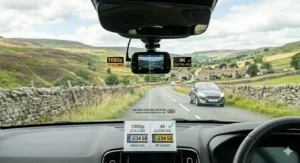
The 70mai A810S is the camera that makes the enthusiast crowd slightly uncomfortable, because it’s very, very good for the money. The A810S comes with a 128GB High-Endurance microSD card included, which is a meaningful inclusion — a decent high-endurance card alone costs £25-£35. The front camera records in true 4K using Sony’s STARVIS 2 sensor, with HDR; the rear handles 1080P. The dual channel dash cam features seamless loop recording, automatically overwriting the oldest footage when the card is full, and supports microSD cards from 32GB up to 512GB.
The ADAS (Advanced Driver Assistance System) deserves a mention, because it’s surprisingly competent on motorway driving. The ADAS system provides real-time lane departure and forward collision warnings — genuinely useful on the M6 at rush hour, where concentration lapses. The 4G LTE connectivity, if you subscribe, allows remote access to footage from anywhere, meaning you can check on your parked car in a supermarket car park without being physically present.
What most UK buyers overlook: the A810S comes with 4G capability but you’ll need the separate hardwire kit (the UP04) for proper 24-hour parking surveillance. Budget around £20-£25 extra. That said, even without hardwiring, the standard parking mode (which activates from a bump) works adequately for most situations.
The 70mai app is polished and consistently updated — a point that matters more than people realise. Cameras with abandoned apps become frustrating very quickly.
✅ 128GB high-endurance card included — ready to use out of the box
✅ 4G LTE remote access — check parked car footage from anywhere
✅ Excellent 4K day footage with well-calibrated HDR
❌ 4G capability requires additional monthly subscription for full remote features
❌ Rear camera is 1080P, not 2K — a step down from the VIOFO A229 Pro
Sold by 70mai-EU on Amazon.co.uk and dispatched from Amazon Fulfillment — Prime eligible. In the £££ mid-range — outstanding value when you factor in the bundled SD card.
3. Nextbase 622GW — The British Favourite
The Nextbase 622GW is a revolutionary dashcam offering world-first features including image stabilisation, what3words integration, and 4K image quality. Nextbase is a British brand, and the 622GW shows it — this camera was designed with UK roads, UK emergency services, and UK users specifically in mind.
The what3words integration is the feature that sets this apart from any other dash cam on the market. If you’re involved in an accident on an unmapped farm track in North Yorkshire or a remote stretch of the A838 in Sutherland, what3words obtains your exact coordinates in a 10-by-10-foot square and sends it to your key contacts so they can locate you regardless of internet connection. For rural British drivers, this is genuinely invaluable.
The Emergency SOS feature automatically notifies emergency services if no movement is sensed after impact — a remarkable safety net that goes well beyond what any Chinese-brand competitor currently offers. Alexa voice control, polarising filter (a genuine glare-reduction asset on bright British motorways where morning and evening sun can be blinding), and 4K at 30fps with slow-motion capability at 120fps round out an impressively comprehensive package.
UK reviewers consistently praise the build quality, the ease of installation via the Click-and-Go magnetic mount, and the customer support — the latter being a significant advantage over imported brands when you actually need help.
✅ what3words emergency location — critical for rural UK driving
✅ British brand with excellent UK customer support
✅ Alexa integration and Emergency SOS — unique safety features
❌ Premium price point — you pay for the British brand and features
❌ Rear camera sold separately (adds to total cost)
Available on Amazon.co.uk with Prime delivery. Upper price bracket — justified if the emergency safety features matter to you, and for rural drivers they absolutely should.
4. Garmin Dash Cam Mini 3 — The Stealth Camera
Not everyone wants a dashboard-mounted conversation piece. Some drivers want something small enough that a potential thief glances at the windscreen and sees nothing. The Garmin Dash Cam Mini 3 is roughly the size of a car key fob. This ultracompact dash cam automatically records 1080p video with a 140-degree field of view and saves video of detected incidents. The built-in Garmin Clarity polariser reduces windshield glare for a clear view, with Garmin Clarity HDR optics for details day and night.
The trade-offs are honest and intentional: no GPS, no rear camera, 1080P rather than 4K. In 2026, where every competitor is waving 4K and dual-sensor credentials, Garmin is essentially saying: some people just want a reliable camera that records, saves incidents, and doesn’t get in the way. That’s a valid position, and the Garmin delivers it with typical brand reliability.
What most buyers don’t expect: the Garmin Drive app integration is genuinely excellent. You can view synchronised video clips from up to four dash cams using the Garmin Drive smartphone app, which enables increased driver awareness and extra camera viewpoints. So if you eventually want multi-camera coverage without a complex installation, the Garmin ecosystem scales neatly.
The built-in Clarity polariser is worth pausing on. On a clear autumn morning on the M25 with sun at a low angle, standard cameras wash out; the polariser maintains contrast and detail. For British driving — where low winter sun is basically a seasonal hazard — this is more useful than it sounds.
UK buyers: currently in stock on Amazon.co.uk from third-party sellers with Prime dispatch. Stock can be limited — check availability.
✅ Ultracompact — virtually invisible to passers-by
✅ Garmin reliability and Drive app ecosystem
✅ Clarity polariser handles British low-sun conditions well
❌ No GPS — no speed or location evidence for disputes
❌ 1080P only — number plate clarity at distance is noticeably lower than 4K rivals
Mid-price range. If discretion is your priority over raw specification, this is the camera.
5. Nextbase 422GW — The Smart Family Choice
The 422GW is where Nextbase hits its sweet spot: enough features to be genuinely useful, at a price that doesn’t require a lengthy conversation with a spouse. The Nextbase 422GW records in 2K 1440p at 30fps with WiFi, Bluetooth app support, GPS, Emergency SOS, parking mode, and a 2.5-inch touch display, with a 140-degree wide angle covering six lanes.
The 2K 1440P is an important step up from 1080P. At 1080p, number plates at distance or in poor light are often unreadable — which defeats the primary purpose of the camera. At 2K, you have a genuine fighting chance of reading a plate from a moving vehicle at a reasonable distance — the difference between winning and losing an insurance dispute can genuinely come down to this single specification.
Emergency SOS is present — a rarity at this price point. Alexa voice control means you can lock a clip, take a photo, or get driving directions without touching the camera. For families who share a car between drivers (and perhaps between children learning to drive), the 422GW’s user-friendly touchscreen and straightforward app make it genuinely accessible to everyone who gets behind the wheel.
For UK urban driving specifically: the 6-lane 140-degree view is wide enough to capture incidents happening at junctions even when they’re not directly in front of you — useful when someone jumps a light at a busy London crossroads or pulls out from a side road.
✅ 2K resolution — number plate-readable in most British conditions
✅ Emergency SOS at a mid-range price point
✅ Alexa voice control — hands-free operation
❌ Rear camera sold separately
❌ GPS accuracy can be inconsistent in dense urban areas (city centre multipath interference)
Mid-range pricing on Amazon.co.uk. The most cost-effective route to a properly capable Nextbase setup.
6. VIOFO A229 Plus — The Night-Vision Specialist
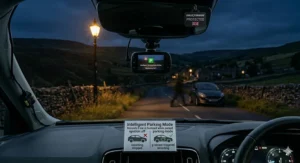
The A229 Plus is the slightly more accessible sibling of the A229 Pro, and it’s a camera that makes particular sense for UK drivers doing a lot of early-morning or late-evening driving — which in Britain, given our approach to daylight, is roughly eight months of the year. The VIOFO A229 Plus features dual STARVIS 2 sensors, 2K+2K front and rear recording, HDR, voice control, 5GHz Wi-Fi, ultra-precise GPS, Super Night Vision 2.0, and a 2.4-inch LCD screen.
The 2K+2K dual-STARVIS 2 configuration is this camera’s key selling point over the A810S. Where the 70mai gives you a slightly stronger front camera (4K vs 2K) but drops to 1080P at the rear, the A229 Plus keeps both cameras equal at 2K with the same Sony sensor technology. In practice, this means your rear footage — the camera that matters when you’re dealing with a tail-gater or a rear-end collision — is meaningfully clearer.
Night Vision 2.0 with dual STARVIS 2 means this camera performs remarkably well on unlit A-roads, dual carriageways, and the kind of dark country lanes that account for a disproportionate number of serious UK accidents. If your commute involves any significant unlit driving, the A229 Plus earns its price over a cheaper camera on this specification alone.
The A229 Plus is sold by VIOFO Ltd directly and sent from Amazon Fulfillment — which means it ships promptly and returns are handled directly. UK reviewers consistently praise the build quality and footage, with some noting the app is more reliable than earlier VIOFO generations.
✅ 2K+2K dual STARVIS 2 — equal quality front and rear
✅ Super Night Vision 2.0 — outstanding on unlit British roads
✅ Sold directly by VIOFO UK — reliable dispatch and returns
❌ Smaller screen than the A229 Pro (2.4 inches — manageable but compact)
❌ Hardwire kit required for 24-hour parking mode (additional cost)
Mid-range pricing. The strongest choice if rear footage quality and night performance matter as much as the front camera.
7. Vantrue E1 Pro — The Compact Overachiever
The Vantrue E1 Pro is the camera that makes you question why you’d ever want anything larger. It’s a front-only dash cam, yes — but it’s a 4K front-only dash cam with Sony STARVIS 2, GPS, 5G Wi-Fi, and HDR, in a form factor small enough that it practically vanishes against the windscreen. The Vantrue E1 Pro is now available at a very accessible price and features good 4K quality capture with a microSD slot supporting up to 1TB capacity cards.
The PlatePix HDR technology is Vantrue’s own take on number plate capture optimisation — essentially, it prioritises licence plate contrast and legibility even when overall scene exposure would otherwise blow out the detail. In practice (and in British conditions, where you’re often dealing with reflective wet tarmac and varying light), it produces front footage that reads number plates reliably in conditions where average cameras give up.
The 1.54-inch IPS screen is small but sharp; you’ll mostly be using the Vantrue app, which is well-regarded and actively maintained. The 24-hour parking mode is genuinely buffered rather than a blunt motion-triggered recording — it captures a short pre-event window, meaning if someone clips your wing mirror in a car park and walks away, you’ve got the approach as well as the impact.
For city drivers who want a discreet, capable front camera without the complexity of rear installation, or for anyone adding a second camera to a second vehicle, the E1 Pro is an excellent choice. Budget-conscious drivers will note: it supports up to 1TB of storage, which at current card prices means genuinely extended recording without constant card management.
✅ 4K STARVIS 2 — premium front footage in a tiny body
✅ PlatePix HDR — optimised number plate capture in variable British light
✅ 1TB card support — exceptional storage capacity
❌ Front only — no rear coverage for rear-end incidents
❌ Small screen — app-dependent for most operations
Mid-range pricing. Currently in stock on Amazon.co.uk with Prime dispatch.
How to Install and Set Up Your Dash Cam: A Practical UK Guide
Getting a dash cam installed correctly makes the difference between a camera that works and footage you can actually use as evidence. A few things most buyers overlook.
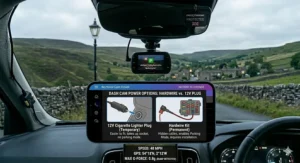
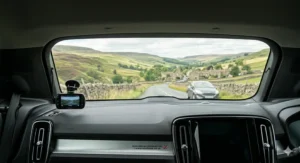
Positioning matters enormously. Mount the camera behind your rear-view mirror, ideally as close to the top of the windscreen as possible. This keeps it within the legal wiper-swept area (relevant for DVSA rules on obstructions to vision), minimises intrusion into your field of view, and gives the camera an unobstructed look at the road. Many first-time buyers mount the camera slightly too low, which means the bonnet takes up a disproportionate chunk of the frame.
Cable management. Running the power cable neatly takes twenty minutes and makes the difference between a professional-looking installation and a cable dangling across your dashboard like an untidy afterthought. Most cameras come with a plastic trim-removal tool — use it to tuck the cable along the A-pillar, across the headliner, and down into the glovebox or fusebox area. UK cars tend to have slightly tighter headliner tolerances than some American vehicles, but it’s entirely manageable with patience.
Hardwiring vs. 12V socket. For basic recording-while-driving use, the 12V cigarette lighter socket is fine. For parking mode — which records while the engine is off — you’ll need a hardwire kit connecting the camera directly to the fusebox. This provides constant low-voltage power and typically includes voltage cutoff protection to prevent your car battery from draining. In the UK, if you’re regularly parking in city centre locations (London, Birmingham, Manchester, Edinburgh) where car parks and street crimes are more common, parking mode is genuinely worth the additional installation effort and £20-£25 cost.
SD card selection. Standard consumer microSD cards are not designed for continuous recording. Use a high-endurance card — Samsung Pro Endurance, SanDisk High Endurance, or Lexar Professional 1066x are the reliable options. In the damp British climate, cards stored in dashboards undergo considerable thermal cycling; quality matters. Aim for a minimum Class 10 / U3 rating.
First setup: turn off audio recording if you’re carrying passengers. UK GDPR and data protection norms generally support recording in a vehicle you own, but recording conversations without consent is murkier legally. Most cameras have a one-button audio toggle — off is the socially considerate default.
UK Driver Profiles: Which Dash Cam Suits You?
Different roads, different lives, different cameras. Here’s the honest breakdown.
The London Commuter (Zone 2 daily, evening returns in the dark) The primary risks: junction incidents, cyclists filtering at speed, aggressive lane changes, and the occasional taxi doing something inadvisable. You need reliable 4K front footage and strong night vision. The 70mai A810S at a very accessible mid-range price covers this comprehensively — the included 128GB card means setup takes ten minutes, the 4G app means you can check parking footage without being at the car, and the ADAS lane warnings are a genuine help on the monotonous stretches of the A roads heading into zone 2.
The Rural Driver (Scottish Highlands, Welsh valleys, Peak District) Unlit roads, occasional deer, dramatic weather, and — critically — being a long way from help if something goes wrong. The Nextbase 622GW is almost purpose-built for this: the what3words integration and Emergency SOS features are transformative when you’re in an area where your address is “roughly halfway up the B837, past the second cattle grid.” GPS location data in footage is especially valuable when incident location is ambiguous.
The Nervous City Parker (terraced house, no driveway, car on the street) You want parking mode, and you want it to work all night without flattening the battery. The VIOFO A229 Pro with a properly installed hardwire kit is the gold standard here: buffered parking mode, motion and impact detection, and the sensitivity is adjustable so passing lorries don’t trigger false recordings all night. UK reviewers in urban areas specifically praise this setup.
The Multi-Driver Family (shared car, varied tech confidence) The Nextbase 422GW wins on accessibility. The touchscreen is genuinely intuitive, the Alexa integration means even the least tech-savvy family member can lock footage with a voice command, and the Emergency SOS gives parents peace of mind when a teenager has the car. Rear camera sold separately — budget for it.
The Driver Who Wants to Forget It’s There The Garmin Dash Cam Mini 3. Full stop. Mount it, plug it in, ignore it. It records. It saves incidents. That’s all it needs to do, and it does it well.
What to Look for in a Dash Cam: The Features That Actually Matter
The marketing copy for dash cams is, charitably, creative. Here’s an honest filter for what to look for in a dash cam and what’s largely noise.
Resolution (Matters enormously) The minimum recommended front camera resolution in 2026 is 1440p (2K). At 1080p, number plates at distance or in poor light are often unreadable — which defeats the primary purpose of the camera. 4K front cameras are now available for under £200 and deliver significantly clearer plate captures and incident evidence. If you’re choosing a dash cam to protect yourself in insurance disputes, 4K or 2K is the baseline worth aiming for.
Image Sensor (Matters a great deal) Sony STARVIS 2 is currently the sensor to look for in 2026. The STARVIS 2 family (IMX678, IMX675, IMX585) delivers dramatically better low-light performance than generic sensors — and given the number of dark, rain-soaked roads the average British driver encounters between October and March, this is not a trivial consideration.
Wide Dynamic Range / HDR (Matters) WDR and HDR help the camera manage extreme contrast — think a bright headlight in an otherwise dark scene, or driving out of a tunnel into sunlight. On UK roads, where weather changes rapidly and you often transition between overcast and bright conditions, HDR processing that works well is worth prioritising.
GPS (Matters for evidence — strongly recommended) GPS embeds your speed and location directly into footage. In any insurance or legal dispute, having corroborated speed data is transformative. Built-in GPS logs your vehicle’s speed and location, embedding it into the video file — this adds another layer of crucial data for evidence.
G-Sensor (Standard — not a differentiator) Every camera above entry level has one. It triggers emergency recording on impact. Don’t pay extra for it as a headline feature; it’s table stakes.
Loop Recording (Standard — not a differentiator) Same story. All cameras loop-record. What varies is how smoothly the loop handles card-full transitions and whether clips have seamless continuity. Premium cameras handle this better, but it’s rarely a buying decision.
“4K” Claims to Verify Some cameras advertise 4K at 30fps but interpolate the signal rather than capturing natively. The Sony STARVIS 2 sensors (particularly the IMX678) produce genuine 4K captures. Check that the camera specifies its sensor; cameras that don’t mention a sensor name in their spec are often worth scrutinising.
Parking Mode: What It Actually Requires Parking mode — which records while the car is unattended — requires a hardwire kit or internal battery. Cameras that claim parking mode without specifying power source usually mean motion-activated recording powered by a capacitor — useful for perhaps 20-30 minutes after the engine stops. For genuine overnight parking surveillance, budget for the hardwire kit.
Dash Cam Features Explained: G-Sensor, Loop Recording & Wide Angle Lens
For those new to dash cams entirely, a quick honest explanation of the terminology you’ll encounter constantly.
G-sensor technology is an accelerometer built into the dash cam that detects sudden changes in velocity — an emergency brake, an impact, a sharp swerve. When triggered, it automatically locks the current recording clip so it cannot be overwritten by the loop. The sensitivity is adjustable; on a setting that’s too sensitive, speed bumps and potholes trigger it constantly, filling your card with protected clips. Set it to medium and review in the app periodically.
Loop recording means the camera writes footage continuously to the SD card and, when the card is full, overwrites the oldest clips. This happens silently and automatically. G-sensor locked clips are exempt from overwriting. The practical implication: you never need to manage storage manually unless you want to review or export footage.
Wide angle lens — typically 140 to 170 degrees — determines how much of the road you capture. Wider is better up to a point; beyond about 160 degrees, you start getting barrel distortion at the frame edges that can make distance judgement in footage harder. The sweet spot for UK roads, which are narrower than US or continental European roads, is 140-150 degrees — wide enough to capture full lane width without the fisheye effect.
Night Vision in marketing terms usually means one of three things: an IR LED array (useful for internal/cabin cameras), a wide-aperture lens (f/1.8 or lower), or a large-sensor chip with low-light processing like STARVIS 2. The latter is significantly more capable than the former; a Sony STARVIS 2 camera at f/1.8 produces genuinely usable night footage. IR LEDs on a front-facing camera are largely decorative at road speeds.
How to Choose a Dash Cam in the UK: A Step-by-Step Framework
Choosing a dash cam is simpler than the spec sheets make it look. Follow this sequence.
- Decide on front-only vs. dual-channel. A front-only dash cam leaves you unprotected in rear-end collisions — the most common accident type on UK roads. A dual-channel (front and rear) system is the strongly recommended minimum configuration. If budget is genuinely tight, a quality front-only camera (like the Vantrue E1 Pro) is still better than a cheap dual camera with poor sensors.
- Set your resolution floor at 2K. For number plate evidence in British conditions — wet, low-light, varying contrast — 2K is the minimum that holds up reliably.
- Check GPS is included. For any camera you might use as insurance or legal evidence, GPS-embedded speed data is worth the small premium over non-GPS models.
- Decide whether you need parking mode. If you park on a public street overnight, particularly in an urban area, parking mode is worth having. Budget an extra £20-£25 for the hardwire kit.
- Check Amazon.co.uk fulfilment status. Cameras dispatched from Amazon Fulfilment (sold by the brand’s own UK entity or an Amazon-fulfilled seller) typically offer more straightforward returns under the Consumer Rights Act 2015 14-day cooling-off period and the standard 30-day return window.
- Factor in SD card cost. Unless the camera includes a high-endurance card (like the 70mai A810S with its 128GB card), budget £25-£40 for a quality high-endurance card separately.
- Consider brand support availability in the UK. Nextbase is British-based with UK customer support. VIOFO and 70mai both have European support teams responding to UK queries. Garmin has comprehensive UK support infrastructure. Lesser-known brands may route support through difficult international channels.
Common Mistakes When Buying a Dash Cam in the UK
A few expensive errors worth avoiding before you click “add to basket.”
Buying a US-voltage model. Most reputable brands now ship UK-configured chargers, but some grey-market camera listings ship with US 110V chargers. UK mains are 230V / 50Hz; most modern car chargers are universal, but verify before purchasing anything that plugs into your home mains.
Choosing resolution over sensor quality. A camera advertising “4K” with an unknown sensor may produce worse real-world footage than a 2K camera with Sony STARVIS 2. Sensor quality, aperture, and HDR processing matter more than the headline resolution number.
Ignoring rear camera footage quality. Many buyers focus entirely on the front camera resolution and discover only after purchase that the rear camera is a basic 1080P or lower sensor. Rear collisions are more common than frontal ones; the rear camera matters.
Mounting too low on the windscreen. Obstructing your view is illegal under the Road Vehicles (Construction and Use) Regulations, and footage shot from a low position captures far more dashboard than road. Place the camera high and behind the rear-view mirror.
Using a standard consumer SD card. This is the most common technical failure point. Standard cards are not rated for continuous writing and will fail — usually by corrupting footage at the worst possible moment. High-endurance cards (Samsung Pro Endurance, SanDisk High Endurance) are mandatory.
Not formatting the SD card regularly. Most cameras recommend formatting the card every 2-4 weeks directly in the camera (not on a computer). This keeps the file system clean and prevents gradual corruption.
Dash Cam Legal Requirements and UK Regulations
Using a dash cam in the UK is entirely legal, and the footage is admissible in court and insurance proceedings. However, a few regulatory points are worth knowing.
UK GDPR (the Data Protection Act 2018) technically applies to recorded footage of identifiable individuals. In practice, for personal use in a private vehicle, the domestic use exemption applies — you’re not required to register as a data controller or post warning notices. If you submit footage to the police (via the National Dash Cam Safety Portal operated by Nextbase and UK police forces), footage should ideally capture the incident clearly and include GPS timestamp data.
For the police submission to be useful: the footage must show a clear offence, ideally with the offending vehicle’s number plate visible. This is another reason 4K resolution matters — police reviewers need to identify plates from the footage alone.
In Scotland, the legal framework is broadly the same under UK GDPR, though Scottish law (separate in various civil matters) governs any subsequent civil actions. Footage is equally admissible.
For professional drivers — taxi drivers, private hire vehicles, courier drivers — recording passenger audio without consent is legally more complex. Consult the Information Commissioner’s Office guidance for professional use cases.
Insurance discounts: many UK insurers offer premium reductions for drivers with dash cams. It’s worth contacting your insurer directly — some providers offer 5-15% reductions, particularly for younger or higher-risk rated drivers.
FAQ: Your Dash Cam Buying Guide Questions, Answered
❓ Do I need to tell my insurance company I have a dash cam?
❓ Is dash cam footage legal in the UK and can it be used as evidence?
❓ What SD card should I use with my UK dash cam?
❓ Do I need a hardwire kit for parking mode?
❓ Can I use a dash cam in a hire car or company vehicle in the UK?
Conclusion: Finding Your Perfect Dash Cam
The honest summary of this dash cam buying guide: the market in 2026 has matured to a point where you genuinely cannot buy a terrible dash cam from a reputable brand at any price point. The days of 720P footage, temperamental loop recording, and SD cards that corrupted themselves quietly are largely behind us.
What you’re choosing between now is nuance. For most British drivers — commuting on lit A-roads, parking in relatively safe areas, wanting occasional insurance evidence — the 70mai A810S is probably the sweet spot: true 4K, STARVIS 2, 128GB card included, excellent app, 4G capability if you ever want it. For UK drivers who venture off the beaten track, the Nextbase 622GW offers safety features that genuinely save lives, not just cars. For those who want the cleanest footage regardless of cost, the VIOFO A229 Pro is the enthusiast benchmark. And for those who want to forget they own a dash cam — the Garmin Mini 3 asks very little of you.
Whatever you choose: fit it properly, use a high-endurance SD card, format it regularly, and let it sit quietly doing its job. The hope, always, is that you’ll never actually need the footage. But on a rainy Wednesday on the A38 when someone pulls out of a side road without looking, you’ll be very glad it was running.
✨ Don’t Miss These Exclusive Deals!
🔍 Check current pricing and availability on all seven dash cams above via the highlighted product links. Amazon.co.uk pricing fluctuates regularly — the deals are often better than they look at first glance. Prime members get next-day delivery on most models dispatched from Amazon Fulfillment.
Recommended for You
- 7 Best Front Dash Cams UK 2026: Tested & Ranked
- Is a Dash Cam Worth It UK? 7 Best Picks for 2026 (Honest Review)
- Best Dash Cams UK 2026: 7 Top-Rated Picks for Every Driver
Disclaimer: This article contains affiliate links. As an Amazon Associate, I earn from qualifying purchases. If you purchase products through these links, we may earn a small commission at no additional cost to you.
✨ Found this helpful? Share it with your mates! 💬🤗
