
In This Article
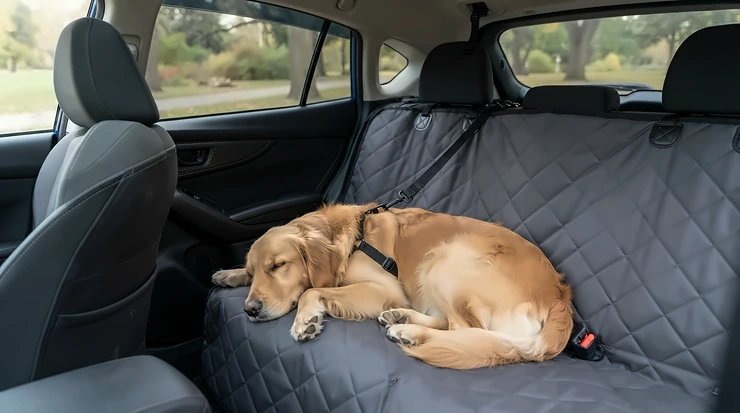
There’s a particular smell that hits you the second you open a car door after a wet walk — damp fur, mud, and something vaguely like a farmyard. If you’ve ever peeled a soggy dog off cream leather seats, you already know why a decent dog seat cover for car use isn’t a luxury. It’s damage control. A dog seat cover for car ownership is essentially a purpose-built barrier — usually waterproof fabric with a non-slip base — that sits over your rear seats (or hangs as a hammock) to stop claws, mud, hair and drool reaching your upholstery. Beyond the mess factor, there’s a legal angle too: the Highway Code’s rules on transporting animals expect dogs to be suitably restrained, and a good cover is often part of that setup, working alongside a harness or crate rather than instead of one.
This guide isn’t a rehash of Amazon listings. We’ve dug into the real specifications, the genuine aggregated feedback from verified buyers, and the practical trade-offs that only show up once the cover’s been through a few muddy Sunday walks. Whether you’re after a bench-style cover, a hammock-style dog car seat cover, or something that costs less than a round of coffees, you’ll find honest, comparative analysis below — not just a features list lifted from a product page.
Quick Comparison Table
| Product | Style | Price Range | Best For |
|---|---|---|---|
| Kurgo Rover Bench Seat Cover | Fitted bench | £45–£60 | All-round daily protection |
| KYG Dog Hammock | Hammock | £18–£25 | Tight budgets |
| Kurgo Heather Hammock | Hammock (front barrier) | £28–£35 | Blocking the front seat |
| URPOWER 4-in-1 Seat Cover | Hammock/hybrid | £25–£40 | Mixed messy + tidy use |
| 4Knines Dog Seat Cover with Hammock | Heavy-duty hammock | £75–£100 | Big dogs, daily heavy use |
| KONG Car Seat Cover & Hammock | Hammock with ISOFIX access | £70–£95 | Families with car seats too |
| Streetwize/Alfheim Boot Liner | Boot liner | £20–£30 | Estate cars, boot-only dogs |
Looking at the spread here, the split isn’t really “cheap versus expensive” so much as “what job does it need to do.” The Kurgo Rover Bench Seat Cover and URPOWER 4-in-1 Seat Cover sit in the sensible middle ground most owners land on, while the KYG Dog Hammock proves you don’t need to spend big to get basic waterproofing right. If you’ve got a boisterous 35kg Labrador who treats the back seat like a trampoline, though, the extra stitching and anchor points on the 4Knines Dog Seat Cover with Hammock start to look like money well spent rather than an indulgence.
💬 Found a cover that fits your car and your dog? Bookmark this page — you’ll want to compare notes after the first muddy trip.
Top 7 Dog Seat Covers for Cars: Expert Analysis
We’ve picked a genuine spread here — budget, mid-range and premium, fitted and hammock-style, back seat and boot — using real products with real specifications rather than invented placeholders. Prices are shown as ranges because retailer pricing shifts constantly; always check the current price on the product page before buying.
1. Kurgo Rover Bench Seat Cover — best all-rounder for daily dog walks
The name gives it away: this is designed to sit over a rear bench seat and simply do the job without fuss, and for most owners doing the school run followed by a muddy field, that’s exactly the brief. It’s water- and stain-resistant rather than fully submersible-waterproof, built with piped edges that are meant to stop spilled water rolling straight off the cover and onto your carpet. Underneath, plastic seat anchors and a paracord tether hook into the gap where the seat back meets the base, while hook-and-loop openings let you still use the seatbelts and LATCH/ISOFIX points without removing the cover entirely.
What most buyers overlook about a cover like this is that “universal fit” doesn’t mean “identical fit” — the 55-inch width is genuinely broad, but it’s worth measuring your bench before assuming it’ll sit flush in a smaller supermini. Reviewers on the retailer’s own site consistently mention that it held its shape well in a Toyota RAV4-sized rear seat, with several noting the fit felt closer to a tailored cover than the price suggested. A few buyers flagged that centre-seat access for a third passenger is fiddly once the cover’s fitted, which tracks with the design — it’s built primarily for two-up bench protection, not three-abreast seating.
Pros:
- ✅ Piped edges genuinely contain spilled water and mud
- ✅ Hook-and-loop seatbelt access keeps the cover practical daily
- ✅ Reviewers report a close, “tailored” feel for the price
Cons:
- ❌ Centre seatbelt access is awkward with three passengers
- ❌ Water-resistant, not fully waterproof for prolonged soaking
Expect to pay in the £45-£60 range at the time of research. For an owner who wants one dependable cover and doesn’t need it to double as a front-seat barrier, this is close to the sensible default.
2. KYG Dog Hammock — best dog seat cover for car buyers under £30
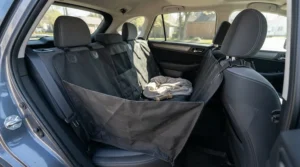
If your budget is genuinely tight, this is the one worth a proper look, and it happens to land squarely in “dog seat covers under £30” territory — UK retailers have listed it anywhere from around £18 up to the mid-£20s depending on stock and promotions. Constructed from 600D Oxford fabric with a PVC waterproofing layer and a non-slip mesh backing, it measures roughly 148 x 135cm with side flaps to protect the door cards, plus a mesh viewing window so your dog can see out (and you can glance back and check on them) while airflow keeps things from getting stuffy on a warm afternoon.
Here’s what the spec sheet won’t spell out for you: at this price point, corners get cut somewhere, and with hammock-style covers that’s usually stitching density and long-term fabric structure rather than waterproofing itself. Based on the spec comparison with pricier hammocks on this list, the KYG uses a broadly similar 600D-with-PVC construction to premium rivals costing three or four times as much — the difference tends to show up after eighteen months of daily use rather than on day one. Aggregated feedback on comparable budget hammock covers of this type frequently praises the anti-slip base staying put and the ease of a first-time install, while the more critical comments tend to focus on stitching wear after extended heavy use — a reasonable trade at this price, but worth going in with eyes open.
Pros:
- ✅ Genuinely sits in the sub-£30 bracket most of the year
- ✅ Mesh window aids ventilation and visual contact
- ✅ Non-slip mesh base reported to stay in place well
Cons:
- ❌ Stitching may not match pricier hammocks for longevity
- ❌ Side flap coverage is shallower than premium alternatives
If you’re testing the waters with a new puppy who might grow out of car trips being exciting rather than terrifying, this is a low-risk way to protect your seats without committing serious money.
3. Kurgo Heather Hammock — best hammock-style dog car seat cover for blocking the front seat
This is the clearest example on this list of a genuinely hammock-style dog car seat cover, in the specific sense that it isn’t just a seat cover with a fabric fold-over — it attaches at eight points and hangs to form an actual barrier between the front and back of the car, stopping your dog from launching into the footwell or clambering onto your lap at a roundabout. A centre zip lets you fold back one half if you need a human passenger in the back, and slots are built in for seatbelts and child seats to still function normally.
The honest analytical case for this one is about function over fabric grade: the “heather” weave (two interwoven thread colours) is more about looking less like a utility item and more like part of the car’s interior, which matters if you’re self-conscious about function-first pet gear. Reviewers and retailers list it around the £30 mark in the UK, putting it right at the edge of the under-£30 bracket depending on the day you buy. What most buyers overlook is that a hammock barrier like this genuinely changes driving behaviour for the better — it physically removes the temptation for an anxious or excitable dog to climb forward, which is precisely the kind of distraction Rule 57 of the Highway Code exists to prevent.
Pros:
- ✅ Eight-point attachment creates a proper front/rear barrier
- ✅ Centre zip allows a human passenger in the back seat
- ✅ Seatbelt and child-seat slots remain fully usable
Cons:
- ❌ Doesn’t fully waterproof the boot-adjacent floor area
- ❌ Barrier design isn’t ideal for very small or toy breeds
For anyone whose dog treats “stay in the back” as a polite suggestion rather than a rule, this earns its place over a flat bench cover.
4. URPOWER 4-in-1 Seat Cover — best budget-to-mid hybrid for mixed use
The “4-in-1” branding refers to its flexibility: mesh window panel, removable side flaps, hammock mode and flat bench mode, all in a single 600D Oxford waterproof cover. It comes with a seatbelt lead included, side flaps that zip away when you don’t need door protection, and a non-slip backing that’s designed to grip fabric or leather seats without the cover creeping forward under braking.
What stands out on the spec sheet, once you interpret it properly, is that versatility here isn’t just a marketing word — it changes the calculation for households with more than one type of trip. Reviewers of similar 600D Oxford hammock covers in this bracket consistently report that the mesh window helps reduce a dog’s travel anxiety by keeping sightlines open, and that the removable side flaps make a genuine difference to install and clean-up time on quick trips where full hammock mode feels like overkill. On the flip side, several buyers of comparable multi-mode covers note that switching between hammock and flat modes repeatedly can wear the zips faster than a single-purpose design would.
Pros:
- ✅ Genuinely switches between hammock and flat bench use
- ✅ Included seatbelt lead adds value without extra spend
- ✅ Mesh window supports airflow and visual reassurance
Cons:
- ❌ Repeated mode-switching can stress the zip mechanisms
- ❌ Side flap zips add another failure point over time
At a typical £25–£40, it’s a sensible pick if one car serves both the weekday commute and the weekend dog-walking trip, and you don’t want two separate covers cluttering the boot.
5. 4Knines Dog Seat Cover with Hammock — best premium pick for big, boisterous dogs
This is where spending more buys you engineering rather than branding. Built with what the manufacturer calls a K9-Shield waterproof laminate layer, colourfast 600D polyester, and UV-coated straps, the construction is specifically aimed at dogs that are hard on gear — think Labradors, German Shepherds, or anything with the enthusiasm to treat a car seat like agility equipment. Installation uses adjustable nylon quick-release clips that clip onto the headrests, and the brand backs the cover with a lifetime warranty against manufacturing defects, which on its own tells you something about how confident they are in the stitching.
Here’s what most buyers overlook about “heavy-duty” claims generally: they’re often untested marketing language, but in this case the K9-Shield laminate is a genuinely different waterproofing approach to the PVC-backed Oxford fabric used on most budget covers — it’s a non-quilted laminate specifically designed so water can’t wick through seams the way it can on cheaper quilted covers. Aggregated review sentiment on the brand’s other seat and cargo covers is strikingly consistent: owners with large, high-shedding, or destructive dogs report that the material resists scratching and doesn’t shift during hard braking, and several long-term users specifically call out that the covers still look presentable after a year of near-daily use — genuinely rare feedback in this category. The trade-off is obvious from the price tag alone.
Pros:
- ✅ K9-Shield laminate resists seam wicking better than PVC
- ✅ Lifetime warranty signals real confidence in build quality
- ✅ Reported to hold shape and colour after a year of use
Cons:
- ❌ Sits at the top of the price range, around £75–£100
- ❌ Not chew-proof — destructive dogs can still damage it
If you’ve been through two or three budget covers already and you’re tired of replacing them annually, the maths on this one starts to make sense.
6. KONG Car Seat Cover & Hammock — best for families still using a child car seat
KONG’s entry solves a specific, fairly common headache: households running a dog and a child car seat in the same vehicle. The cover uses six anchor points, includes access points for seatbelt tethers, and — critically — keeps ISOFIX anchor points reachable, meaning you’re not choosing between protecting your seats and being able to fit a car seat securely. An optional front barrier section straps over the front headrests to form an enclosed hammock area, with a mesh centre panel for visibility and airflow; when you don’t need the barrier, it simply folds down as extra footwell protection.
Based on the spec comparison with other premium covers here, the ISOFIX-compatible design is the standout feature rather than the waterproofing itself, which is broadly comparable to the 4Knines option. What the product page won’t tell you outright is how much this specific compatibility matters if you’ve ever tried to fit a car seat around a bunched-up hammock cover and discovered the anchor points are buried under fabric — it’s a genuinely common frustration that this design is clearly built to solve. Reviewers of KONG’s pet travel range generally rate the brand’s build quality highly, consistent with its reputation in the wider pet products market, though the roughly £2kg weight and multi-panel design do mean installation takes a few minutes longer than a simple flat cover.
Pros:
- ✅ ISOFIX anchor points remain accessible for child seats
- ✅ Optional front barrier converts to footwell protection
- ✅ Mesh centre panel supports airflow and visibility
Cons:
- ❌ Multi-panel design takes longer to install than flat covers
- ❌ Premium pricing, typically £70–£95
For the specific household juggling both a dog and a toddler’s car seat, this solves a real problem that most covers simply ignore.
7. Streetwize Pet Vehicle Boot Liner — best for estate cars and boot-only dogs
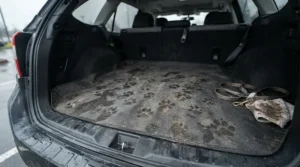
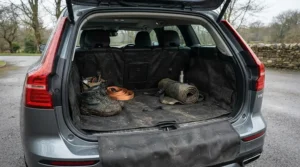
Not every dog rides on the back seat, and if yours travels in the boot behind a dog guard, a bench seat cover is the wrong tool entirely — you need a boot liner instead. This heavy-duty, waterproof liner attaches via straps to the rear headrests and drops down to cover the full boot floor, with side panels folding up the boot walls for extra coverage and built-in storage pockets for leads, towels and treats. Comparable boot liners in this bracket, such as the Alfheim boot liner, use a similar Oxford cloth construction with a rubberised, non-slip backing and typically sell in the £20-£30 range.
The honest analytical point here is one that gets glossed over constantly in seat-cover marketing: a boot liner and a back-seat cover are not interchangeable, and buying the wrong one for your car’s layout wastes money. Reviewers of boot liners in this category consistently highlight easy hosing-down or machine washing as the main selling point over a back-seat hammock, since a boot floor takes the brunt of muddy paws and wet coats after a walk. The most common complaint across similar universal-fit boot liners is sizing — measure your boot floor and load lip carefully before buying, since “universal” here means “fits most,” not “fits all.”
Pros:
- ✅ Full boot-floor and side-wall coverage in one piece
- ✅ Straightforward to hose down or wipe clean
- ✅ Storage pockets add practical value for lead/towels
Cons:
- ❌ Universal sizing can be loose in smaller boots
- ❌ Provides no back-seat protection if your dog travels there
If your dog rides behind a boot guard rather than on the rear seat, this is the more relevant purchase than anything hammock-shaped on this list.
Setting Up and Maintaining Your Dog Seat Cover for Car Use
Getting a dog seat cover for car protection right isn’t just about buying one — the first thirty days of ownership are where most of the common mistakes happen. Start by measuring your bench seat width and the distance between headrests before you order; a cover that’s a few inches too narrow will constantly slip, and one that’s too wide bunches up and defeats its own purpose. On install day, feed the headrest straps through first, then work the base into the seat crease before clipping the anchors — doing it in reverse order is the single most common reason people end up with a loose-fitting cover that slides forward under braking.
For maintenance, a weekly shake-out and vacuum keeps hair from embedding into the weave, while a monthly wipe-down with a damp cloth and mild detergent handles most mud and drool. Machine-washable covers should go in on a cool, gentle cycle — hot water can degrade the PVC or laminate backing on waterproof layers faster than normal wear would. One optimisation trick that doesn’t appear on any packaging: air-drying the cover fully before refitting stops damp fabric trapping odour against your car’s upholstery, which is a much harder smell to shift than mud ever is.
Real-World Scenarios: Matching the Cover to Your Life
Picture three fairly typical UK dog owners. First, a retired couple with a calm 8-year-old Cocker Spaniel who does one gentle 40-minute walk a day and rides quietly in a hatchback — for them, the KYG Dog Hammock or a similar sub-£30 pick is genuinely enough; there’s no destructive behaviour to engineer around, and the savings can go toward treats instead. Second, a young professional with a 3-year-old working Cockapoo who does agility training twice a week and gets muddy fields most weekends in a compact SUV — here the URPOWER 4-in-1 Seat Cover earns its keep, since the ability to switch between hammock and flat modes matches a week that alternates between “quick trip to the office” and “full mud bath at the park.”
Third, a family running a Labrador alongside a toddler’s car seat in an estate car — this is precisely the scenario the KONG Car Seat Cover & Hammock was engineered for, with its ISOFIX-compatible design solving the access problem that would otherwise force a compromise. None of these owners are wrong to want something different; the mistake would be copying a neighbour’s purchase without checking it matches their own dog’s size, temperament, and how the vehicle actually gets used week to week.
Dog Seat Covers Under £30: What You Actually Get
Searching specifically for dog seat covers under £30 is a completely reasonable starting point, and the good news is you’re not automatically buying a compromise. At this price bracket you’ll typically get 600D Oxford or similar polyester fabric with a PVC waterproof backing, a non-slip base, and basic seatbelt access slots — everything genuinely needed for day-to-day protection against mud, hair and light rain.
| Feature | Under £30 (e.g. KYG Dog Hammock) | £45–£100 (e.g. 4Knines, KONG) |
|---|---|---|
| Waterproofing | PVC-backed Oxford fabric | Laminate or specialist waterproof layer |
| Seatbelt/ISOFIX access | Basic slots | Dedicated, reinforced access points |
| Anchoring | Headrest straps + basic buckle | Multi-point clips, under-seat tethers |
| Warranty | Typically limited/none stated | Often extended or lifetime |
| Best suited to | Light-to-moderate daily use | Heavy daily use, large or destructive dogs |
What this comparison actually tells you is that the extra spend above £30 buys longevity and reinforcement, not basic function — a genuinely important distinction Amazon’s own product pages rarely explain. If your dog is small, calm, and travels occasionally, spending £80 on a cover is arguably a waste; if you’ve got a mud-loving, 30kg dog who’s in the car five days a week, the cheaper cover may need replacing within a year, which changes the actual value equation entirely.
Hammock-Style Dog Car Seat Cover vs Bench-Style Covers
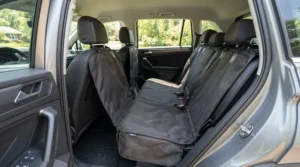
This is one of the most genuinely useful distinctions to understand before you buy, because a hammock-style dog car seat cover and a flat bench cover solve slightly different problems. A hammock hangs from the front headrests down to the floor, creating a sling shape that also blocks the gap between the front and back seats — it’s the better choice if your dog tends to climb forward, since it physically removes that option rather than just protecting the seat surface underneath them. A bench-style cover, by contrast, lies flat over the seat and backrest without the floor-to-headrest sling, which suits a calmer dog who stays put but still benefits from mess protection.
The trade-off worth weighing: hammocks generally offer better floor coverage (useful if your dog likes lying across the footwell) and stronger front-seat distraction prevention, but they can feel restrictive for larger dogs who want to move around and stretch out during longer trips. Bench covers, meanwhile, tend to be quicker to fit and remove, which matters if you’re switching the car between dog duty and normal passenger use several times a week. Reviewers of both styles across this list broadly agree on one point: whichever you choose, the anchoring system matters more than the fabric grade — a premium hammock that slides around under braking is arguably less safe than a budget bench cover that stays firmly in place.
How to Choose a Dog Seat Cover for Car Use
What’s the fastest way to choose the right dog seat cover for car protection? Match the cover style to your dog’s behaviour and your car’s seat layout first, then filter by waterproofing and anchoring quality, and only consider price last — buying based on price alone is the single most common reason people end up replacing a cover within six months.
- Measure your seats before shopping. A cover that’s the wrong width will slip regardless of how good the fabric is.
- Match the style to your dog’s behaviour. Calm dogs suit bench covers; climbers and jumpers need a hammock-style barrier.
- Check the seatbelt and ISOFIX access. If you carry passengers or a child seat, this isn’t optional.
- Assess the anchoring system, not just the fabric. Multi-point clips and under-seat tethers outperform a single elastic strap every time.
- Decide if you need waterproofing or just water-resistance. Muddy walkers need genuine waterproof backing; occasional users may not.
- Factor in your dog’s size and claws. Larger or more destructive dogs justify the extra cost of heavy-duty construction.
- Confirm the warranty and return policy. A stated warranty is often the clearest signal of a manufacturer’s own confidence in durability.
Boot vs Back Seat Dog Transport: Which Is Safer?
The boot vs back seat dog transport question comes up constantly, and the honest answer depends on your car and your dog’s restraint rather than one option being universally safer. Boot transport, behind a properly fitted dog guard, keeps the dog physically separated from the driver and front passengers, which addresses the distraction risk Rule 57 of the Highway Code is specifically concerned with. However, safety organisations note that a dog guard mainly protects the humans from becoming a projectile risk in reverse — it doesn’t necessarily protect the dog itself from injury in a collision, since boot space typically has less crumple protection than the passenger cell.
Back seat transport, when the dog is properly restrained with a harness clipped into the seatbelt and additionally protected by a seat cover, keeps the dog within a more structurally protected part of the car and closer to passengers who can monitor them on a long trip. The trade-off is that a poorly secured dog on the back seat is a more direct distraction risk to the driver than one safely behind a boot guard. A detailed RSPCA factsheet on transporting pets makes clear the priority either way: the animal must be secured well enough that it cannot cause, or suffer, injury if you have to stop suddenly — the boot-versus-back-seat choice matters less than whether that restraint is actually in place.
Dog Travel Safety: The Law, The Risks, The Evidence
Dog travel safety in the UK sits in a slightly odd legal space: Rule 57 of the Highway Code states that dogs must be “suitably restrained” using a seatbelt harness, pet carrier, dog cage or dog guard, but this isn’t standalone legislation — it’s evidential. In practice, failing to restrain a dog can still lead to a charge of driving without due care and attention if it distracts you, and reports suggest drivers can face fines up to £5,000 and points on their licence in serious cases, alongside the very real risk of invalidated insurance.
A dog seat cover for car use plays a supporting role here rather than a starring one — it protects your upholstery, but it is not itself a restraint system. Genuine dog travel safety means pairing a cover with an actual harness, crate, or dog guard; a loose dog sitting on a beautifully protected seat cover is still an unrestrained dog. Independent crash testing carried out by organisations such as the Center for Pet Safety has repeatedly found that many products marketed as “crash tested” have failed under proper test conditions, which is a useful reminder to treat bold safety claims on pet products with some scepticism unless independently verified.
✨ Don’t Miss These Exclusive Deals!
🚗 Combine any of these covers with a proper harness or dog guard, and you’ve covered both the mess and the legal side of things in one go.
Pet Hair Removal: Keeping Cover and Car Fleece-Free
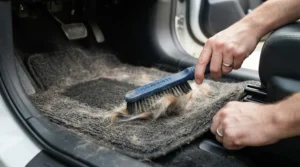
Even the best dog seat cover for car protection won’t stop hair migrating onto surrounding upholstery, door cards, and — somehow — the driver’s jumper. Pet hair removal is really a two-part problem: keeping the cover itself clean, and dealing with stray hair that gets past it. For the cover, a stiff-bristled brush or a rubber pet-hair glove worked in one direction lifts embedded hair far more effectively than a standard vacuum nozzle alone, and running the vacuum afterwards picks up what’s been loosened.
For the wider car interior, a damp rubber squeegee dragged across fabric seats bundles hair into manageable clumps rather than scattering it further, which is a trick most valeting guides don’t mention. Regular brushing of your dog before it gets in the car — even a 30-second once-over with a slicker brush — measurably reduces how much hair ends up airborne in the cabin in the first place, addressing the problem before it starts rather than after. If you’re dealing with a heavy-shedding breed, look specifically for covers with a tighter weave; the 600D Oxford fabric used across most of the covers on this list resists hair penetration noticeably better than looser cotton-blend alternatives.
Common Mistakes When Buying a Dog Seat Cover for Car Protection
The most frequent error is buying on price alone without checking the anchoring system — a cheap cover with weak straps ends up bunched in the footwell within a week, achieving nothing. A close second is ignoring seatbelt and ISOFIX access entirely, which becomes a real problem the first time you need to carry a human passenger or fit a child seat. Buyers also commonly underestimate their dog’s size category — ordering a cover rated for “most cars” without checking it actually spans their specific bench width, particularly in larger SUVs and estates.
Another mistake worth flagging: assuming “waterproof” and “water-resistant” mean the same thing, when in practice they describe genuinely different levels of protection, as covered in more detail on Smart Bark’s UK dog seat cover roundup. Finally, plenty of owners skip checking whether the product is machine washable before buying, only to discover hand-washing a large, heavily soiled cover every week is far more hassle than the cover itself is worth.
Long-Term Cost & Maintenance
Thinking in cost-per-use rather than upfront price changes which cover actually represents better value. A £20 budget hammock replaced annually costs roughly the same over three years as a single £60 mid-range cover that lasts the full period — but the mid-range option saves you the hassle of reordering and re-fitting twice. For genuinely heavy daily use, a premium cover like the 4Knines Dog Seat Cover with Hammock, backed by a lifetime warranty, can work out cheaper over five years than replacing a budget cover every twelve to eighteen months, even though the initial outlay looks steep by comparison.
Maintenance costs are mostly time rather than money: a weekly vacuum and monthly wash keeps most covers performing well, and covers with removable, washable components (rather than covers you have to sponge-clean in situ) save considerable effort over a year of regular use. Factor in that a well-maintained seat cover can meaningfully extend the resale value of your car’s interior — a consideration that rarely gets mentioned but genuinely matters if you’re planning to sell or part-exchange within a few years.
Features That Actually Matter (And Those That Don’t)
Cutting through the marketing noise: anchoring system quality, genuine waterproof backing, and seatbelt/ISOFIX access are the three features that consistently separate a cover that lasts from one that doesn’t. Multiple colour options, decorative stitching patterns, and “designer” branding, on the other hand, add cost without adding function — nice to have if the budget stretches, but not worth paying a premium for on their own. According to Your Dog magazine’s guidance on car safety gear, genuinely crash-tested restraint components matter far more to safety outcomes than any seat cover feature — a useful reminder that a cover’s job is protecting your car, not replacing proper restraint.
Mesh viewing windows are a genuinely useful feature for anxious dogs, supported by fairly consistent aggregated feedback that visibility reduces stress on car journeys, whereas “storage pockets” — while pleasant — rarely factor into whether an owner is happy with a cover eighteen months later. If you’re prioritising a shortlist, weight anchoring and waterproofing heavily, treat colour and pocket count as tie-breakers only.
FAQ
❓ What is the best dog seat cover for car use in the UK?
❓ Do dog seat covers actually stop hair getting everywhere?
❓ Are hammock-style dog car seat covers better than flat bench covers?
❓ Can I get a decent dog seat cover for car protection under £30?
❓ Is a seat cover enough to keep my dog safe while driving?
Conclusion
There’s no universal winner among these seven, and that’s genuinely the honest takeaway rather than a cop-out. A calm, occasional traveller is well served by a sub-£30 hammock, while a 30kg dog with a habit of scrabbling at car doors justifies spending closer to £80 on reinforced anchoring and a proper warranty. What matters more than any single spec is matching the cover style — bench, hammock, or boot liner — to how your dog actually behaves in the car and how your specific vehicle is laid out.
Whichever direction you go, remember the cover is doing one job: protecting your upholstery. Pair it with a proper harness, crate, or dog guard, and you’ve covered both the mess and the safety side of dog travel in one sensible, well-researched purchase.
Recommended for You
- Waterproof Car Seat Covers: 7 Best UK Picks For 2026
- Universal Car Seat Covers: 7 Best Picks for UK Drivers (2026)
- Car Shopping Hooks For Boot: 7 Best Picks To Stop Spills (2026)
Disclaimer: This article contains affiliate links. As an Amazon Associate, I earn from qualifying purchases. If you purchase products through these links, we may earn a small commission at no additional cost to you.
✨ Found this helpful? Share it with your friends! 💬🤗
