
In This Article
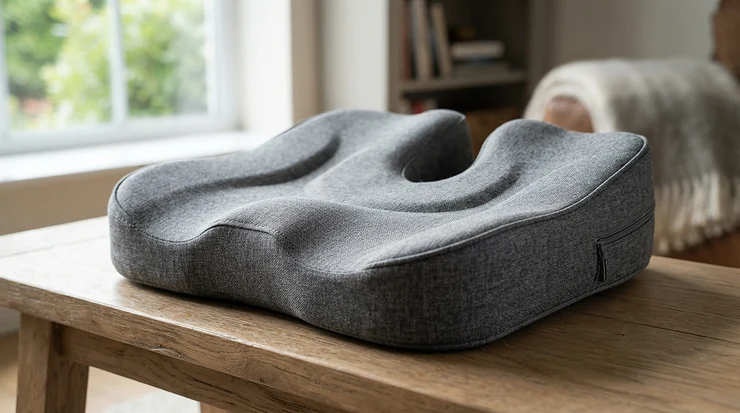
A memory foam car seat cushion is a portable pad, usually 3–8 cm thick, that sits on top of your existing driver’s seat and moulds to your body using viscoelastic polyurethane foam. It spreads your weight across a wider area, softens hard spots and, in some designs, adds a coccyx cutout or a few centimetres of lift.

Here’s the uncomfortable truth about factory car seats: they’re built to a price, a crash-test standard and an “average” human who doesn’t exist. If you’re taller, shorter, heavier or simply spend ninety minutes a day crawling around the M25, you and the average part ways somewhere near junction 10. Cue the numb bottom, the nagging lower back and the sudden urge to stop at every services.
The material has a surprisingly glamorous past. According to Wikipedia’s memory foam entry, it was developed in the 1960s under a NASA contract to make aircraft cushions safer, and it softens with body heat so it can mould to you within a few minutes. Today it’s the go-to filling for a memory foam car seat cushion, and the reason so many drivers swear by one.
So does it actually work? Sometimes, brilliantly. Other times it’s a slippery slab that shuffles about at every roundabout. This guide separates the two. I’ve researched seven real products sold through Amazon UK, compared their specifications and weighed them against the themes that recur in published buyer feedback. I haven’t personally sat on any of them for six hours on the A1, so you won’t find invented “when I tested this” stories here — just honest analysis you can act on.
Along the way we’ll settle the memory foam cushion vs lumbar support cushion debate, look at when a coccyx cushion for driving earns its keep, tackle sciatica while driving, explain what genuine pressure point relief looks like, and build a plan for long road trip comfort that goes well beyond buying foam.
Memory Foam Car Seat Cushion Quick Comparison (2026)
Short on time? Here’s how the seven picks line up. Prices appear as ranges or pointers only, because Amazon prices move constantly — always check the current price before you buy.
| Product | Type | Standout Feature | Price Pointer | Best For |
|---|---|---|---|---|
| Lofty Aim 2-Piece Memory Foam Set | Seat + lumbar set | High-density feel, dual straps | Upper end of this group | Daily commuters with back and tailbone aches |
| Xtremeauto 2-Piece Memory Foam Set | Seat + lumbar set | UK-based brand, breathable mesh | Around £30 | Buyers who value UK support and returns |
| DpTerranubis 2-in-1 Seat Cushion & Lumbar Pillow | Seat + lumbar set | W-shaped coccyx cutout | Check current price | Tailbone-sensitive drivers |
| OEMASSIVE Gel Lumbar Support Pillow | Lumbar only | Cooling gel honeycomb | Low-£30s | Drivers whose seat base is fine but backrest isn’t |
| Tel Charme Gel-Infused Seat Cushion | Seat only | 13.5 cm height boost | Check current price | Shorter drivers who need lift |
| Zhixan Coccyx Booster Wedge | Wedge seat cushion | 15° tilt, very light | Under £15 | Budget-conscious drivers |
| FORTEM Car Seat Cushion and Back Support Pillow | Two-piece set | Pieces usable separately | Check current price | Households or flexible use |
Looking at the table, the pattern is clear. The two-piece sets — Lofty Aim, Xtremeauto, DpTerranubis and FORTEM — tackle seat and backrest together, which makes them the natural answer when your discomfort spans both. Zhixan wins on price, Tel Charme is the outlier for height, and OEMASSIVE is the specialist: superb if the seat base is fine, useless for tailbone pressure. That split neatly frames the memory foam cushion vs lumbar support cushion question we’ll unpick shortly.
Two honest caveats. First, I’ve used price ranges because exact prices change daily and shouldn’t be treated as fixed. Second, for several of these I could verify the spec sheet but not a trustworthy aggregate of UK star ratings, so I’ve said so where it applies rather than inventing numbers. A memory foam car seat cushion is only as good as its foam, and foam quality is exactly what a product photo can’t show you.
💬 Just one click — help others make better buying decisions too!😊
Top 7 Memory Foam Car Seat Cushion Picks: Expert Analysis
Each entry opens with what makes the product stand out, translates the specs into everyday meaning, and closes with a price pointer and value verdict. Where I couldn’t verify review data, I say so plainly.
1. Lofty Aim 2-Piece Memory Foam Set — best all-round set for daily commuters
The standout here is completeness: a seat cushion plus a separate lumbar pillow, so one purchase tackles both the seat base and the backrest.
The set weighs about 2.5 kg, and that’s a genuinely useful clue. In foam, weight tends to track density, so this bundle should hold its shape longer than the featherweight pads that flatten into a biscuit by month three. The cover mixes PU leather with 4D mesh, a sensible compromise: the leather wipes clean after a spilled coffee while the mesh lets heat escape. Dual adjustable straps anchor both pieces independently, which matters because a lumbar pillow that slides down your back is worse than no pillow at all.
Here’s my analytical take. If you drive more than an hour a day and your aches span bottom and back, this is the most complete answer in the group, and dense foam is what delivers lasting pressure point relief. A UK buying guide published in July 2026 ranked it first, though that guide openly says it doesn’t lab-test anything, so treat that as a signal rather than proof. I couldn’t verify a trustworthy aggregate of UK customer ratings for this exact bundle at the time of research, so read the live reviews for comments on firmness before committing.
Pros:
- ✅ Seat and lumbar pieces cover both pain zones
- ✅ Dense-feeling foam suggests longer shape retention
- ✅ Dual straps keep both pieces anchored
Cons:
- ❌ Heaviest, least portable set in this group
- ❌ Sits at the top end of the price range
Price and verdict: upper end of this group — check current price. Worth it for daily commuters; overkill for the occasional day trip.

2. Xtremeauto 2-Piece Memory Foam Set — best for UK-backed returns and support
Xtremeauto presents itself on Amazon as a UK-based small business, and that pedigree matters more than it sounds when a cushion arrives flat or fails early.
The listing describes high-density memory foam with a breathable mesh cover and a non-slip base, and the pair weighs about 1.72 kg. That’s roughly 0.8 kg lighter than Lofty Aim, which hints at a slimmer or less dense build, although weight alone can’t prove it. What the mesh cover means in practice is a cooler ride in a sun-baked car, at the cost of the tougher wipe-clean surface that PU leather offers.
My analytical take: this is the sensible middle-of-the-road set for commuters who spend an hour or so a day behind the wheel and like knowing a UK seller sits at the other end of the returns process. The set is pitched at lower back, hips and tailbone together, which is ambitious for a single seat pad, so keep expectations realistic. One UK guide flagged that the mesh may wear faster than leather-style covers under heavy daily use, and that’s a fair point to weigh if you’re rough on your interior. I found no reliable aggregated UK review data for this exact bundle at the time of research, so I won’t pretend otherwise.
Pros:
- ✅ UK-based brand with UK customer support
- ✅ Breathable mesh copes with warm cars
- ✅ Lighter and easier to carry between vehicles
Cons:
- ❌ Mesh cover may wear faster with daily use
- ❌ Mid-range money rather than the cheapest set
Price and verdict: around £30 at the time of research — strong value for a UK-supported set, though prices may vary.
3. DpTerranubis 2-in-1 Seat Cushion & Lumbar Pillow — best W-shaped coccyx cutout set
The hook is a W-shaped seat cushion with a hollow coccyx cutout, paired with a curved lumbar pillow — effectively a coccyx cushion for driving and a back support in one box.
What does the cutout mean in practice? Your tailbone hangs over a void rather than pressing into foam, which is exactly what you want if a firm seat leaves your lower spine bruised after an hour. The 3D breathable mesh cover is machine washable, a practical win for anyone who eats a sandwich at the wheel, and the silicone bottom grips the seat to stop the pad creeping forward under braking.
My take: this is the pick for tailbone-sensitive drivers who also want some back support. The trade-off is that cutouts only work when they line up with your anatomy, so you’ll need to sit right back in the seat every time. It was described as grey, which may not flatter every interior. I couldn’t verify a stable price or a reliable aggregate of UK ratings at the time of research, and the brand is far less established than some rivals here, so treat long-term durability as unproven.
Pros:
- ✅ W-shaped cutout removes direct tailbone pressure
- ✅ Machine-washable 3D mesh cover
- ✅ Silicone base grips the seat
Cons:
- ❌ Grey colour may clash with some interiors
- ❌ Durability and review track record unverified
Price and verdict: check current price. A sensible buy if tailbone pressure is your main complaint.
4. OEMASSIVE Gel Lumbar Support Pillow — best lumbar-only fix with cooling gel
The standout is a cooling gel honeycomb structure — technically gel rather than memory foam, so it’s here as the honest counterpoint in the memory foam cushion vs lumbar support cushion argument.
The honeycomb lattice lets air move through the pillow, which is why gel designs are popular in summer: dense foam can trap heat against your back like a hot-water bottle. Adjustable straps with an included extension mean it can wrap around chunkier seat backs, a small spec with a big real-world payoff on wide, bucket-style seats. The elastic breathable cover keeps things light.
What does that mean for you? If your seat base is already comfortable and it’s the small of your back that complains, a dedicated lumbar pillow is lighter and less fiddly than a full set. But it does nothing for tailbone pressure or seat-base numbness, so it’s the wrong tool if your discomfort begins below the belt line. One UK guide noted limited stock when it was written, so check availability. I couldn’t verify a reliable aggregate of UK ratings, so scan recent reviews for comments on how firm the pillow feels after a month of use.
Pros:
- ✅ Gel honeycomb structure helps with summer heat
- ✅ Strap extension fits wide seat backs
- ✅ Lighter and less bulky than a full set
Cons:
- ❌ Lumbar only — no tailbone or seat-base relief
- ❌ Not memory foam, so the feel differs
Price and verdict: low-£30s at the time of research — fair for a specialist, poor value if you actually needed a seat cushion.
5. Tel Charme Gel-Infused Seat Cushion — biggest height boost in the group
The standout number is a 13.5 cm (about 5.3 inch) height boost, far beyond anything else on this list.
Gel-infused memory foam, a 4D air mesh cover and an anti-slip rubber base studded with grip dots tell you it’s built to stay put and stay cool. The cover is removable and washable. But let’s translate that headline figure: memory foam compresses under you, so the effective lift will be smaller than the label suggests, and a chunky cushion changes your hip angle, your reach to the pedals and your distance from the roof. Tall drivers in low hatchbacks should be cautious.
My analytical take: this is for shorter drivers, especially in SUVs or vans where headroom is generous and the road view is the problem. Its seat-only design means no lumbar pillow at this level, so pair it with a separate one if your back complains too. For long road trip comfort, a raised, cooler seat can reduce the slumped posture that tends to creep in around hour three — provided your headroom survives it. I couldn’t verify UK rating data, so check the live reviews for comments on firmness and compression.
Pros:
- ✅ Huge 13.5 cm lift suits shorter drivers
- ✅ Gel-infused foam and mesh for cooler sitting
- ✅ Removable washable cover and grip-dot base
Cons:
- ❌ Headroom problems likely in low-roofed hatchbacks
- ❌ Seat only, so no lumbar support
Price and verdict: check current price. Excellent for the right driver, a poor gamble in the wrong car.

6. Zhixan Coccyx Booster Wedge — best budget pick with a 15° tilt
The standout is a 15° wedge that tilts the seat rather than merely padding it.
Measuring roughly 40 × 34 × 7.5 cm and weighing just 1.2 kg, it’s the lightest option here, with a hidden carry handle for office-to-car swaps. It adds about 3 cm of height, so it won’t transform your view. What the wedge does do is raise the back of your thighs so your hips sit level with, or a touch above, your knees — the position posture guides often recommend when dealing with sciatica while driving and general lower-back fatigue. The honeycomb mesh cover is machine washable, and silicone particles plus adjustable straps keep it in place.
So who’s it for? Budget-conscious drivers who want a coccyx cushion for driving without paying for a full set, and anyone whose main complaint is stiff hips in stop-start traffic. The catch: it’s a budget brand with a thin long-term track record, and 3 cm of lift is modest. I couldn’t verify a trustworthy aggregate of UK ratings at the time of research, so lean on the spec-level reasoning here and check recent reviews for how the foam holds up after a few months.
Pros:
- ✅ Wedge shape helps hips sit level with knees
- ✅ Light 1.2 kg body with carry handle
- ✅ Washable mesh cover and strap-secured base
Cons:
- ❌ Only around 3 cm of height boost
- ❌ Unproven long-term durability
Price and verdict: under £15 at the time of research — the best value entry point, provided you accept the durability gamble.
7. FORTEM Car Seat Cushion and Back Support Pillow — best for flexible, piece-by-piece use
The standout is flexibility: two separate memory foam pieces you can use together, alone, or even split between two people.
The set pairs a wedge-shaped seat cushion with a back support pillow, both with adjustable straps and washable covers. That modular design has a real-world payoff: one UK reviewer on the Amazon listing described using the seat piece as a booster in their own car and the back pillow in their husband’s passenger seat, while still saying both together gave the best support. The brand’s own website advertises a one-year warranty on its seat-and-lumbar range, though you should confirm that on your specific listing. An independent 2026 review adds the usual memory foam caveat: firmness is personal, and this is practical rather than plush.
My take: a safe, sensible all-rounder for households, or anyone who isn’t sure whether they need the seat piece, the back piece or both. The trade-off is that you won’t get a dedicated coccyx cutout or a cooling gel layer, so it’s less targeted than some rivals. I couldn’t verify a stable price, so check the live listing before deciding.
Pros:
- ✅ Pieces work separately or together
- ✅ Washable covers and adjustable straps
- ✅ Brand advertises a one-year warranty
Cons:
- ❌ Firmness is subjective and may not suit everyone
- ❌ No dedicated coccyx cutout or cooling gel
Price and verdict: check current price. Strong value if flexibility matters more than specialisation.
Top 7 Memory Foam Car Seat Cushion Specs at a Glance
| Product | Weight | Cover and Base | Key Feature | Best For |
|---|---|---|---|---|
| Lofty Aim | About 2.5 kg | PU leather + 4D mesh; dual straps | Seat and lumbar pieces | Daily commuters |
| Xtremeauto | About 1.72 kg | Breathable mesh; non-slip base | UK brand, two pieces | Buyers wanting UK support |
| DpTerranubis | Not stated | 3D mesh, washable; silicone base | W-shaped coccyx cutout | Tailbone-sensitive drivers |
| OEMASSIVE | Not stated | Elastic breathable; adjustable straps | Cooling gel lumbar | Backrest-only fixes |
| Tel Charme | Not stated | 4D air mesh, removable; grip-dot base | 13.5 cm lift | Shorter drivers |
| Zhixan | About 1.2 kg | Honeycomb mesh, washable; silicone + straps | 15° wedge | Budget buyers |
| FORTEM | Not stated | Washable cover; adjustable straps | Two pieces, usable apart | Flexible households |
Reading across the rows, weight is the only spec that hints at foam density, and only Lofty Aim, Xtremeauto and Zhixan publish it. If long-term shape retention is your priority, that makes Lofty Aim the most reassuring on paper, while Zhixan is the lightest and easiest to move. Where a weight says “not stated”, that’s a reason to ask questions in the listing’s Q&A section, not a reason to assume the best.
✨ Don’t Miss These Carefully Selected Picks!
🔍 Take your next drive to the next level with these hand-picked options. Click on any highlighted product name above to check current pricing and availability. Your lower back — and your passengers, who’ll stop hearing about it — will thank you!
How to Choose a Memory Foam Car Seat Cushion
Choose a memory foam car seat cushion by matching it to your pain zone, checking your headroom, and insisting on dense foam, a non-slip base and easy returns. Work through these steps in order:
- Pin down the pain zone. Tailbone pain points to a cutout or wedge, lower-back ache to a lumbar piece, and general numbness to a well-padded seat base. Buying a coccyx cushion for driving when your real problem is an unsupported lower back is the classic wrong turn.
- Measure your headroom. Sit normally and check the gap between your head and the roof lining; every centimetre of cushion eats into it, and a thick pad in a low hatchback becomes a scalp-scraping experience.
- Prioritise foam density over thickness. Dense foam holds its shape and delivers lasting pressure point relief, while thick but airy foam bottoms out quickly. Weight and a stated “high-density” claim are your best clues.
- Insist on a non-slip base and straps. A cushion that migrates during braking is a distraction at best and a pedal hazard at worst.
- Choose a breathable, washable cover. UK summers are milder than most, but a closed car in July still turns foam into a heat pack.
- Decide between a set and a single piece. The memory foam cushion vs lumbar support cushion question is really about where you hurt; if it’s both places, a two-piece set saves fiddling.
- Check returns and warranty. Comfort is personal, so buy from a seller with a straightforward returns process.

Memory Foam Cushion vs Lumbar Support Cushion: Which Do You Need?
The short answer is that a seat cushion changes how your pelvis sits, while a lumbar cushion changes how your lower spine is supported. They solve different problems, and confusing them wastes money.
A memory foam seat cushion spreads load under your sit bones, softens vibration from the road and can lift you a few centimetres. A lumbar support cushion fills the gap between the small of your back and the seat, keeping the natural inward curve that slumping flattens. If you feel pain after twenty minutes in the seat, that’s usually a seat-base issue; if it arrives in the second hour as an ache across the belt line, the backrest is often the culprit.
| Option | What It Fixes | What It Doesn’t Fix | Best For |
|---|---|---|---|
| Memory foam seat cushion | Seat-base pressure, small lift | Backrest gap | Zhixan and Tel Charme buyers |
| Lumbar support cushion | Lower-back curve and slumping | Tailbone and seat pressure | OEMASSIVE buyers |
| Two-piece set | Both zones together | Portability and bulk | Lofty Aim, Xtremeauto, DpTerranubis, FORTEM |
| Factory seat alone | Nothing extra | Everything above | Cars with excellent adjustable lumbar |
The table shows why sets are popular: they’re the only option that treats both zones without a second purchase. But if your car already has adjustable lumbar support, a seat cushion alone may be all you need, and if your seat base is comfortable, a lone OEMASSIVE-style pillow is the leaner fix. In the memory foam cushion vs lumbar support cushion debate, the winner is whichever matches your actual pain map, not whichever has the longest feature list.
Coccyx Cushion for Driving: When a Cutout Is Worth It
A coccyx cushion for driving is a seat pad with a cutout or channel at the rear, so your tailbone hovers over empty space instead of pressing into foam. It’s the design to look at if the very base of your spine feels bruised after a drive, or if you’re recovering from a tailbone injury.
Two products here take this approach. The DpTerranubis uses a W-shaped seat with a hollow cutout, while the Zhixan wedge is marketed as a coccyx booster and combines a tilt with a foam body. In a car, the challenge is alignment: bucket seats are contoured, so a flat cutout can drift off-centre. That’s why straps and grippy bases matter more here than on an office chair.
Practical tips for making a coccyx cushion for driving work: sit all the way back before you settle, check the cutout sits under your tailbone rather than your thighs, and avoid pairing it with a very thick lumbar pillow that pushes you forward and undoes the alignment. Expect a short adjustment period too — the sensation of “hovering” feels odd at first.
One honest note: persistent tailbone pain that doesn’t ease with better seating deserves a conversation with a GP, not just a new cushion. A cutout manages pressure; it doesn’t diagnose or treat the cause.
Sciatica While Driving: What a Cushion Can and Can’t Do
Sciatica while driving is a miserable combination of fixed posture, vibration and long periods without movement. The NHS explains that sciatica happens when the sciatic nerve is irritated or compressed, usually improves within a few weeks to months, and can come back. Its self-help advice is to carry on with normal activities as far as possible and avoid sitting or lying down for long periods.
That last point matters. A memory foam car seat cushion doesn’t treat sciatica, but it can make the sitting part less punishing by reducing pressure under the buttocks and helping you hold a better position. Posture guides for sciatica while driving commonly suggest keeping your hips level with or slightly above your knees and reclining the backrest a little, and a wedge such as the Zhixan supports that hip position. Beyond gear, small movements every 20–30 minutes and regular stops do more than any foam.
Please don’t ignore the red flags. The NHS says to go to A&E or call 999 if you have sciatica on both sides, severe or worsening weakness or numbness in both legs, numbness around your genitals or bottom, or trouble controlling your bladder or bowels — and not to drive yourself there. See a GP if pain hasn’t improved after a few weeks, is worsening, or is stopping you doing normal activities. A cushion is a comfort aid, never a substitute for that advice.
Pressure Point Relief: What Memory Foam Is Really Doing
Genuine pressure point relief means spreading your body weight over a larger contact area so no single spot carries the load. On a hard seat, most of your weight lands on two bony points under your buttocks, the sit bones, which is why numbness and soreness start there first.
Memory foam helps because it’s viscoelastic: it softens in response to body heat and pressure, then slowly rebounds when you stand. That slow response lets it wrap around you, increasing contact area and reducing peak pressure. Denser foam does this without collapsing, which is why density matters more than thickness. The flip side is that memory foam is temperature-sensitive, so it can feel firm on a frosty morning and take a few minutes to soften.
Bottoming out is the enemy. If you can feel the hard seat through the cushion, the foam has run out of travel and you’ve lost the benefit. Over long drives, gel layers and mesh covers matter too, because trapped heat makes you fidget, and fidgeting makes you shift onto pressure points. For most drivers, pressure point relief comes from a combination of dense foam, sensible thickness and a cover that lets heat escape.

Long Road Trip Comfort: A Practical Plan
Long road trip comfort is 30 per cent equipment and 70 per cent habits. Even the best memory foam car seat cushion can’t rescue a driver who sits rigid for four hours.
The Highway Code’s Rule 91 recommends a minimum break of at least 15 minutes after every two hours of driving, and advises against starting a long journey when tired. Treat that as a floor, not a target. Here’s a plan that builds comfort around it:
- Before you set off: fit your cushion at home, reset your seat, steering wheel and mirrors, and check the seatbelt still crosses your mid-shoulder.
- First hour: notice hot spots or numbness early; if something’s wrong, fix it at the first safe stop rather than gritting your teeth to junction 30.
- Every 30–60 minutes: shift position slightly, roll your ankles and squeeze your glutes to keep circulation moving.
- At every break: walk for a few minutes, stretch your hips and hamstrings, and drink water.
- Share the driving if you can, and swap the cushion to the passenger seat if it suits them.
For long road trip comfort, a set like Lofty Aim or FORTEM gives you both seat and back support, while a raised option such as Tel Charme helps if the windscreen view is your problem. Whatever you choose, the aim is the same: never sit in one position long enough for your body to complain.
Setting Up Your Cushion: The First 30 Days
A cushion works best when you give it a proper introduction. Here’s a simple first-month plan.
Day one: unpack it, let the foam breathe for a day if it has a factory smell, and read the care label. Place it flat on the seat with the low or open end toward the front, pull the straps snug, and re-adjust your seat, steering wheel and mirrors, because you’re now sitting higher or further forward.
Week one: use it for short drives of 30–60 minutes. Memory foam softens gradually with body heat, and your muscles need time to adjust to a slightly different posture.
Weeks two to three: extend to longer runs and note where discomfort appears. If it’s the lower back, add or move a lumbar piece; if it’s the tailbone, check the cutout alignment. Pair the cushion with the NHS’s exercises for sciatica problems if that’s relevant to you, since movement matters as much as support.
Week four: judge honestly. Is the foam still springing back? Is the base still gripping? Is your seat position still safe?
Common mistakes in the first 30 days include over-tightening straps into the foam, leaving the cushion in a baking car, forgetting to re-adjust the head restraint and machine-washing foam itself. Wash the cover according to its label, spot-clean the foam, and air it out occasionally.
Real-World Scenarios: Which Cushion for Which Driver?
Numbers only go so far, so here are three hypothetical driver profiles matched to the products, with the reasoning shown.
Profile 1 — the A-road commuter. Forty-five minutes each way, five days a week, in a mid-sized hatchback with a firm seat. Lower back aches by the return leg. Budget is moderate, use is daily. A two-piece set such as Lofty Aim or Xtremeauto fits: both seat and lumbar zones are covered, and daily use justifies denser foam. If the UK support and returns matter, the Xtremeauto edges ahead.
Profile 2 — the shorter driver on a budget. Average height or below, driving a small city car a few times a week, and mostly bothered by stiff hips in traffic. Here the Zhixan wedge suits: it’s cheap, light and adds a modest lift, and its tilt helps with the hips-level-with-knees position often recommended for sciatica while driving. Check headroom first.
Profile 3 — the couple sharing one car and one wallet. One partner has a niggling lower back, the other a bruised tailbone, and they alternate driving. The FORTEM two-piece set is flexible enough to split between drivers, or the DpTerranubis works if tailbone sensitivity is the priority. It’s a reminder that the best memory foam car seat cushion is the one that matches the person sitting on it.
Long-Term Cost and Maintenance: What Each Pick Really Costs
A cheap cushion that lasts six months costs more per use than a pricier one that lasts three years. To compare fairly, think in cost per driving day rather than sticker price.
| Product | Price Pointer | Cost Logic | Value Verdict |
|---|---|---|---|
| Zhixan | Under £15 | Lowest outlay; durability unproven | Best entry value |
| Xtremeauto | Around £30 | Mid-range; UK support lowers risk | Balanced value |
| OEMASSIVE | Low-£30s | Specialist lumbar piece only | Good if you need only lumbar |
| Lofty Aim | Upper end | Denser foam may last longer | Best for daily use |
| DpTerranubis, Tel Charme, FORTEM | Check current price | Price and durability need checking | Compare before buying |
Consider the arithmetic: a cushion at around £30 used on roughly 220 commuting days a year works out at about 14p per day in the first year, and closer to 7p if it lasts two. A £12-ish wedge that lasts only a few months might end up costing more per day than that, so cheap isn’t automatically economical. The table suggests denser, heavier sets tend to make more sense for daily drivers, while budget wedges suit occasional use.
Maintenance is minimal: wash covers per the label, spot-clean the foam, and let it air. Replace it when it stays dented, no longer springs back, or you feel the seat through it. Those are the signs that pressure point relief has gone.
Safety First: Airbags, Seatbelts and UK Rules
A memory foam car seat cushion changes your seating position, so a few safety checks are non-negotiable.
Airbags: a pad on the seat base doesn’t sit in the path of a frontal airbag, but many cars have side airbags built into the seat backs, and a lumbar pillow could interfere with them. Check your vehicle handbook, and don’t cover any airbag labels or seams.
Seatbelt: raising your seat height can shift the belt angle. The belt should still cross mid-shoulder, not your neck, and lie snug across your hips.
Head restraint and pedals: a thicker cushion can leave your head restraint too low relative to your head, and it can alter how far your feet reach the pedals. Re-adjust both, and make sure nothing can slide under your feet.
Stability: a cushion must not move under braking. Use straps and a grippy base, and stop using it if it slips.
On your rights, the Consumer Rights Act 2015 generally gives you a short-term right to reject faulty goods within 30 days, with repair, replacement or refund options after that, so a seller with clear returns is worth having. Check the current rules with a consumer-advice service if a dispute arises.
FAQ
❓ Is a memory foam car seat cushion safe to use with airbags and seat belts?
❓ How thick should a memory foam car seat cushion be for driving?
❓ Can a memory foam car seat cushion damage leather car seats?
❓ How long does a memory foam car seat cushion last?
❓ Is a memory foam car seat cushion worth buying for a daily commute?
Conclusion: Choosing the Right Memory Foam Car Seat Cushion
A good memory foam car seat cushion won’t rebuild your spine, but it can turn a grimace-inducing drive into a merely long one. The trick is matching the product to your pain map: a two-piece set such as Lofty Aim or Xtremeauto for back and bottom together, DpTerranubis or Zhixan if a coccyx cushion for driving is what you need, OEMASSIVE if it’s only the lumbar curve, Tel Charme for extra height, and FORTEM for flexibility.
The memory foam cushion vs lumbar support cushion decision comes down to where you hurt. For sciatica while driving, remember the NHS advice: keep moving, avoid long sitting spells and get medical help when red flags appear. For real pressure point relief, prioritise dense foam over thickness. And for long road trip comfort, combine equipment with breaks, stretching and a proper seat setup.
Above all, be a sceptical shopper. I’ve flagged where I couldn’t verify review data or prices, because pretending otherwise helps nobody. Check the live listings, read recent reviews for patterns, and use the returns window if the cushion doesn’t suit you.
Recommended for You
- Lumbar Support Cushion For Car Seat: 7 Top Picks For Bad Backs 2026
- Dog Seat Cover For Car: 7 Best UK Picks That Actually Work (2026)
- Waterproof Car Seat Covers: 7 Best UK Picks For 2026
Disclaimer: This article contains affiliate links. As an Amazon Associate, I earn from qualifying purchases. If you purchase products through these links, we may earn a small commission at no additional cost to you.
✨ Found this helpful? Share it with your friends! 💬🤗
