
In This Article
Let’s be honest with each other for a moment. Is a dash cam worth it, or is it just another gadget gathering dust in the glovebox next to an expired parking permit and a biro that no longer works? The short answer: yes, unequivocally, for most UK drivers in 2026, a dash cam is worth every penny. The longer answer — and the one that’ll actually help you make a smart decision — is what this guide is for.
Britain’s roads have never been more fraught. Insurance fraud through staged “crash for cash” collisions remains rampant across the UK, costing honest motorists an estimated £340 million per year in inflated premiums. Hit-and-run incidents in supermarket car parks happen with depressing regularity. And with the average UK car insurance premium now well over £600 annually for many drivers, protecting your no-claims bonus is a genuinely serious financial concern, not paranoia.
A dash cam is, in essence, a silent witness that never blinks, never misremembers, and never has somewhere else to be. It records exactly what happened, in exactly the right order, with GPS coordinates and a timestamp that no opposing insurance claim can argue with. For UK drivers specifically — navigating narrower roads, tighter junctions, endless roundabouts, and a distinctly optimistic approach to lane discipline from other motorists — the case for fitting one is compelling.
This guide answers the question “is a dash cam worth it” from every angle: the insurance implications, the legal landscape, the features that genuinely matter, and a ranked review of the seven best models currently available on Amazon.co.uk. Whether your budget is under £80 or stretching past £250, there’s a right answer here for your situation.
Quick Comparison: Best Dash Cams on Amazon.co.uk 2026
| Model | Resolution | Front/Rear | Key Feature | Price Range | Best For |
|---|---|---|---|---|---|
| VIOFO A229 Pro 2CH | 4K + 2K | ✅ Both | Dual Sony STARVIS 2 | £150–£185 | Best overall value |
| Nextbase 622GW | 4K front | Front only* | What3words + Alexa | £160–£200 | Safety features |
| 70mai A810S | 4K + 1080p | ✅ Both | ADAS + 4G LTE | £140–£170 | Tech-savvy drivers |
| Garmin Dash Cam X310 | 4K HDR | Front only* | Multi-cam sync | £200–£250 | Premium Garmin users |
| Garmin Dash Cam Mini 3 | 1080p | Front only | Ultra-compact | £110–£130 | Discreet install |
| Vantrue E1 Lite | 1080p HDR | Front only | Budget + reliability | £60–£80 | First-time buyers |
| VIOFO A229 Plus 2CH | 2K + 2K | ✅ Both | Dual STARVIS 2 budget | £100–£135 | Front and rear on a budget |
*Rear camera modules available separately
What the table tells you: The VIOFO A229 Pro offers the strongest combination of resolution, dual-camera coverage and sensor quality for its price — making it the standout choice for most UK drivers who want genuine evidence quality without paying premium-brand prices. Budget buyers should note the Vantrue E1 Lite sacrifices resolution for its entry-level price, which is an acceptable trade-off for light urban use, but wouldn’t be my first choice if motorway driving or night-time commuting is part of your routine.
✨ Don’t Miss These Exclusive Deals!
🔍 Ready to pick your perfect dash cam? Click any highlighted product below to check current pricing and availability on Amazon.co.uk. These are hand-picked for UK drivers in 2026 — quality guaranteed.
💬 Just one click — help others make better buying decisions too! 😊
Top 7 Dash Cams for UK Drivers: Expert Analysis
1. VIOFO A229 Pro 2CH — Best Overall for UK Roads
The VIOFO A229 Pro is the one that’s genuinely difficult to argue against. Both cameras — front and rear — use Sony STARVIS 2 IMX678 and IMX675 sensors respectively, which is the current benchmark in dash cam imaging. That matters enormously in Britain, where overcast skies and wet tarmac combine to make licence plate capture genuinely tricky under budget sensors.
The front camera records in 4K HDR, the rear in 2K, with 5GHz Wi-Fi for fast footage transfer to your phone without the faff of removing the SD card. GPS is built in, logging your speed and position alongside every clip. The 24-hour parking mode works via a hardwire kit (sold separately — factor that into your budget), and the supercapacitor rather than a battery means no heat-related failures in the kind of glass-fronted car parks British summer occasionally produces.
What most UK buyers overlook about this model is the CPL (circular polarising filter) included in the box — a feature you’d pay extra for on most competitors. It dramatically reduces windscreen glare on those low-sun motorway runs in autumn and winter, improving the legibility of plates ahead.
UK reviewers on Amazon.co.uk consistently praise footage quality and ease of the VIOFO app, though some note the initial GPS lock takes a moment on cold mornings.
✅ Dual Sony STARVIS 2 sensors — front AND rear
✅ CPL filter included (usually an expensive add-on)
✅ Supercapacitor: no battery degradation in heat
❌ Hardwire kit sold separately for full parking mode
❌ App interface slightly less polished than Garmin’s
Price range: £150–£185. Outstanding value at this level — arguably the best-performing dash cam per pound currently on Amazon.co.uk.
2. Nextbase 622GW — Best for Emergency Safety Features
Nextbase is the brand most British drivers have actually heard of, and the 622GW remains their flagship for good reason. It records in true 4K at 30fps with digital image stabilisation — a feature that makes a real difference on potholed British B-roads where cheaper cameras produce nauseous, juddering footage.
The standout feature is What3Words integration paired with the Emergency SOS system. If the G-sensor detects a significant collision and you don’t respond within a set period, the camera can automatically contact emergency services with your precise location. On a dark rural road in Scotland or mid-Wales where “I’m near a tree” isn’t especially helpful to a dispatcher, that three-word address precision is worth its weight. Amazon Alexa built-in lets you save clips hands-free — genuinely useful when you want to preserve footage of the lorry that cut you up on the M6 without pulling over.
In British conditions — frequent rain, low winter sun, heavy motorway spray — the built-in polarising filter and enhanced night mode punch well above the 622GW’s weight class. The magnetic mount system is a practical bonus if you share a car or drive a company vehicle: on and off in seconds.
The caveat is that rear camera coverage requires a separately purchased Click-In module, so the “complete” cost is higher than it first appears.
✅ What3words + Emergency SOS — genuinely life-saving potential
✅ Image stabilisation: noticeably smoother than competitors
✅ Built-in CPL filter and Amazon Alexa
❌ Rear camera sold separately — adds meaningful cost
❌ Pricier than VIOFO for similar core recording quality
Price range: £160–£200 (front only). Justifies the premium for safety-conscious drivers and those covering rural or long-distance miles.
3. 70mai A810S — Best for Tech-Forward Drivers
The 70mai A810S is the most technologically ambitious entry on this list. It bundles 4K front and 1080p rear recording with dual Sony STARVIS 2 sensors, an ADAS (Advanced Driver Assistance System) suite, and — most unusually — an optional 4G LTE module that turns your dash cam into a live-streaming, remotely-accessible vehicle monitor. The 128GB SD card included in the box is a welcome touch that most rivals skimp on.
The ADAS features — lane departure warnings, forward collision alerts, driver fatigue detection — won’t replace a proper safety system, but they’re a useful nudge for tired or distracted drivers, particularly on motorways late at night. The 4G connectivity means you can check live footage of your parked car from your phone, which has obvious appeal if your vehicle sits in a city centre car park overnight.
For UK drivers navigating urban environments — think ULEZ zones, narrow city streets, the daily ordeal of London or Manchester rush hour — the wide 146° angle captures plenty of context around incidents. The Wi-Fi app control is straightforward, and the voice control works reliably with minimal shouting.
UK reviewers note the 4G LTE kit does require a separate SIM and modest monthly data cost, so factor that into the running costs if cloud connectivity is what draws you.
✅ ADAS suite included — lane departure, forward collision
✅ 128GB SD card in the box
✅ 4G LTE optional for remote monitoring
❌ 4G module costs extra; requires SIM subscription
❌ Rear camera resolution capped at 1080p vs A229 Pro’s 2K
Price range: £140–£170 with rear camera. Solid mid-range option with genuinely useful technology extras for urban commuters.
4. Garmin Dash Cam X310 — Best Premium Single-Cam
Garmin has always been the brand that doesn’t try too hard and ends up doing everything rather well, and the X310 is a case in point. It records 4K HDR with a built-in clarity polariser (Garmin’s term for the CPL filter), packs GPS, a 2.4-inch touchscreen, and can be wirelessly synchronised with up to three other compatible Garmin dash cams — meaning you could build a comprehensive multi-camera system with tidy, cable-free rear coverage.
The Garmin Drive app is, frankly, the best companion app in this category. Clean, intuitive, and quick to pull footage — important in the moments after an incident when you’re flustered and need to save the clip before it loops over. The incident detection with GPS logs your speed, G-force data, and location automatically on any event.
The honest caveat: the X310 is a front-only camera at this price. Pairing it with a Garmin Mini 3 as a rear unit gives you a beautiful dual-camera system, but suddenly the total spend is comfortably past £300. For that money, the VIOFO A229 Pro delivers comparable or better recording on both ends with less faff. The Garmin X310 earns its price for drivers who already live in the Garmin ecosystem, value exceptional build quality, or simply refuse to deal with inferior companion apps.
✅ Garmin Drive app: best-in-class for ease of use
✅ Multi-camera wireless sync capability
✅ Exceptional build quality — genuinely premium feel
❌ Front-only: substantial additional cost for rear coverage
❌ Premium price that’s harder to justify purely on specs
Price range: £200–£250. Best suited to drivers who prioritise reliability and usability over raw value.
5. Garmin Dash Cam Mini 3 — Best Compact/Discreet Option
Small enough to hide behind your rear-view mirror and light enough that you’ll forget it’s there, the Garmin Dash Cam Mini 3 is the most discreet dash cam on this list. At roughly 30g and barely longer than your thumb, it records 1080p video — adequate for most insurance claim purposes — and can be synchronised wirelessly with other Mini 3 units or the X310 for a clean multi-camera setup.
The resolution is the trade-off. In 2026, 1080p is getting towards the lower end of acceptable for number plate capture at motorway speeds or in low light. In good conditions on a well-lit urban road, it’s perfectly capable. But if you regularly drive unlit rural lanes at night or do long motorway stints, you’ll benefit from stepping up to a 2K or 4K option. What3words is notably absent here, as is GPS.
That said, for a first dash cam — or for a second vehicle where budget and discretion matter — the Mini 3 punches above its class. Garmin’s reliability track record is excellent, and the app experience remains the category’s best regardless of the camera tier.
✅ Genuinely tiny — invisible once mounted
✅ Excellent Garmin Drive app and ecosystem compatibility
✅ Can sync wirelessly with other Garmin cameras
❌ 1080p resolution: bottom of acceptable range for plate capture
❌ No GPS or What3words
Price range: £110–£130. Ideal as a secondary camera or for drivers who prioritise discretion above all else.
6. Vantrue E1 Lite — Best Budget Option Under £80
If your budget is firmly under £80 and you want something dependable from a brand with a track record rather than an unpronounceable novelty from a budget marketplace, the Vantrue E1 Lite is the sensible answer. It records in 1080p HDR, uses a 160° wide angle lens, and supports loop recording with a G-sensor for automatic emergency clip saving. Wi-Fi and GPS are onboard — rare at this price point — alongside a buffered parking monitor that records brief clips when motion is detected near your car.
The 1080p resolution means you’ll accept some compromise on plate legibility at speed or in poor light, but for urban driving — commuting, school runs, town centre parking manoeuvres — it does the job. The key insight here is that a 1080p recording clearly showing a hit-and-run in a car park is infinitely more useful than 4K of nothing, which is what you have without any dash cam at all.
UK buyers note it’s compact enough to avoid cluttering your windscreen, and setup takes under ten minutes.
✅ Wi-Fi and GPS at under £80 — genuinely impressive
✅ 160° wide angle captures more context than most budget rivals
✅ Reliable brand with good UK customer support
❌ 1080p limits evidence quality at motorway speeds
❌ Front-only; no rear option
Price range: Under £80. The smart entry point for first-time buyers who want reliability without financial risk.
7. VIOFO A229 Plus 2CH — Best Budget Front and Rear
The VIOFO A229 Plus sits below the Pro model in the range but above the A229 2-channel entry tier — and for budget-conscious buyers who insist on front AND rear coverage, it’s the sweet spot. Both cameras use Sony STARVIS 2 sensors (a significant advantage over same-priced competitors that cut costs on rear sensor quality), recording in 2K + 2K — a step down from the Pro’s 4K front, but still excellent for insurance evidence.
The 5GHz Wi-Fi, voice control, and ultra-precise GPS are all present. The 2.4-inch screen is larger than most rivals at this price. Night vision performance with STARVIS 2 on both ends is genuinely impressive — in wet, dark UK conditions, the rear camera captures following vehicles’ plates with clarity you simply don’t get from budget sensors.
The practical point: rear-end collisions are the most common accident type on UK roads. A front-only camera gives you zero evidence for the incident most likely to happen to you. The A229 Plus gives you both ends at a price that’s genuinely accessible.
✅ Dual STARVIS 2 on front AND rear — rare at this price
✅ 2K + 2K delivers excellent night vision both ways
✅ 5GHz Wi-Fi and GPS included
❌ 2K front vs the A229 Pro’s 4K — noticeable in challenging conditions
❌ Hardwire kit for parking mode sold separately
Price range: £100–£135. Excellent choice for drivers who need front and rear on a tighter budget.
How a Dash Cam Actually Works in a UK Insurance Claim
This is where the theory becomes personal finance. Understanding how dash cam footage integrates with UK motor insurance claims — and what it does and doesn’t guarantee — is essential before you spend a penny.
The Evidence Process
When an incident occurs, you’ll want to manually save the relevant footage immediately (most cameras do this automatically via G-sensor, but checking manually is wise). Copy the file to a computer or phone before the SD card’s loop recording can overwrite it. The clip includes video, GPS track, speed data, and timestamp — all of which are admissible and carry substantial weight with UK insurers.
When submitting a claim, your insurer will typically request the footage digitally. Most UK insurers now have dedicated portals for dash cam evidence submission. If the footage clearly establishes fault on the opposing driver, expect the process to accelerate considerably — insurers hate drawn-out liability disputes, and clear footage short-circuits them.
Will a Dash Cam Lower My Insurance Premium?
Directly, sometimes. Several UK insurers — including Direct Line, Admiral, and others — offer premium discounts for fitted dash cams, though the discount varies and few advertise it prominently. More reliably, a dash cam protects your no-claims discount, which has a far larger impact on your long-term premium than any upfront reduction. Losing a four-year no-claims discount could cost you hundreds of pounds more than not fitting a £150 camera.
“Crash for Cash” — A Specifically British Problem
The Insurance Fraud Bureau estimates that induced collision fraud costs UK consumers over £340 million annually, and it’s concentrated in particular urban areas and motorway junctions. The classic move: a fraudster brakes hard in front of you with no warning. Without footage, it’s your word against theirs (and their assembled “passengers”), and the default assumption can favour the car that was hit. With a 4K GPS-stamped clip showing them brake-checking you at 60mph, the fraud collapses immediately.
Dash Cam Setup Guide: Getting It Right the First Time in the UK 🇬🇧
Mounting Position
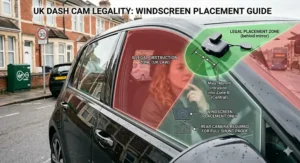
UK law requires dash cams to be mounted so they don’t obstruct your view of the road. The Highway Code advises positioning behind the rear-view mirror — typically a 15cm square area where a sat-nav or dash cam is permitted. Don’t mount it centre-windscreen at eye level, however tempting the adhesive pad makes it.
The SD Card Question
This is the single most common reason dash cams fail to capture usable footage. Standard consumer SD cards are not designed for the constant write cycles that a dash cam demands, and many fail silently within months. Use a high-endurance SD card rated for dashcam use — brands like Samsung Pro Endurance or Lexar High-Endurance are well-regarded. Replace it every 12–18 months. At £15–£25 for 128GB, this is not where to cut corners.
Hardwiring vs Cigarette Lighter
A 12V cigarette lighter adaptor is fine for basic recording while driving. For parking mode — recording when your car is unattended — you need to hardwire the camera to your vehicle’s fuse box via a hardwire kit (typically £15–£25 extra). This keeps the camera on a low-power circuit that doesn’t drain your battery. In a UK residential street or city car park, where door dings and overnight vandalism are realistic concerns, parking mode is worth the minor faff of professional installation.
UK Climate Considerations
British damp is a slow assassin of electronic components. Ensure the adhesive mount is firmly set — suction mounts can fail in the temperature swings between a frosty morning and a parked car in July sun. Run cables tidily behind door seals and A-pillars to prevent moisture ingress. The supercapacitor models (VIOFO A229 series) handle temperature extremes better than battery-based cameras — a practical advantage in the UK’s gloomy winters and occasional unexpected heatwaves.
Real-World UK Driver Scenarios: Which Dash Cam Fits Your Life?
Scenario A: The Daily London Commuter, Budget £150
Sarah drives from Lewisham into central London five days a week — a mixture of South Circular misery, the odd ULEZ zone, and the particular joy of Elephant & Castle’s road layout. Her primary concern is the lorry that cut her up on the Old Kent Road last month and the regular occurrence of cyclists filtering alongside her in stop-start traffic.
Best fit: VIOFO A229 Plus 2CH. The dual STARVIS 2 sensors capture both the van pulling out in front and the cyclist squeezing past the nearside. The 2K resolution is entirely adequate for urban speeds. GPS timestamps will confirm she was stationary when that cyclist clipped her mirror.
Scenario B: The Retired Couple in Rural Cumbria, Budget Open
Derek and Margaret drive rural A-roads and single-track lanes in the Lake District, covering long distances on dark winter evenings and sharing the road with agricultural vehicles.
Best fit: Nextbase 622GW with Click-In rear module. The Emergency SOS with What3words could, genuinely, be a life-saving feature on remote roads where the nearest postcode covers four villages. The enhanced night mode handles dark rural lanes better than most. Image stabilisation keeps footage smooth on the rough surfaces that feature liberally on Cumbrian B-roads.
Scenario C: The Company Car Driver, Discreet Setup Preferred
James drives a lease vehicle for work, covering 40,000 miles a year on motorways and is not permitted to permanently modify the car.
Best fit: Garmin Dash Cam X310 with a Mini 3 rear. The magnetic mounts mean both cameras can be removed cleanly at the end of the lease without leaving a trace. The Garmin Drive app is quick enough to save relevant clips in the car park before moving on. The multi-cam wireless sync keeps the installation tidy and cable-free.
Is a Dash Cam Worth It? What the Sceptics Get Wrong
The most common objection goes something like: “I’ve been driving for twenty years and never needed one.” This is the classic fallacy of the uneventful past. The question isn’t whether you’ve needed evidence before — it’s whether you’d want to be without it the first time you do.
The No-Claims Bonus Maths
Here’s a concrete way to think about it. A typical four-year no-claims discount in the UK can reduce your annual premium by 60% or more. If your base premium is £800, that discount saves you around £480 per year. Losing it to a disputed not-at-fault incident — one that a £160 dash cam would have resolved instantly — costs you potentially thousands in increased premiums over subsequent years. The camera pays for itself on its first prevented dispute.
GPS Data: More Than Just Video
A point that surprises many drivers: a decent dash cam doesn’t just record video — it records speed, location, and G-force data alongside every frame. In a dispute about whether you were doing 35 or 55 mph when an incident occurred, that GPS log is objective and contemporaneous evidence that no dashcam-free alternative can replicate. This is particularly relevant as the UK’s pothole compensation framework evolves — several councils have successfully challenged claims where dash cam footage contradicted the claimant’s account.
“What About Privacy?”
UK GDPR does technically apply to personal vehicle dash cam footage, though the “household exemption” covers recordings made for personal use on public roads. You’re not obliged to register with the ICO for a personal dash cam, but you should avoid pointing cameras at private property (your neighbour’s driveway, for instance) during parking mode. The Information Commissioner’s Office provides clear guidance if you’re unsure.
Features That Actually Matter (And Those That Don’t) 🎯
The dash cam market is positively stuffed with specifications that look impressive in an Amazon listing and make almost no real-world difference. Here’s an honest sorting:
Worth Paying For
Sony STARVIS 2 sensor — Not marketing. The difference in night vision quality between STARVIS 2 and a generic sensor is visible and meaningful for licence plate capture. On a wet, unlit road at 10pm, it’s the difference between readable and blurry.
GPS — Essential. Without speed and location data, your footage is less compelling evidence. Every model above £80 should have it.
Supercapacitor (vs battery) — Batteries degrade and can fail in heat. Supercapacitors are more reliable over a 3–5 year lifespan. Worth prioritising for longevity.
Rear camera coverage — If rear-end collisions are the most common UK accident type, a front-only camera leaves your most likely scenario unrecorded.
5GHz Wi-Fi — Footage transfer at 2.4GHz is genuinely slow. 5GHz matters when you need to pull clips quickly.
Features You Can Live Without
4K on both front and rear — 4K front is meaningful. 4K rear is largely irrelevant for evidence purposes.
Cloud subscriptions — Useful for fleet managers; unnecessary complexity for personal use.
App-based AI alerts — Interesting demo, forgotten within a week. Your phone’s maps do navigation better.
Voice commands — A luxury, not a necessity. Fine if it’s there; not worth paying extra for.
UK Dash Cam Regulations: What You Actually Need to Know
Legally, dash cams are not banned and not mandatory in the UK. However, several rules apply:
Under the Highway Code, your dash cam must not obstruct your view of the road. Mounted behind the rear-view mirror, this isn’t an issue. Plonked in the centre of your windscreen at eye level, it might be.
UK GDPR applies if you use footage commercially or share it publicly without justification. Personal use footage submitted to your insurer or the police is explicitly permitted.
Operation Snap — a scheme operated by multiple UK police forces — allows drivers to submit dash cam footage of dangerous driving directly online. Several forces, including Avon & Somerset and West Midlands, have secured successful prosecutions based on dash cam evidence. The camera makes you a participant in road safety, not just a passive observer.
Insurance-wise, your insurer must be notified of any modifications to your vehicle, but a dashcam is typically classed as a minor accessory and doesn’t affect your policy. Check your specific terms if unsure.
FAQ: Dash Cams for UK Drivers
❓ Do I need to tell my insurer I have a dash cam?
❓ Can dash cam footage be used against me in a UK insurance claim?
❓ Does a dash cam work in a car park with the engine off?
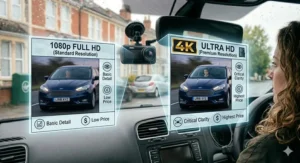
❓ Is a 4K dash cam worth it over 2K for UK road evidence?
❓ Are dash cams legal to use in school zones or near sensitive sites in the UK?
Conclusion: So, Is a Dash Cam Worth It?
For UK drivers in 2026, the answer is straightforwardly yes — with the caveat that which dash cam matters considerably more than simply having one.
The VIOFO A229 Pro 2CH is the pick for most people: dual Sony STARVIS 2 sensors, front and rear coverage, a CPL filter in the box, and genuine 4K quality for roughly £165. If safety features and emergency connectivity matter more to you — and particularly if you drive rural roads alone — the Nextbase 622GW’s Emergency SOS and What3words integration justify its premium. Budget-first? The Vantrue E1 Lite gets you reliably on the road for under £80 with Wi-Fi and GPS included.
What all seven cameras on this list share: they’ll record your next incident, protect your no-claims bonus, and give you something no eyewitness can reliably provide — the truth, with a timestamp. For the cost of a tank of petrol and an hour’s installation, that strikes me as rather good value.
✨ Don’t Miss These Exclusive Deals!
🔍 Ready to invest in your peace of mind on UK roads? Click any highlighted product name in this article to check the latest pricing and availability on Amazon.co.uk. Prime members get free next-day delivery — you could be recording by tomorrow morning.
Recommended for You 📖
- 7 Best Front Dash Cams UK 2026: Tested & Ranked
- Dash Cam Buying Guide UK 2026: 7 Best Picks Revealed
- Best Dash Cams UK 2026: 7 Top-Rated Picks for Every Driver
Disclaimer: This article contains affiliate links. As an Amazon Associate, I earn from qualifying purchases. If you purchase products through these links, we may earn a small commission at no additional cost to you.
✨ Found this helpful? Share it with your mates! 💬🤗
