
In This Article
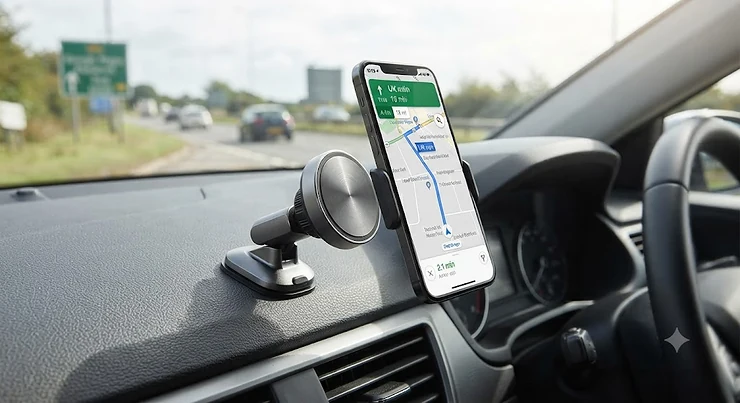
Here’s a scene most British drivers know too well: you’re crawling along the A40 at rush hour, phone balanced precariously on the passenger seat, and every time you hit a pothole it slides another six inches towards the footwell. A proper strongest magnetic phone holder car buyers can rely on solves that problem in one satisfying click — no fumbling, no glancing down, no phone doing a swan dive into your coffee cup. But “strong” is doing a lot of heavy lifting in that phrase, and not every mount marketed with a big magnet number actually delivers when you’re taking a roundabout at speed with a phone the size of a small tablet strapped to your dashboard.

This guide cuts through the gram-force marketing jargon. We’ve researched seven genuinely available mounts — spanning budget vent clips to machined-aluminium dashboard units — and looked at what independent testers, aggregated buyer feedback, and published specifications actually say about hold strength, heat tolerance, and phone compatibility. You’ll get honest analysis, not a rewritten spec sheet: what the magnet numbers mean in practice, which mounting style suits which car, and where a metal plate becomes non-negotiable rather than optional. Whether you’re commuting with a featherweight iPhone SE or hauling around a Pro Max wrapped in a rugged case, there’s a genuinely strongest magnetic phone holder car option below that will actually hold.
Quick Comparison Table
| Mount | Mounting Style | Magnet Strength | Best For |
|---|---|---|---|
| Rokform Adjustable Magnetic Car Mount | Dashboard (3M adhesive) | Up to 90 lb pull force | Raw holding power, big phones |
| Peak Design Car Mount SlimLink | Dashboard (3M adhesive) | MagSafe-strength SlimLink array | Design-conscious drivers |
| ESR HaloLock Magnetic Car Phone Mount | Air vent | 2,300gf (N52H magnets) | MagSafe iPhone users on a mid budget |
| Anker MagGo/Nano Qi2 Car Mount | Vent or suction | 16N magnetic force + 15W charging | Wireless charging while driving |
| LISEN Magnetic Car Mount (6 Magnets) | Vent clip | Up to 8lb hold, 6 neodymium magnets | Budget, universal Android/iPhone |
| andobil MagSafe Car Mount Pro | Vent clip | 23 N55 magnets, 8.8lb pull | Heavy phones, thick cases |
| Belkin Car Vent Mount Pro (Qi2) | Vent | Qi2-certified magnetic array | Trusted brand, simple setup |
Looking at the table, the pattern that jumps out is a split between dashboard mounts that trade convenience for genuinely enormous pull figures, like the Rokform Adjustable Magnetic Car Mount, and vent mounts that prioritise a quick install but rely more heavily on clip rigidity than magnet grade. If you drive a car with weak, flexy vent slats, a dashboard-adhesive option such as the Peak Design Car Mount SlimLink is worth the extra faff of a 3M cure time. For most UK drivers doing a daily commute, the andobil MagSafe Car Mount Pro and LISEN Magnetic Car Mount sit in a comfortable middle ground of price and reliability.
💬 Found a mount you like already? Bookmark this page and compare prices before you commit — your phone will thank you.
Top 7 Strongest Magnetic Phone Holders for Car: Expert Analysis
1. Rokform Adjustable Magnetic Car Mount — highest raw pull force on this list
Rokform built its reputation on rugged, aluminium-bodied gear, and the Adjustable Magnetic Car Mount is the clearest expression of that philosophy in this list. The company states the mount delivers up to 90lb of magnetic pull force via a CNC-machined aircraft-aluminium swivel head, which is a genuinely enormous figure compared with most competitors here. In practical terms, this is the mount you reach for if you drive somewhere with proper suspension abuse — gravel tracks, speed bumps taken slightly too fast, or a van with a bouncy cab.
Based on the spec comparison, the standout detail isn’t just the magnet — it’s the build. Corrosion-resistant aluminium housing and a spring-loaded ball joint mean the swivel mechanism should outlast the plastic ratchets found on cheaper mounts, and Rokform includes steel plates so non-magnetic phones and cases still get a firm grip. Reviewers consistently note that the mount feels reassuringly solid in hand, with several buyers specifically praising how steady their phone stays on rough roads, and the product sits at roughly 4.8 stars across several hundred reviews at the time of research. What most buyers overlook is that maximum-strength adhesive mounts need a genuine 72-hour cure before you load them with a heavy phone — skip that step and you’re not testing the magnet, you’re testing the glue.
Pros:
- ✅ Exceptionally high stated pull force for big phones
- ✅ Aircraft-grade aluminium resists corrosion and flex
- ✅ Includes steel plates for universal case compatibility
Cons:
- ❌ Requires a lengthy adhesive cure before full use
- ❌ Dashboard-only mounting limits placement flexibility
At around £35-45, the Rokform Adjustable Magnetic Car Mount sits mid-pack on price but punches well above it on raw holding power, making it good value if durability outweighs your need for wireless charging.
2. Peak Design Car Mount SlimLink — best for a genuinely premium dashboard finish
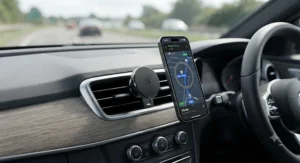
Peak Design approaches the strongest magnetic phone holder car category from a design-first angle rather than a specs-first one. The proprietary SlimLink attachment system pairs an array of MagSafe-compatible magnets with a zirconia-ceramic alignment insert, and the mount body is machined and anodised aluminium rather than moulded plastic. On paper this means a mount that looks like it was designed into the dashboard rather than clipped on as an afterthought — genuinely rare in this category.
Independent hands-on testing from a technology reviewer found the SlimLink system held an iPhone 14 Pro Max, one of Apple’s heaviest handsets, securely through spirited driving with zero rattling, which is meaningful because vibration-induced looseness is usually where cheaper mounts fail first. The buttery-smooth ball head lets you fine-tune viewing angle without the phone drifting back down under its own weight, a common annoyance on lower-quality swivels. What the spec sheet won’t tell you, but this reviewer’s real-world test suggests, is that the one-handed attach-and-detach action genuinely reduces the temptation to fiddle with your phone while driving, since placing it takes under a second.
Pros:
- ✅ Premium anodised-aluminium build feels genuinely upmarket
- ✅ SlimLink magnets rated for MagSafe-level strength
- ✅ Buttery ball-head adjustment holds angle under vibration
Cons:
- ❌ Requires a Peak Design case or universal adapter for non-MagSafe phones
- ❌ Among the pricier options in this guide
Sitting in the £70-90 range, the Peak Design Car Mount SlimLink is a premium purchase, but the finish and hold quality genuinely justify it for drivers who want their dashboard to look considered rather than cluttered.
3. ESR HaloLock Magnetic Car Phone Mount — best mid-range MagSafe vent option
ESR’s HaloLock range sits confidently in the middle of the market, and the vent-mounted, non-charging version of this mount uses high-grade N52H magnets rated at 2,300gf of holding force. That figure matters because it’s noticeably stronger than the entry-level HaloLock chargers ESR also sells, which top out nearer 1,400-1,600gf — so buyers specifically hunting for hold strength should check which HaloLock variant they’re adding to the basket. Here’s what to weigh: this model drops wireless charging entirely to put more of its magnet budget into raw grip.
The mount’s hook-and-arm vent clip is designed to work across horizontal, vertical, circular, and cross-hatch vent styles, and ESR includes two metal rings so non-MagSafe Android phones can use the mount just as securely as an iPhone. Reviewers consistently report that the vent clip itself is the more likely failure point than the magnet — a theme that shows up across the wider vent-mount category, since clip plastic can soften slightly in prolonged summer heat. Based on the spec comparison, this is a sound pick for iPhone 12-and-later owners who want strong MagSafe-grade hold without paying for a charging coil they may not need.
Pros:
- ✅ 2,300gf N52H magnets — stronger than ESR’s charging models
- ✅ Works with nearly every vent type via rotatable hook
- ✅ Includes metal rings for Android and non-MagSafe compatibility
Cons:
- ❌ No wireless charging on this specific variant
- ❌ Vent clip plastic can soften slightly in extreme heat
At roughly £20-30, the ESR HaloLock Magnetic Car Phone Mount offers some of the best pull-force-per-pound in this guide, provided you don’t need charging built in.
4. Anker MagGo/Nano Qi2 Car Mount — best for wireless charging while driving
Anker’s MagGo and Nano ranges bring Qi2-certified 15W wireless charging into the strongest magnetic phone holder car conversation, and the magnetic profile that Qi2 standardises brings genuinely precise coil alignment alongside the hold. One retailer’s testing found the magnet strength here handles heavy Pro Max and Ultra-class phones securely across bumps and potholes, while Anker’s own Nano Car Mount is rated at a stated 16N of magnetic force with a 3M adhesive base tested to support weights up to roughly 22.5lb of side-loading stress.
Reviewers consistently report the magnet grip as reassuring — one aggregated customer summary specifically flags the vent mount’s secure hold and the magnet strength as sufficient for daily use, though a handful of buyers noted that wireless charging output can feel underwhelming next to a wired cable when running navigation apps continuously. What most buyers overlook is that Anker’s higher-tier Prime 25W model has stricter vehicle compatibility requirements around vent-blade depth, so it’s worth measuring your vents before ordering rather than after.
Pros:
- ✅ Qi2-certified 15W charging with strong magnetic alignment
- ✅ 3M adhesive rated for real-world weight stress
- ✅ Reliable, well-established brand with solid warranty support
Cons:
- ❌ Wireless charging draws more battery than it delivers during heavy navigation use
- ❌ Premium tiers have stricter vent-depth compatibility
Priced around £30-45 depending on wattage tier, the Anker MagGo/Nano Qi2 Car Mount is the clear pick if hands-free charging matters as much as hold strength to you.
5. LISEN Magnetic Car Mount (6 Magnets) — best budget universal option
LISEN’s approach to the strongest magnetic phone holder car brief is refreshingly blunt: six built-in neodymium magnets, a metal plate for every phone in the box, and a price that undercuts most of this list. The brand states the mount can hold up to roughly 8lb, more than enough for any consumer smartphone even in a chunky case, and the “three grasp point” vent clip design is specifically engineered to stop the common budget-mount failure of slowly working loose from vibration over weeks of use.
Reviewers consistently note that this mount handles heavier Android phones with protective cases well, including specific aggregated feedback describing it as strong enough to hold phones with bulky external battery cases — a genuinely useful data point since that’s exactly the scenario where weaker budget magnets fail. What the spec sheet won’t tell you, but LISEN’s own installation notes make clear, is that the metal plate is mandatory for every phone, including MagSafe iPhones, because the mount’s magnets aren’t the same polarity array as Apple’s system. Skip the plate and you’ll get a noticeably weaker, wobblier hold than the numbers suggest.
Pros:
- ✅ Genuinely low price for six-magnet neodymium hold
- ✅ “Three grasp point” clip resists loosening over time
- ✅ Metal plates included for guaranteed universal compatibility
Cons:
- ❌ Metal plate is mandatory even for MagSafe iPhones
- ❌ Not recommended for some thick rubberised cases like Otterbox
At around £12-18, the LISEN Magnetic Car Mount delivers disproportionate value, making it a sensible starter mount or a second-car backup.

6. andobil MagSafe Car Mount Pro — best for heavy phones and thick cases
andobil has iterated aggressively on magnet count across its car mount range, and the current Pro version uses 23 N55 magnets rated at a stated 8.8lb of magnetic attraction — among the highest vent-mount figures in this guide. Reviewers consistently note the mount holds large phones such as Pro Max-class iPhones steady through rough roads, and the double-locking, aerospace-material clip is designed to grip vent slats more firmly than the single spring clips found on cheaper alternatives.
Here’s what to weigh: andobil’s circular cooling design leaves airflow gaps around the phone, which several reviewers specifically credit with keeping devices cooler during long navigation sessions than solid-backed mounts. The company also supplies an extra metal ring so non-MagSafe phones snap on with equivalent strength. One long-term buyer specifically described the magnet as strong and strategically positioned after switching an SUV from an older magnet-format mount, which lines up with andobil’s marketing claims about vent-slat grip. Based on the spec comparison, this is arguably the strongest genuinely affordable vent mount currently available.
Pros:
- ✅ 23 N55 magnets deliver near-top-tier vent-mount pull
- ✅ Circular cooling cutout reduces heat build-up on long drives
- ✅ Military-grade metal clip designed against vibration loosening
Cons:
- ❌ Bulkier profile than slimmer competing vent mounts
- ❌ Some vent shapes need the wider circular attachment, adding setup time
Typically priced in the £18-25 range, the andobil MagSafe Car Mount Pro is arguably the best pound-for-pound pick here for owners of large, heavy handsets.
7. Belkin Car Vent Mount Pro (Qi2) — best for trusted-brand simplicity
Belkin’s Qi2-certified Car Vent Mount Pro brings a recognisable accessory brand’s reliability to the strongest magnetic phone holder car shortlist, with up to 15W of Qi2 wireless charging for compatible iPhones from the 12 series onward and recent Samsung Galaxy S25-series devices in a magnetic case. Independent testing highlighted the mount’s solid, expensive-feeling construction and genuinely secure magnetic hold, alongside a built-in cable strap for tidier cable management than most rivals offer.
That said, honest analysis has to include the drawbacks too: the same independent review noted the mount sits further from the vent than expected, making it feel top-heavy and prone to tugging air vents downward over time, and this specific variant skips wireless charging entirely if you opt for the non-Pro model. Reviewers consistently flag Belkin’s build quality and two-year warranty as reassuring, but buyers should weigh the mount’s size against smaller vents before committing, since compact vent openings may struggle with its footprint.
Pros:
- ✅ Well-known, widely trusted accessory brand
- ✅ Solid build quality with tidy cable management
- ✅ Qi2-certified 15W charging on compatible models
Cons:
- ❌ Larger footprint can feel top-heavy on some vents
- ❌ Some reviewers found it strains smaller vent flaps over time
At around £35-50, the Belkin Car Vent Mount Pro trades a little bulk for brand reassurance and a genuinely reputable warranty.
Setting Up Your Magnetic Car Mount: Installation & Maintenance Guide
Getting the strongest magnetic phone holder car mount to actually perform at its rated strength starts before you ever clip a phone onto it. For adhesive dashboard mounts like the Rokform Adjustable Magnetic Car Mount or Peak Design Car Mount SlimLink, clean the surface thoroughly with isopropyl alcohol rather than a standard wipe, since factory dashboard treatments and dust film both weaken 3M bond strength considerably. Press firmly for a full minute, then — and this is the step most people skip — leave the mount completely unloaded for the manufacturer’s stated cure time, typically 24 to 72 hours, before mounting a phone.
For vent clips such as those on the ESR HaloLock, andobil MagSafe Car Mount Pro, or LISEN Magnetic Car Mount, rotate the clip so its grasp points sit against the sturdiest part of the vent slat, not the thin plastic tip, and re-tighten after the first week once the plastic has settled slightly. Common first-30-day mistakes include mounting the plate off-centre on the phone case, which throws off the magnetic alignment and makes the phone sit slightly crooked, and forgetting that thick cases need the plate positioned specifically over the mount’s strongest magnet cluster rather than anywhere convenient. A quick monthly check — tug gently, inspect the clip teeth for wear, wipe the magnet face free of grit — keeps hold strength consistent for years rather than months.
Real-World Scenarios: Which Mount Matches Your Driving Life
Consider a university student commuting eight miles daily on pot-holed B-roads in an older hatchback with no built-in sat-nav display: budget matters, vibration resistance matters, and a mount like the LISEN Magnetic Car Mount or andobil MagSafe Car Mount Pro covers both needs without overspending on wireless charging they may rarely use at low speeds. Contrast that with a delivery driver doing eight hours a day of stop-start city driving, phone constantly running navigation and burning battery — here, the Anker MagGo/Nano Qi2 Car Mount earns its keep because charging while mounted directly addresses the battery-drain pain point that budget mounts can’t solve.
Then there’s the professional who values how their car’s interior looks and drives a newer vehicle with a genuinely premium cabin — the Peak Design Car Mount SlimLink matches that priority precisely, since its main selling point is disappearing into the dashboard rather than dominating it. Finally, picture a tradesperson with a van full of tools, driving over rough building-site access roads multiple times a day with a large-screen Android phone in a rugged case: the Rokform Adjustable Magnetic Car Mount‘s stated 90lb pull and steel-plate compatibility is specifically built for that kind of punishment, where lesser magnets would eventually shake loose.
Common Problems With Magnetic Car Mounts (And How to Fix Them)
Problem: the phone slowly rotates or droops during driving. This is almost always a ball-joint tension issue rather than a magnet weakness — mounts like the Peak Design Car Mount SlimLink include an adjustable friction dial specifically to fix this, so check whether yours has one before assuming the mount is faulty. Problem: the phone won’t snap on securely despite a “strong magnet” rating. In nearly every case this traces back to a missing or misaligned metal plate, particularly with mounts such as the LISEN Magnetic Car Mount, where the plate is mandatory rather than optional for full-strength grip.
Problem: the vent clip loosens after a few weeks. Heat cycling from the car’s climate control softens plastic clips slightly, so retightening once after the initial bedding-in period, as recommended for the ESR HaloLock Magnetic Car Phone Mount, solves this in minutes. Problem: wireless charging feels slow or the phone gets warm. This is a known trade-off with magnetic charging mounts like the Anker MagGo/Nano Qi2 Car Mount, and it’s rarely a fault — Qi2 charging is inherently less efficient than a cable, so expect noticeably slower top-ups on long, hot summer drives. Problem: the phone case blocks a proper magnetic connection. Thick rubberised or battery-pack cases sometimes sit too far from the mount’s magnets; swapping to a slimmer case or adding a spacer-free metal plate, as andobil supplies with the andobil MagSafe Car Mount Pro, usually restores full hold strength.
What Is the Strongest Magnetic Phone Holder for Car?
The strongest magnetic phone holder car buyers can genuinely rely on is a mount using high-grade neodymium (N52 or N55) magnets, rated by gram-force or pound-force pull, combined with a rigid mounting mechanism — whether adhesive dashboard plate or reinforced vent clip — that doesn’t loosen under vibration. Magnet strength alone doesn’t guarantee stability; the mount’s structural rigidity and metal-plate alignment matter just as much for keeping a heavy, cased smartphone secure over rough UK roads.
How to Choose the Strongest Magnetic Phone Holder for Car
- Check the magnet rating in gram-force or pull-force, not just marketing adjectives. A mount stating 2,000gf or higher, or a pull force above 5lb, is genuinely in strong-hold territory; anything unspecified should be treated cautiously.
- Match mounting style to your car. Dashboard adhesive mounts like the Rokform Adjustable Magnetic Car Mount suit flat, clean surfaces; vent clips such as the andobil MagSafe Car Mount Pro suit cars without spare dashboard real estate.
- Confirm metal-plate inclusion for non-MagSafe phones. If you’re on Android or an older iPhone, a mount without a bundled plate, or one incompatible with your case, will underperform its rated strength.
- Weigh charging against simplicity. Wireless charging models like the Anker MagGo/Nano Qi2 Car Mount add convenience but also complexity and heat; a non-charging mount is often more reliable long-term.
- Consider your phone’s actual weight and case thickness. Pro Max and Ultra-class phones in rugged cases need mounts rated well above their own weight, such as the andobil MagSafe Car Mount Pro‘s 8.8lb figure.
- Read aggregated review themes, not just star ratings. Recurring complaints about clip loosening or heat sensitivity tell you more than an average score alone.
- Factor in installation commitment. Adhesive mounts need a genuine cure period and are semi-permanent; vent clips are faster to relocate between cars.
Common Mistakes When Buying a Magnetic Car Phone Mount
The most frequent mistake is buying purely on the biggest magnet number without checking whether a metal plate is required — and forgotten — for your specific phone, which quietly halves the effective hold strength people expect. A close second is ignoring vent geometry entirely; a mount like the ESR HaloLock Magnetic Car Phone Mount works across most vent shapes, but some cars, particularly certain SUV and truck models, have circular or unusually deep vents that reject standard clips altogether.
Buyers also frequently underestimate cure time on adhesive mounts, loading a phone within minutes of installation and then blaming the magnet when the whole mount peels away — the fault lies with rushing the 3M bond, not the magnetic array. Finally, many shoppers assume “MagSafe compatible” and “as strong as MagSafe” are the same claim; several budget mounts use weaker generic magnets arranged in a MagSafe-style ring purely for alignment, not for equivalent pull force, so it’s worth checking gram-force figures independently of MagSafe branding claims.
Magnetic Phone Mount Dashboard vs Vent vs Adhesive: Which Mounting Style Wins?
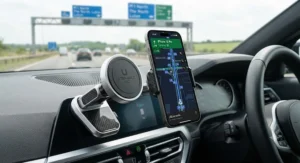
Choosing between a magnetic phone mount dashboard setup, a vent clip, and a straightforward adhesive puck comes down to trade-offs rather than one style being objectively superior. A dashboard mount, like the Rokform Adjustable Magnetic Car Mount or Peak Design Car Mount SlimLink, typically offers the highest stability because it’s bonded directly and permanently to a rigid surface — there’s no clip mechanism to loosen over time, and viewing angles tend to be more customisable since you’re not constrained by vent position. The trade-off is commitment: repositioning means fresh adhesive, and a poorly chosen spot can obstruct your view of the road, which the Highway Code specifically flags as a concern for any mounted device.
Vent mounts, including the ESR HaloLock, andobil MagSafe Car Mount Pro, and LISEN Magnetic Car Mount, win on installation speed and flexibility — they clip on in seconds and move between cars easily — but rely on vent slat rigidity, which varies enormously between vehicle models and can degrade with heat cycling over several summers. This is genuinely the adhesive vs vent mount decision in miniature: adhesive wins on long-term stability and viewing freedom, vent wins on convenience and reversibility. For most UK drivers with standard horizontal vents, a reinforced vent clip is perfectly adequate; for older cars with brittle or unusually shaped vents, dashboard adhesive is the safer long-term bet.
Magnetic Car Mount With Metal Plate: What It Does and Why You Need One
A magnetic car mount with metal plate is, in essence, a translation layer between a mount’s magnets and a phone that has no magnetic array of its own. Apple’s MagSafe-equipped iPhones (12 series onward) and some Qi2-certified Android handsets have a built-in ring of magnets that pairs directly with a compatible mount, but every other phone needs a thin ferromagnetic disc — usually adhered to the phone’s back or slipped inside the case — for the mount’s magnets to grip onto at all.
What most buyers overlook is that plate placement matters enormously: centre it precisely over where the mount’s strongest magnet cluster will sit, not simply in the middle of the phone, or you’ll get a weaker, off-balance hold regardless of how strong the mount’s rated pull force is. Mounts such as the LISEN Magnetic Car Mount and andobil MagSafe Car Mount Pro both include multiple plate shapes specifically because phone and case geometry varies so much, and reviewers consistently note that skipping the plate — even on iPhones that “should” work via generic magnets — produces a noticeably wobblier result than using the plate as instructed.
Phone Weight Capacity and Heavy Phone Case Compatibility Explained
Phone weight capacity is where marketing numbers and lived experience diverge most sharply. A modern flagship phone in a rugged, battery-integrated case can weigh well over 300 grams, and that weight isn’t static — it’s compounded by vibration, cornering forces, and gravity working against the mount at odd angles, not just sitting still on a shelf. This is why a mount’s stated pull force needs meaningful headroom above your phone’s actual weight; the Rokform Adjustable Magnetic Car Mount‘s 90lb figure and the andobil MagSafe Car Mount Pro‘s 8.8lb rating both sit comfortably above what any single smartphone weighs, which is precisely the point — headroom absorbs the extra dynamic forces a bumpy road adds.
Heavy phone case compatibility specifically trips up budget mounts because chunky, rubberised, or battery-pack cases add distance between the phone and the mount’s magnets, weakening the connection even when the magnets themselves are rated strongly. Reviewers consistently flag that some six-magnet budget mounts, including variants of the LISEN Magnetic Car Mount, aren’t recommended for certain thick rubberised cases like Otterbox without careful plate positioning, while andobil’s circular cooling design on the andobil MagSafe Car Mount Pro was specifically praised for accommodating thicker cases without sacrificing hold. If you run a heavy case, prioritise mounts with explicitly stated pull figures well above your phone’s boxed weight, and always fit the plate directly against the case’s back rather than trusting bare-phone magnets to bridge the gap.
Safety, Regulations and UK Driving Law for Mounted Phones
Owning the strongest magnetic phone holder car money can buy doesn’t exempt you from UK law — quite the opposite, since a secure mount is precisely what keeps hands-free use legal. Under current legislation, it is illegal to hold and use a phone while driving, covering everything from calls to checking maps, even when stationary in traffic, with penalties reaching six points and a fixed fine. Following a 2022 tightening of the rules, the law now closes a previous loophole that allowed drivers to argue certain phone uses weren’t covered by the “interactive communication” wording — virtually all handheld use is now an offence regardless of intent.
Mounting your phone keeps hands-free use legal, but the Highway Code still requires an unobstructed view of the road, so mount placement matters as much as mount strength — a Peak Design Car Mount SlimLink positioned low and to the side is safer than a bulky mount stuck centrally on the windscreen. It’s also worth noting a genuine, if minor, safety consideration around magnets themselves: Apple’s own guidance states that iPhone and MagSafe accessories contain magnets that might interfere with certain medical devices, recommending a safe distance from pacemakers and similar implants, which is a sensible thing to bear in mind if you or a passenger has one. Beyond the legal angle, UK road safety charity Brake highlights that even hands-free phone use carries a measurable crash-risk increase due to cognitive distraction, so a secure mount is a safety tool, not a licence to interact with your phone constantly while driving.
Features That Actually Matter (And Those That Don’t)
Genuinely important: magnet grade and rated pull force, mount rigidity (clip or adhesive quality), and metal-plate inclusion for non-MagSafe phones. These three factors, more than anything else, determine whether a mount survives daily UK roads. Also worth prioritising: heat tolerance ratings on adhesive pads, since a mount rated only to moderate temperatures can soften on a hot dashboard in direct summer sun, loosening its bond over time.
Largely irrelevant marketing noise: exaggerated magnet counts without a corresponding gram-force figure (23 small magnets can be weaker than 6 large ones), LED accent lighting on charging mounts, and vague “military-grade” branding language used across budget and premium mounts alike without independent verification. Reviewers consistently note that build material — aluminium versus reinforced plastic — correlates far more strongly with long-term reliability than headline magnet counts, so if you’re choosing between two similarly priced mounts, prioritise construction quality over spec-sheet bragging rights.
Long-Term Cost & Maintenance: Is a Premium Mount Worth It?
Total cost of ownership for a magnetic car mount rarely stops at the sticker price. Budget vent clips such as the LISEN Magnetic Car Mount, priced around £12-18, may need replacing within two or three years if the clip plastic fatigues from heat cycling, effectively doubling their real cost across a typical car ownership period. By contrast, aluminium-bodied mounts like the Rokform Adjustable Magnetic Car Mount or Peak Design Car Mount SlimLink, sitting in the £35-90 range depending on model, are built around materials that resist the wear that kills cheaper plastics, making their genuine cost-per-year lower despite a higher upfront price.
Wireless charging mounts add a different calculation entirely: the Anker MagGo/Nano Qi2 Car Mount and Belkin Car Vent Mount Pro both replace the need for a separate car charger and cable, which is a modest but real saving, though buyers should factor in that Qi2 charging draws more current for less output than a wired connection, meaning slightly higher fuel or electric costs for EV drivers over thousands of miles of use. For most drivers doing standard commuting, a mid-range mount like the andobil MagSafe Car Mount Pro at £18-25 offers the best balance of durability and price, while frequent high-mileage drivers or tradespeople genuinely benefit from investing in the Rokform Adjustable Magnetic Car Mount‘s more robust construction.
✨ Ready to stop your phone sliding off the seat? Check current prices on today’s top picks and pick the mount that matches your drive.
FAQ
❓ What is the strongest magnetic phone holder for car use?
❓ Do I need a metal plate for a MagSafe iPhone?
❓ Is a vent mount or dashboard mount stronger?
❓ Can a magnetic car mount damage my phone or bank cards?
❓ Are magnetic car mounts legal in the UK?
Conclusion
Choosing the strongest magnetic phone holder car setup for your own driving life really comes down to matching magnet strength and mounting style to how, and where, you actually drive. If raw holding power against rough roads is your priority, the Rokform Adjustable Magnetic Car Mount and its stated 90lb pull sit at the top of this list, while the Peak Design Car Mount SlimLink answers the same brief with more design polish for those willing to pay a premium. Budget-conscious drivers shouldn’t feel short-changed either — the LISEN Magnetic Car Mount and andobil MagSafe Car Mount Pro both deliver genuinely strong, well-reviewed hold at a fraction of the premium price, provided the included metal plates are fitted correctly.
Wireless charging changes the calculus slightly, and if keeping your phone topped up during long navigation sessions matters more than absolute magnet strength, the Anker MagGo/Nano Qi2 Car Mount or Belkin Car Vent Mount Pro both bring Qi2-certified charging into a genuinely secure magnetic hold. Whichever you choose, remember that the magnet is only half the story — correct plate placement, a properly cured adhesive bond or well-seated vent clip, and sensible mount positioning under UK law all matter just as much as the gram-force number on the box.
Recommended for You
- Magsafe Car Mount: 7 Best Picks for UK Drivers in 2026
- Best Magnetic Car Mount 2026: 7 Top Picks Tested & Compared
- Hardwire Kit vs Cigarette Lighter Dash Cam: 7 Picks for 2026
Disclaimer: This article contains affiliate links. As an Amazon Associate, I earn from qualifying purchases. If you purchase products through these links, we may earn a small commission at no additional cost to you.
✨ Found this helpful? Share it with your friends! 💬🤗
