

In This Article
Why Your Car Seat Is Quietly Wrecking Your Back
Here’s the uncomfortable truth nobody tells you when you buy a car: the seat that felt fine on a five-minute test drive around the block turns into an instrument of slow torture somewhere around mile forty. A lumbar support cushion for car seat use is a shaped foam or gel insert, usually strapped to the seatback, that fills the hollow of your lower spine so your back stays in its natural curve instead of slumping into a C-shape every time you drive. That gap is the real villain here, and almost every factory seat in a mainstream family car leaves it wide open.

If you’ve ever climbed out of the car after a long motorway stretch feeling like your lower back has fused into the shape of the headrest, you already know the problem a lumbar support cushion for car seat comfort is trying to solve. Britain’s roads don’t help matters. UK commuters are already logging serious hours behind the wheel each year, and that time behind the wheel adds up fast across a working life, which is exactly the kind of repeated, low-grade strain that turns into chronic lower back pain driving home from work every evening.
The good news: this is one of the cheapest, least invasive fixes in the entire car-accessories aisle. You don’t need a new seat, a chiropractor on retainer, or a four-figure ergonomic overhaul. You need a well-chosen cushion that matches your torso length, your seat shape, and how long you actually sit still each day. Over the next few thousand words we’ll walk through seven real, currently available options — budget, mid-range and properly premium — plus the buying logic, the fitting tricks, and the mistakes that turn a good cushion into an expensive paperweight in your boot.
Quick Comparison: 7 Lumbar Support Cushions for Car Seats at a Glance
Before the deep dive, here’s the shortlist. This table sorts roughly budget to premium, and every product name stays bold throughout the article so you can scan and match at a glance.
| Cushion | Type | Price Range | Best For |
|---|---|---|---|
| Medipaq 3D Mesh Back Lumbar Support Cushion | Memory foam, elastic strap | Under £20 | Best For first-time buyers on a tight budget |
| OEMASSIVE Gel Back Support Cushion | Gel honeycomb, adjustable straps | Around £20-£25 | Best For hot cars, leather and vinyl seats |
| Everlasting Comfort Lumbar Support Pillow | Memory foam, dual straps | £25-£35 range | Best For most drivers, all-round pick |
| Xtremeauto Back Lumbar Support Car & Van Seat Cushion | Memory foam, 2-piece set | £25-£35 range | Best For van drivers and fleet use |
| Aylio Original Lumbar Support Cushion | Tapered memory foam | £30-£40 range | Best For tall drivers, long torsos |
| ComfiLife Lumbar Support Back Pillow | Memory foam, mesh/leatherette | £30-£40 range | Best For chronic lower-back stiffness |
| Cushion Lab Extra Dense Lumbar Pillow | Patented multi-region Hyperfoam | £55-£70 range | Best For severe or long-standing back pain |
A pattern worth noticing straight away: price climbs with how precisely the foam is shaped to the spine’s actual curve, not simply with how much foam is stuffed in. The budget pair here relies on a single contoured block and an elastic strap, which is genuinely fine for shorter commutes, while the two premium entries add multi-zone shaping that targets the lower, mid and upper back separately. If your drive is under thirty minutes a day, that extra structure matters less than fit and strap security; if you’re doing motorway stretches most days, the shaping starts earning its keep.
💬 Found a cushion that jumps out already? Save this table and scroll on — the full breakdown below explains exactly why each one earns its spot.
Top 7 Lumbar Support Cushions for Car Seats: Expert Analysis
Seven products, three price tiers, one job: filling the gap between your spine and the seatback without turning your commute into a science experiment. Specs below come from manufacturer listings and aggregated buyer feedback found during research; where a claim (like a “chiropractor recommended” label) is the brand’s own marketing line rather than an independently verified fact, that’s flagged honestly rather than repeated as gospel.
| Cushion | Foam / Fill | Strap System | Cover | Price Range |
|---|---|---|---|---|
| Medipaq 3D Mesh Back Lumbar Support Cushion | 4lb density visco-elastic memory foam | Single adjustable elastic strap | Breathable 3D mesh, hand-washable | Under £20 |
| OEMASSIVE Gel Back Support Cushion | Gel + polyester honeycomb | Adjustable straps with extenders | Breathable elastic weave | £20-£25 range |
| Everlasting Comfort Lumbar Support Pillow | Heat-responsive memory foam | Dual adjustable straps, fits up to 81cm chairs | 3D polyester mesh, machine washable | £25-£35 range |
| Xtremeauto Back Lumbar Support Car & Van Seat Cushion | Memory foam, 2-piece set | Elastic strap system | Washable outer cover | £25-£35 range |
| Aylio Original Lumbar Support Cushion | Tapered memory foam, thick base | Two fixed straps | Removable, machine-washable cover | £30-£40 range |
| ComfiLife Lumbar Support Back Pillow | Memory foam, temperature-responsive firmness | 3-strap adjustable system | 3D mesh and leatherette blend | £30-£40 range |
| Cushion Lab Extra Dense Lumbar Pillow | Patented Hyperfoam, multi-region shaping | Single strap, doubles as luggage strap | CertiPUR-US foam, recycled-polyester cover | £55-£70 range |
A quick read of that table before we go product by product: the more expensive entries aren’t chasing softness, they’re chasing shape. The Cushion Lab Extra Dense Lumbar Pillow and, to a lesser degree, the ComfiLife Lumbar Support Back Pillow both split the back into separate zones rather than presenting one uniform curve, which matters most if your pain sits specifically in the lower lumbar rather than spread across the whole back.
1. Medipaq 3D Mesh Back Lumbar Support Cushion — best budget pick under £20
At this price, expecting miracles would be unfair, but the Medipaq 3D Mesh Back Lumbar Support Cushion does the basics properly. It’s built from 4lb-density visco-elastic memory foam, which is a genuinely firm grade for a budget product — most sub-£20 cushions cut corners here with cheap open-cell foam that goes flat within weeks.
The 35 x 34 x 12cm shape sits mid-back and fills the lumbar hollow without pushing you forward off the seat, which matters in smaller hatchbacks where legroom is already tight. In practice, that density means it resists the seat-crush the same way office-grade foam does, so it holds its curve through a winter of daily short hops rather than collapsing into a pancake.
Aggregated buyer feedback for the Medipaq range, including long-distance and taxi drivers among the reviewers, consistently mentions relief from stiffness on long trips, alongside occasional notes that the single elastic strap can loosen or wear over very heavy daily use — a fair trade-off for the price, but worth knowing before you buy.
Pros:
- ✅ Genuinely dense 4lb memory foam for the price bracket
- ✅ Compact size suits smaller cars and vans
- ✅ Hypoallergenic, anti-microbial foam treatment
Cons:
- ❌ Single strap can loosen with daily heavy use
- ❌ Less structured shaping than pricier multi-zone designs
At under £20, this is close to an impulse buy, and for anyone testing whether a lumbar cushion helps at all before committing to something pricier, it’s a sensible first step — check current price on Amazon UK before deciding.
2. OEMASSIVE Gel Back Support Cushion — best cooling gel design for hot cars
Memory foam has one recurring complaint in UK summers: black leather seats turn into griddles, and foam traps heat against your back. The OEMASSIVE Gel Back Support Cushion sidesteps that with a gel-and-polyester honeycomb structure instead of solid foam.
The honeycomb geometry does two jobs at once — it lets air move behind your back the way a mesh office chair does, and the gel itself doesn’t retain heat the way memory foam does, so the practical effect is a cushion that stays noticeably cooler on a warm dashboard-baked afternoon. Its generous coverage (roughly 88cm x 41cm) means it spans more of the seatback than most dedicated lumbar-only pillows, so it’s really a hybrid between a lumbar cushion and a full seatback cover.
A UK buying-guide roundup singled this style out specifically for British summers, noting that the cooling structure is a practical advantage as car interiors run hotter even on moderate days. The trade-off is bulk: gel cushions of this size sit heavier and less discreetly than a slim foam pillow, and the honeycomb texture can feel firmer underfoot until you’re used to it.
Pros:
- ✅ Genuinely cooler than foam on hot leather seats
- ✅ Full-height coverage supports more of the back
- ✅ Adjustable straps with headrest-friendly design
Cons:
- ❌ Bulkier and heavier than dedicated lumbar-only pillows
- ❌ Firmer honeycomb texture takes a few drives to adjust to
This is the one to reach for if you park on the street with no shade, drive a car with dark leather seats, or simply run hot — check the current price range before you commit, since gel cushions vary more in cost than foam ones.
3. Everlasting Comfort Lumbar Support Pillow — best all-rounder bestseller
If you asked ten people to name a lumbar cushion brand, several would say Everlasting Comfort, and the reason isn’t marketing spend — it’s that the Everlasting Comfort Lumbar Support Pillow solves the fit problem better than most competitors. The heat-responsive memory foam softens slightly with body warmth and firms up again in a cold car, which sounds like a gimmick until you’re the one sitting in a chilly car on a January morning waiting for the foam to warm through.
The dual adjustable straps extend to fit seats and chairs up to 81cm wide, which is wider than almost any car seat you’ll encounter, so fit is rarely the issue — it’s more a question of getting the height right on the strap before you drive off. At the time of research, this listing’s buyer ratings numbered in the thousands, sitting around 4.5 out of 5, which is a meaningfully large sample for a category where fit is so personal.
The OEKO-TEX Standard 100 certification is worth knowing about if you’re chemically sensitive or buying for a child’s car seat area — it means the textile components have been tested against a long list of regulated substances, not just marketing language.
Pros:
- ✅ Wide-fitting dual-strap system suits almost any seat
- ✅ OEKO-TEX certified textiles, family-friendly
- ✅ Large base of aggregated buyer ratings to draw on
Cons:
- ❌ Firmness varies noticeably with temperature
- ❌ Mesh cover shows wear faster than leatherette alternatives
For most UK drivers without a specific medical condition driving the search, this is the safest first purchase in the whole list — check the current price range, as it fluctuates with promotions.
4. Xtremeauto Back Lumbar Support Car & Van Seat Cushion — best British brand for vans and fleet drivers
There’s a practical reason to care that a brand is British, and it isn’t patriotism — it’s returns. The Xtremeauto Back Lumbar Support Car & Van Seat Cushion comes from a UK automotive accessories company, which means warranty claims and replacement parts don’t involve international shipping delays or currency conversion headaches.
Sold as a two-piece memory foam set covering both the seat base and the lumbar area, it’s aimed squarely at people who live in their vehicle for work — van drivers, delivery contractors, tradespeople commuting between sites. A UK-focused buying guide highlighted exactly this: the ergonomic design covering the full sitting surface and lumbar zone makes it well suited to commuters spending an hour or more a day in the driver’s seat, which describes most van-based trades.
Because it’s a two-piece set rather than a single lumbar pillow, it adds more bulk to install and remove than the standalone options here, and the base cushion needs periodic repositioning if you slide around on vinyl van seats.
Pros:
- ✅ UK-based brand simplifies warranty and returns
- ✅ Two-piece set supports seat base and lumbar together
- ✅ Designed with van and fleet drivers specifically in mind
Cons:
- ❌ Bulkier two-piece install than single-cushion rivals
- ❌ Base cushion can shift on smooth vinyl van seats
For company vehicles and daily fleet use, having a UK seller behind the product is worth the modest premium over unbranded imports — check current price on Amazon UK.
5. Aylio Original Lumbar Support Cushion — best tapered shape for tall drivers
Most lumbar cushions are shaped like a rounded loaf. The Aylio Original Lumbar Support Cushion is deliberately thicker at the base and tapers thinner toward the top, which sounds like a small detail until you’re over six foot and your lower back sits lower in the seat relative to where a standard cushion’s peak support lands.
Aylio has built this design since 2008, with an occupational therapist involved in later product development, and that clinical input shows in the taper — it’s designed to follow the natural transition from lumbar curve into thoracic spine rather than presenting one flat contour. The two fixed straps keep it anchored well, though unlike the Everlasting Comfort design they don’t extend as far, so very wide bucket seats can be a tighter fit.
Aggregated reviews for this cushion consistently mention that the strap system stays put through long journeys, a detail that matters more than foam softness once you’re three hours into a drive and the cushion is doing its job silently rather than needing constant readjustment.
Pros:
- ✅ Tapered shape suits taller drivers and longer torsos
- ✅ Occupational-therapist-informed design lineage
- ✅ Straps reported to stay secure on long drives
Cons:
- ❌ Less strap extension than wider-fitting rivals
- ❌ Taper shape less ideal for shorter torsos
If you’ve tried a standard rounded cushion and found the support landed in the wrong place, the taper here is worth the price difference — check the current price range before buying.

6. ComfiLife Lumbar Support Back Pillow — best chiropractor-recommended pick
ComfiLife markets the ComfiLife Lumbar Support Back Pillow as recommended by chiropractors and physical therapists — that’s the brand’s own claim rather than an independently verified clinical endorsement, so treat it as marketing context rather than medical fact. What is independently verifiable is the construction: contoured memory foam designed to support the lumbar vertebrae and discs, with a 3-strap adjustable system that’s more robust than the single-strap budget options.
One detail buried in the product listing deserves more attention than it gets: this foam is explicitly temperature-responsive, softening in warm conditions and firming in cold ones. On a frosty British morning that means the cushion will feel notably firmer for the first few minutes of your drive until your body heat and the car’s heater work through it — not a fault, just a fact worth knowing rather than being surprised by.
The mesh-and-leatherette cover blend is a genuine practical upgrade over pure mesh: it breathes where your back touches it but resists the fraying that pure mesh covers eventually show on the strap-contact points.
Pros:
- ✅ Robust 3-strap adjustable mounting system
- ✅ Durable mesh-and-leatherette cover blend
- ✅ Contoured shape targets lumbar discs specifically
Cons:
- ❌ Firmness noticeably lower in cold conditions until warmed
- ❌ “Chiropractor recommended” claim is brand marketing, not verified
A solid mid-range pick for anyone with diagnosed lower-back stiffness who wants sturdier mounting hardware than the cheaper options offer — check the current price range on Amazon UK.
7. Cushion Lab Extra Dense Lumbar Pillow — best premium multi-region support
Every other cushion on this list treats the lower back as one curve. The Cushion Lab Extra Dense Lumbar Pillow treats it as three separate zones — a branched spine crevice, an extended upper-mid back section, and a bolstered lower-back bolster — held together in one contoured S-curve shape. That’s a patented (USPTO-registered) design, not just marketing language, and it’s the clearest reason this cushion costs roughly double its nearest rival here.
The proprietary Hyperfoam is genuinely denser than the memory foam used elsewhere on this list, described by the brand as dynamically rebounding rather than slow-recovery, meaning it pushes back against your spine rather than slowly sinking under sustained pressure. For anyone with a diagnosed disc issue or long-standing chronic pain, that extra structure and rebound is often exactly what a single-block foam cushion can’t provide.
The CertiPUR-US certification confirms the foam is made without certain flame retardants, heavy metals and ozone depleters, which is a genuine third-party standard rather than a self-awarded label. The strap doubles as a travel strap, a nice touch for anyone who also flies or trains regularly.
Pros:
- ✅ Patented multi-region shaping, not just one contour
- ✅ CertiPUR-US certified, independently regulated foam standard
- ✅ Firm, rebounding support suited to chronic or severe pain
Cons:
- ❌ Roughly double the price of the mid-range options here
- ❌ Firmness may feel too structured for those wanting a plush feel
If budget genuinely isn’t the deciding factor and you’ve struggled with chronic lower back pain driving that cheaper cushions haven’t fixed, this is the one worth the stretch — check the current price range, as premium cushions like this see periodic promotional pricing.
How to Choose the Right Lumbar Support Cushion for Your Car
A lumbar support cushion for car seat use is only as good as the fit between it and your specific spine, seat, and driving pattern. Here’s the short version, straight from the criteria that actually separate a good match from a wasted purchase:
- Measure your commute time, not just the distance. A 20-minute stop-start city crawl loads the spine differently to 45 minutes of steady motorway driving — the latter benefits far more from firm, structured foam.
- Check your seat’s existing lumbar adjustment first. If your car already has a manual or powered lumbar dial, a thin cushion may be redundant; if it doesn’t, you’re filling a genuine gap.
- Match foam firmness to your pain type. Diffuse aching favours softer, broader foam; a sharp point of pain low in the spine often responds better to firmer, more contoured shaping like the Cushion Lab design.
- Consider your torso length. Taller drivers generally do better with a taper that extends support further up the back, as covered in the Aylio review above.
- Think about heat. Dark leather seats and unshaded parking mean gel or mesh-covered cushions earn their keep in summer.
- Look at the strap system, not just the foam. A cushion that migrates down the seatback after twenty minutes is worse than no cushion at all, since it changes your posture unpredictably mid-drive.
- Buy from a UK-fulfilled listing where possible. It simplifies returns if the fit is wrong, and Amazon UK’s returns window gives you a real trial period rather than a guess.

Lumbar Cushions vs Traditional Back Support Alternatives
Before you commit to a dedicated cushion, it’s worth being honest about the alternatives people reach for first — because some of them genuinely work, up to a point.
| Approach | Cost | Targeted Support | Portability | Best For |
|---|---|---|---|---|
| Dedicated lumbar cushion (this list) | Under £20 to £70 range | High — shaped to lumbar curve | Excellent, moves between cars | Best For daily commuters and chronic pain |
| Rolled towel or DIY pillow | Free | Low — no consistent shape | Good, but shifts easily | Best For a one-off emergency fix |
| Built-in seat lumbar dial | Included with car, or a costly retrofit | Medium — limited range of adjustment | None, fixed to the vehicle | Best For newer, higher-spec vehicles |
| Full seat or vehicle upgrade | Hundreds to thousands of pounds | High, if properly specified | None | Best For long-term vehicle owners with budget |
The rolled towel is the classic free fix, and it does something, but a towel has no memory — it flattens unevenly within minutes and needs constant readjustment, which is itself a distraction while driving. A built-in lumbar dial is genuinely good when a car has one, but it typically offers depth adjustment only, not the shaped, multi-zone support that something like the Cushion Lab Extra Dense Lumbar Pillow provides. For most people, a dedicated cushion sits in the sweet spot: cheaper than any seat retrofit, far more consistent than a towel, and portable enough to follow you between your own car and a hire car or a partner’s vehicle.
💬 Which alternative have you actually tried already? A comment below on what worked (or didn’t) helps other readers avoid the same trial and error.
Common Mistakes When Buying a Car Lumbar Support Cushion
The most expensive cushion isn’t automatically the right one, and a surprising number of returns happen for entirely avoidable reasons.
Buying based on foam softness alone is the first trap. A cushion that feels plush in a showroom or in your hands often turns out too soft to hold its shape after two hours of body heat and body weight — the foam that feels firm and slightly unyielding in the shop is usually the one that still supports you properly on hour three of a drive.
Ignoring your seat’s existing shape is the second. Bucket seats with pronounced side bolsters, common in sportier trims, can squeeze a wide cushion uncomfortably against the bolster edges; a narrower, more sharply contoured cushion like the Medipaq 3D Mesh Back Lumbar Support Cushion often fits these seats better than a bulkier two-piece set.
The third mistake is skipping the strap-length check. Straps that are too short for your seat frame get stretched to their limit and fail early; straps with generous extension, like those on the Everlasting Comfort Lumbar Support Pillow, cost little extra and last considerably longer.
Finally, people underestimate how much a cushion changes their seating position. Adding 3-4cm of foam behind your back moves you slightly forward relative to the pedals and wheel — always readjust your seat position after fitting a new cushion rather than assuming your old settings still apply.
Lumbar Cushion for Long Commutes: What Actually Changes in Your Body
A lumbar cushion for long commutes earns its keep differently than one bought for the odd weekend trip, because the damage from bad seating posture is cumulative rather than immediate. Ergonomic seating research consistently points to the same mechanism: when your lower back loses its natural inward curve (called lordosis) and rounds into a C-shape, pressure inside the spinal discs increases, and small support muscles along the spine have to work harder to hold you upright.
The HSE’s own guidance on good posture — written for office seating but built on the same spinal mechanics that apply behind the wheel — specifically recommends using a cushion to provide additional lower-back support where a chair’s built-in support isn’t enough. The same physics apply whether you’re sitting at a desk or gripping a steering wheel; a car seat is simply a chair you can’t get up from every twenty minutes.
Over a 45-minute commute, the difference a properly fitted lumbar cushion makes isn’t dramatic in the first ten minutes — it’s dramatic in minute thirty-five, when an unsupported back has already started to fatigue and slump, while a supported one is still holding its shape. That’s the entire case for treating this as a long-commute tool rather than a one-off comfort gadget: the benefit compounds with duration, which is exactly why the Cushion Lab Extra Dense Lumbar Pillow and ComfiLife Lumbar Support Back Pillow, both built for sustained structural support, tend to outperform lighter options once you’re past the 30-minute mark.
Adjustable Lumbar Support Car Cushion: Getting the Fit Right for Your Body
An adjustable lumbar support car cushion is only adjustable in the ways its strap system allows, and this is where a lot of buyers get the wrong product for their body without realising it. Height adjustment along the seatback is the first axis that matters — your lumbar curve sits at a specific point relative to your hip crease, and that point moves depending on your torso length and how upright your seat back is reclined.
Most of the cushions on this list use a strap-and-buckle system rather than a mechanical dial, which means the “adjustment” happens once, when you first fit it, rather than on the move. Get this step right and you rarely need to touch it again; get it wrong and you’ll find yourself constantly shifting position, which defeats the entire purpose.
A practical test: sit in your normal driving position, reach behind you, and find the exact point where your hand naturally rests in the small of your back. That’s where the cushion’s peak should sit — not the middle of your entire back, and not down at your tailbone. The Aylio Original Lumbar Support Cushion‘s tapered design is specifically useful here because it gives you more margin either side of that peak point; a uniform round cushion is far less forgiving if you get the placement slightly wrong.
For recline angle, a common mistake is fitting a lumbar cushion while the seat is reclined further than your normal driving position, only to find the support lands in the wrong place once the seat is upright. Always fit and adjust with the seat exactly where you actually drive it.
Safety, Regulations and Ergonomic Standards for UK Drivers
There’s no specific UK law governing aftermarket lumbar cushions, but there are relevant standards worth knowing before you buy or fit one. Any textile product sold in the UK must meet general product safety requirements, and certifications like OEKO-TEX Standard 100 (carried by the Everlasting Comfort Lumbar Support Pillow) or CertiPUR-US (carried by the Cushion Lab Extra Dense Lumbar Pillow) go beyond the legal minimum by independently testing for regulated chemicals in the foam and fabric.
On actual seating posture and workplace ergonomics, the NHS’s guidance on back pain confirms that staying active and maintaining reasonable posture during activities like driving genuinely helps manage and prevent recurrence, though it’s not a substitute for medical advice if pain is severe, persistent, or accompanied by numbness or weakness — those symptoms warrant seeing a GP rather than relying on a cushion.
There’s one genuine safety consideration specific to cars rather than office chairs: never let a cushion or its strap interfere with your seatbelt’s path across your body, and never fit anything so thick that it changes your seating height enough to alter your sightline over the dashboard or your reach to the pedals. If a cushion changes either of those, readjust your seat position immediately rather than compensating with an awkward posture.

Long-Term Cost and Maintenance: Is a Lumbar Cushion Worth It?
Run the numbers and this is one of the easier value cases in the whole car-accessories category. Even the premium Cushion Lab Extra Dense Lumbar Pillow, at the top of this list’s price range, costs less than a single private physiotherapy session, and a well-made memory foam cushion typically holds its shape for two to three years of daily use before the foam noticeably softens.
Maintenance is minimal but not zero. Machine-washable covers, which most of the cushions here have, should be washed every few weeks if you commute daily — sweat and skin oils break down foam faster when they’re allowed to soak through a cover repeatedly rather than being washed off. Straps are the first component to fail, generally through UV exposure if the car sits in direct sun, so a cushion stored out of the car when not in daily use will simply last longer.
The real long-term cost comparison isn’t cushion versus no cushion — it’s cushion versus the downstream cost of untreated postural strain, which can mean physiotherapy, time off work, or a far more expensive ergonomic car seat retrofit. At under £70 even for the premium pick here, a lumbar cushion is one of the few genuinely low-risk purchases in this entire category.
Practical Usage Guide: Fitting and Adjusting Your Lumbar Cushion in Under Ten Minutes
Getting a lumbar cushion right the first time saves weeks of low-grade annoyance, so it’s worth doing properly rather than strapping it on in the supermarket car park and hoping for the best.
Start with the seat in your normal driving position — upright enough that you’re not slouched, reclined enough that your shoulders aren’t hunched forward. Sit down and locate the natural hollow in your lower back with your hand before you fit anything; this is your target zone, and it’s usually a hand’s width above your belt line, not the middle of your back.
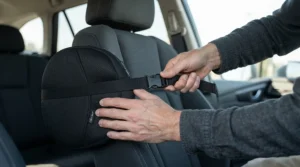
Fit the cushion with its peak roughly at that point, threading the straps behind the seatback through the gap where the backrest meets the base. Tighten enough that the cushion doesn’t slide during normal movement, but not so tight that it pulls the foam into an unnatural shape. Drive a short test journey — five to ten minutes is enough — and note whether the pressure point has moved during normal steering and braking movements; if it has, that’s your cue to shift the strap height by a centimetre or two rather than assuming the first fit was final.
In the first thirty days, the most common mistake is giving up too early. New foam often feels unfamiliar or even slightly uncomfortable for the first week as your back adjusts to actually being supported rather than slumping — that’s not a sign the cushion is wrong, it’s a sign your posture is changing. Wash the cover every two to three weeks if you commute daily, and check strap tension monthly, since straps stretch slightly with use and need periodic retightening.
Real-World Scenarios: Which Kind of Driver Are You?
The daily commuter doing 45 minutes each way on the motorway needs consistency above everything else — a cushion that holds its shape through five drives a week without flattening. The Everlasting Comfort Lumbar Support Pillow or ComfiLife Lumbar Support Back Pillow both suit this profile well, offering durable foam and secure strap systems built for repeated daily use rather than occasional trips.
The van-based tradesperson spending most of a working day in and out of the vehicle, often on rougher industrial estate roads, needs something that survives constant re-entry and exit without shifting. This is exactly the case the Xtremeauto Back Lumbar Support Car & Van Seat Cushion was designed around, with its two-piece set covering both the seat base and lumbar zone for a job that’s as much about the seat as the back.
The occasional long-distance driver — someone doing the odd 3-hour trip to visit family rather than a daily grind — has different priorities: they need a cushion that performs immediately on trip one rather than one that needs weeks of daily use to prove its worth, and portability between their own car and hire cars matters more. A budget option like the Medipaq 3D Mesh Back Lumbar Support Cushion or the OEMASSIVE Gel Back Support Cushion covers this well without a large upfront cost for infrequent use.
The driver with a diagnosed back condition, whether a disc issue, sciatica, or chronic lower back pain that’s been assessed by a GP or physiotherapist, is the profile where spending more genuinely pays off. The structured, multi-zone shaping of the Cushion Lab Extra Dense Lumbar Pillow is built for exactly this level of need, where a single-block foam cushion simply doesn’t provide enough targeted support.
Lower Back Pain from Driving: A Problem-by-Problem Fix List
Lower back pain driving isn’t one single problem — it shows up in a handful of distinct patterns, and matching the right fix to the right pattern matters more than buying the most expensive cushion available.
Problem: aching that builds gradually over a long drive. This is classic postural fatigue — the small stabilising muscles along your spine tiring from holding an unsupported position. A general-purpose cushion like the Everlasting Comfort Lumbar Support Pillow addresses this directly by taking that load off the muscles from the start of the drive rather than after the ache sets in.
Problem: a sharp point of pain low in the spine. This pattern often responds better to firmer, more precisely shaped support than to soft padding — the Cushion Lab Extra Dense Lumbar Pillow‘s multi-region design is built for exactly this kind of localised pain, though persistent sharp pain is also a reasonable trigger to see a GP rather than relying on a cushion alone.
Problem: stiffness that’s worse getting out of the car than during the drive itself. This usually points to a seating position issue rather than a lumbar support issue specifically — check your seat height and distance from the pedals before assuming a cushion will fix it, since sitting too low or too far from the wheel forces compensatory postures no cushion can correct.
Problem: pain that’s worse on one side. Uneven pain often relates to how you’re twisted toward the wheel or mirrors, or a wallet or phone habitually carried in one back pocket while driving — worth ruling out before assuming the cushion itself is the issue.
Problem: the cushion helps initially but the pain returns after a few weeks. This is frequently a sign the foam has started to compress and lose its shape, particularly with budget options under sustained daily use — it’s less about the cushion failing and more about matching cushion durability to how often you actually drive.
Ergonomic Car Accessories That Pair Well With a Lumbar Cushion
A lumbar cushion solves one part of the ergonomic picture, but it works best alongside a handful of other ergonomic car accessories rather than in isolation. A supportive seat cushion underneath (as opposed to behind) you addresses hip and coccyx pressure that a lumbar pillow alone doesn’t touch — several of the products referenced in the buying guides found during research pair lumbar and seat cushions as two-piece sets for exactly this reason.
A steering wheel cover with proper grip texture reduces the tendency to hunch forward and grip too tightly, which indirectly undoes some of the postural benefit of a good lumbar cushion by pulling your shoulders and upper back out of alignment. Similarly, a well-positioned phone mount prevents the neck-craning posture that comes from glancing down at a phone in a cup holder or on the passenger seat — a problem that sits above where any lumbar cushion can help.
What doesn’t actually matter as much as marketing suggests: heated cushion attachments add comfort but do nothing for spinal alignment, and elaborate massage-function cushions often lack the firm, consistent structure that genuine lumbar support needs, prioritising a pleasant sensation over sustained postural correction. If you’re choosing where to spend money first, a properly fitted lumbar cushion beats a heated or massaging one for actual back-pain outcomes, every time.

Frequently Asked Questions
❓ Do lumbar support cushions for car seats actually work?
❓ How do I know if I need a lumbar cushion or a full seat cushion?
❓ Can a lumbar cushion damage my car seat or void warranty?
❓ How long does it take to get used to a lumbar support cushion?
❓ What is the best lumbar support cushion for long commutes on a budget?
Conclusion: Which Lumbar Support Cushion for Car Seat Should You Buy?
There’s no single correct answer here, which is exactly the point of running through seven genuinely different products rather than crowning one universal winner. If you want the safest, most broadly tested starting point, the Everlasting Comfort Lumbar Support Pillow covers the widest range of seats and body types for a moderate outlay. If your budget is tight and you just want to test whether a cushion helps at all, the Medipaq 3D Mesh Back Lumbar Support Cushion does the job honestly for under £20.
For specific situations, match the product to the problem rather than the price tag: hot leather seats and summer glare call for the OEMASSIVE Gel Back Support Cushion; van and fleet driving calls for the Xtremeauto Back Lumbar Support Car & Van Seat Cushion; a taller frame suits the Aylio Original Lumbar Support Cushion‘s taper; robust adjustable mounting favours the ComfiLife Lumbar Support Back Pillow; and genuine chronic or diagnosed back pain justifies stretching to the Cushion Lab Extra Dense Lumbar Pillow‘s patented multi-region shaping.
What all seven share is the same basic promise: filling the gap between a factory seat and your actual spine, for a fraction of the cost of a seat retrofit or a course of physiotherapy. Fit one properly, give your back a couple of weeks to adjust, and revisit current UK road-traffic patterns — however many hours you’re spending in the driver’s seat this year, they’re not getting any shorter, so the case for sorting this out now rather than later only gets stronger.
✨ Ready to stop dreading the drive home? Pick the cushion that matches your situation above, check its current price on Amazon UK, and give your back the support your factory seat never bothered to include!
Recommended for You
- Dog Seat Cover For Car: 7 Best UK Picks That Actually Work (2026)
- Waterproof Car Seat Covers: 7 Best UK Picks For 2026
- Universal Car Seat Covers: 7 Best Picks for UK Drivers (2026)
Disclaimer: This article contains affiliate links. As an Amazon Associate, I earn from qualifying purchases. If you purchase products through these links, we may earn a small commission at no additional cost to you.
✨ Found this helpful? Share it with your friends! 💬🤗
