
In This Article
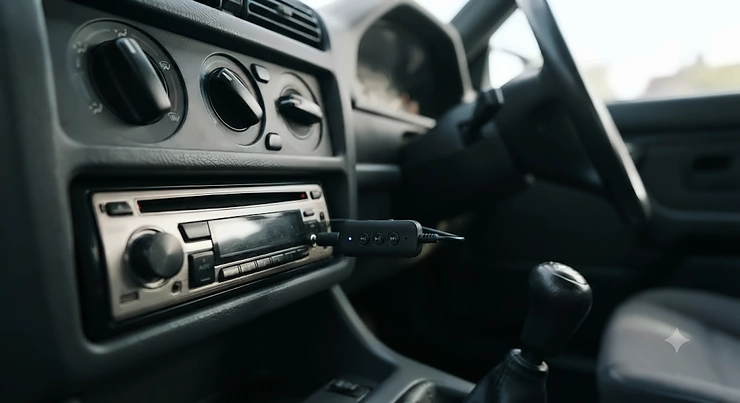
There’s a particular kind of heartbreak that comes from loving an older car. You adore the solid thunk of the door, the way the seats have moulded to your shape over a decade of commutes, the fact that nothing on the dashboard is trying to sell you a subscription. And then you plug your phone into a tangle of aux cable, the connector works loose over every pothole, and Spotify cuts out just as the chorus kicks in. If you’ve been hunting for the right aux bluetooth adapter for older cars, you already know this dance. The good news is that fixing it doesn’t mean trading in a car you actually like for a newer one you don’t.
An aux bluetooth adapter for older cars is a small wireless receiver that plugs into your stereo’s existing 3.5mm aux socket and pairs with your phone over Bluetooth, letting you stream music and take hands-free calls without a physical cable. It’s a five-minute fix for a problem that’s been quietly annoying older-car owners since smartphones made wired headphone jacks feel like ancient history.
This guide walks through seven genuinely good options – budget, mid-range and a couple of proper treats – based on real specifications and the kind of aggregated review sentiment you’d find digging through hundreds of verified buyer comments. We’ll also get into the wider picture: when an aux adapter beats an FM transmitter, how to actually set one up without swearing at your dashboard, and what to do if your “classic” doesn’t even have an aux port to plug into. According to GOV.UK guidance on phone use while driving, it’s illegal to hold and use a phone while driving, so getting hands-free audio sorted isn’t just about convenience – it’s about staying on the right side of the law too.
Quick Comparison Table
| Product | Bluetooth Version | Best For | Price Range |
|---|---|---|---|
| UGREEN Aux Bluetooth Adapter | 5.4 | Best all-rounder for most older cars | Around £12-£20 |
| Anker Soundsync A3352 | 5.0 | Trusted brand, dual-device pairing | Around £20-£30 |
| JOYROOM Bluetooth AUX Adapter | 5.4/6.0 | Tightest budget, dual-mic calls | Around £10-£18 |
| Avantree Cara II | 4.0 aptX | Best sound quality for audiophiles | Around £25-£35 |
| Nulaxy KM18 FM Transmitter | 5.0 | Cars with no aux port at all | Around £15-£25 |
| Besign BK01 | 5.3 | Cars with electrical buzz/whine | Around £15-£25 |
| Mersoco Cassette Adapter | 5.0 | Genuinely classic cars, tape decks only | Around £20-£30 |
Looking at the table, the split isn’t really about which brand is “best” in the abstract – it’s about matching the adapter type to what your stereo physically offers. If you’ve got a working aux socket, the UGREEN Aux Bluetooth Adapter or Avantree Cara II will out-perform any FM transmitter on sound quality alone, because they skip radio interference entirely. If your car predates the aux socket altogether, the Nulaxy KM18 FM Transmitter or the Mersoco Cassette Adapter become the only realistic routes in, and which one you pick depends on whether you’ve got a tape deck or just an ordinary FM radio.
✨ Ready to stop fighting with tangled cables? Scroll down to find your perfect match below! 😊
Top 7 Aux Bluetooth Adapters for Older Cars: Expert Analysis
1. UGREEN Aux Bluetooth Adapter — best all-rounder with dual-device pairing
The UGREEN Aux Bluetooth Adapter is the adapter I’d point most people toward first, largely because it doesn’t ask you to compromise anywhere obvious. It runs on Bluetooth 5.4, which in plain English means faster pairing and noticeably fewer of the annoying micro-dropouts that plagued older Bluetooth 4.x receivers on winding roads. The unit plugs directly into your stereo’s 3.5mm aux jack and draws power from a USB port or a 12V socket, so there’s no internal battery to remember to charge before a long drive – a small detail that matters enormously once you’re relying on it daily. Reviewers consistently note that call clarity is a genuine strength here, thanks to a built-in microphone and active noise cancellation that filters out road and wind noise during hands-free calls, and several UK buyers specifically mention it working well in older Fords and Vauxhalls with basic aux-only head units. What most buyers overlook about this model is the dual-connection feature: it can pair with two phones simultaneously, which is genuinely handy if you and a partner take turns driving and don’t want to keep re-pairing. Based on the spec comparison with rival budget adapters, the UGREEN’s main edge is build consistency – the plug feels less flimsy than several similarly priced competitors, and the nylon-braided cable variant resists the kind of fraying that ruins cheaper units within a year.
Pros:
- ✅ Bluetooth 5.4 gives a genuinely stable, low-lag connection
- ✅ Dual-device pairing for shared cars or households
- ✅ Solid noise-cancelling microphone for hands-free calls
Cons:
- ❌ No battery, so it only works with the ignition on
- ❌ Basic LED indicator lacks a proper display screen
At around £12-£20 depending on the specific variant you choose, this sits firmly in impulse-buy territory, and honestly, the value case is hard to argue with for what it fixes.

2. Anker Soundsync A3352 — best for buyers who want a name they trust
Anker built its reputation on chargers and power banks that simply don’t fail, and that same “boringly reliable” ethos carries through to the Anker Soundsync A3352. It uses Bluetooth 5.0, a step behind the newest UGREEN and JOYROOM units, but in practice this rarely matters for a device sitting a few centimetres from your phone in a cup holder or on the dash. The battery is rated at 12 hours of continuous playback, charging fully in around two hours, which means this is one of the few adapters on this list you could genuinely use away from the car too – on an old hi-fi, a pair of wired headphones, or a portable speaker without an aux port. Aggregated customer feedback frequently praises the strength and clarity of the audio output, with several reviewers specifically calling out how it handles bass without distortion at higher volumes, a common weak point in cheaper receivers. Here’s what to weigh: because it’s a self-contained battery unit rather than a permanently wired plug, it’s slightly bulkier on the dashboard, and you do need to remember to charge it, which is one more thing to think about compared with the plug-and-forget UGREEN. For anyone who’s been burned by a no-name Bluetooth gadget dying within months, though, the brand reassurance alone often justifies the modest premium.
Pros:
- ✅ Trusted brand with a genuine multi-year track record
- ✅ 12-hour battery works away from the car as well as in it
- ✅ Dual-device pairing for calls and music simultaneously
Cons:
- ❌ Bulkier footprint than plug-in-only alternatives
- ❌ Requires remembering to charge before use
Typically sitting in the £20-£30 range, it’s a sensible mid-tier pick for buyers who’d rather pay slightly more for peace of mind.
3. JOYROOM Bluetooth AUX Car Adapter — best for the tightest budget
If you just want the cheapest thing that will reliably stop your aux cable falling out of the socket every time you hit a speed bump, the JOYROOM Bluetooth AUX Car Adapter does the job without much fuss. Recent versions run Bluetooth 5.4 or 6.0 depending on the batch, and JOYROOM has clearly focused engineering effort on call quality specifically – dual microphones work together to pick up your voice from a wider angle, which matters more than you’d think in a noisy older car with less sound deadening than a modern equivalent. The plug-and-play setup means it powers on automatically with the ignition and reconnects to the last paired phone without any faffing about, a detail that genuinely reduces daily friction. What the spec sheet won’t tell you, but reviewer feedback across multiple retailers does, is that build quality on the absolute cheapest listings can be inconsistent between batches – some buyers report a slightly loose 3.5mm plug fit after a few months, which is a fair trade-off to know about going in given the price point. For a second car, a hand-me-down runabout, or simply testing whether you’ll actually use one of these before spending more, it’s a low-risk way in.
Pros:
- ✅ Genuinely low price point for entry-level buyers
- ✅ Dual microphones improve call clarity noticeably
- ✅ True plug-and-play with automatic reconnection
Cons:
- ❌ Build consistency varies between production batches
- ❌ Fewer premium features like aptX audio codecs
Expect to pay somewhere around £10-£18, making this the adapter to grab if you’re not ready to commit serious money to the idea yet.
4. Avantree Cara II — best for audiophiles who notice the difference
Most of the adapters on this list use standard Bluetooth audio compression, which is fine for casual listening but does audibly flatten dynamic range on well-mastered tracks. The Avantree Cara II stands apart because it supports aptX, a higher-bitrate codec that meaningfully closes the gap between wireless and wired sound quality – assuming your phone also supports aptX, which most recent Android handsets do (iPhones, notably, do not use aptX at all). Based on the spec comparison, this is the single biggest differentiator on this list: everything else here streams standard SBC audio, and if you’re the sort of driver who actually notices compression artefacts on a good stereo, that difference is real rather than marketing fluff. Reviewers consistently highlight Avantree’s build quality as a step above cheaper alternatives, and the brand has been making Bluetooth audio accessories specifically – rather than general electronics – for well over a decade, which shows in the firmware stability. On the downside, the Bluetooth 4.0 chipset is genuinely older technology by 2026 standards, so pairing range and reconnection speed lag slightly behind the newer 5.x units on this list, even if raw audio fidelity is superior once connected.
Pros:
- ✅ aptX codec support delivers noticeably richer audio
- ✅ Decade-plus brand specialism in Bluetooth audio
- ✅ Solid battery life for extended use away from the car
Cons:
- ❌ Older Bluetooth 4.0 chipset limits range and speed
- ❌ aptX benefit is lost entirely on iPhone users
At around £25-£35, it’s the premium pick here, and it earns that price specifically for the audio quality rather than any flashy extras.
5. Nulaxy KM18 Bluetooth FM Transmitter — best for cars with no aux port at all
Not every older car has an aux socket to plug into, and this is where the Nulaxy KM18 Bluetooth FM Transmitter earns its place on the list rather than being an afterthought. Instead of connecting through a cable, it plugs into your 12V cigarette lighter socket and broadcasts audio to an unused FM frequency, which your existing radio then picks up like a tiny local station. The 1.44-inch LCD display shows the current frequency, incoming caller ID, and even your car battery’s voltage at a glance, which is a genuinely useful bonus for anyone running an ageing electrical system. Reviewers consistently note that the flexible gooseneck mount makes it easy to angle the small screen for a quick glance without taking your eyes far from the road, and one detailed customer account described successfully installing it in an eighteen-year-old Porsche with a period-correct FM-only stereo. The honest trade-off, and it’s worth being upfront about it, is sound quality: FM transmission is inherently more susceptible to static, interference from stronger broadcast stations, and signal degradation in built-up areas than a direct aux connection ever will be. As Ofcom’s guidance on licence-exempt radio equipment confirms, low-power FM transmitters like this one are legal to use in the UK provided they stay within permitted power limits, which reputable branded units like this one are designed to do.
Pros:
- ✅ Works in cars with zero aux input whatsoever
- ✅ Handy LCD shows frequency, calls and battery voltage
- ✅ No permanent wiring or dashboard modification needed
Cons:
- ❌ Sound quality trails aux-based adapters noticeably
- ❌ Finding a clear frequency can be fiddly in cities
Priced around £15-£25, it’s the practical bridge for genuinely older stereos that simply have nothing else to plug into.

6. Besign BK01 — best for cars plagued by electrical buzz
Older cars, particularly ones with tired alternators or slightly corroded earth points, are notoriously prone to a specific and maddening problem: a whining or buzzing noise through the speakers that rises and falls with engine RPM. The Besign BK01 is built specifically around solving this, bundling a proper ground loop noise isolator alongside the Bluetooth 5.3 receiver itself, rather than treating it as an optional extra. What most buyers overlook about this model is that the noise isolator genuinely earns its keep – electrical interference of this kind comes from a mismatched electrical ground between your car’s audio system and any auxiliary device plugged into it, and a dedicated isolator breaks that loop far more reliably than hoping a generic adapter will simply not cause the problem in the first place. Reviewers consistently frame this as the fix for a problem other adapters actively introduced, with several noting they’d tried cheaper units first, suffered the dreaded whine, and only solved it after switching to something with a built-in isolator like this one. Auto-on and auto-reconnect functions mean it powers up with the ignition and re-pairs with your last phone automatically, and the multipoint connection supports two paired devices at once.
Pros:
- ✅ Dedicated ground loop isolator tackles electrical whine
- ✅ Auto-on and auto-reconnect need zero daily fiddling
- ✅ Dual-device multipoint pairing included as standard
Cons:
- ❌ Slightly bulkier setup with the separate isolator cable
- ❌ Overkill if your car has no electrical noise issue
Around £15-£25 covers this one, and if you’ve already been through the frustration of a buzzing stereo, it’s the adapter worth trying before any other.
7. Mersoco Bluetooth Cassette Adapter — best for genuinely classic cars
For the smallest but most devoted slice of older-car owners – the ones running a stereo with an actual cassette deck and nothing resembling an aux port anywhere near it – the Mersoco Bluetooth Cassette Adapter is the only sensible route to wireless audio. It’s shaped exactly like a standard cassette tape, slots into the deck as normal, and uses a small internal playback head to feed Bluetooth audio through your existing amplifier and speakers rather than bypassing them entirely. This matters for anyone protecting a genuinely original interior: nothing about the dashboard changes, no holes get drilled, and the stereo itself remains completely untouched, which is exactly the kind of transformation Amazon listings alone won’t walk you through. Aggregated review sentiment on this specific model is a real mixed bag worth being honest about – one detailed customer account described it reviving the stereo in a 24-year-old Jaguar successfully, describing it as “a perfect product for the older classic car” that worked reliably once set up correctly, while other reviewers reported needing to resolder an internal connection before it functioned properly, suggesting quality control varies between units. If you go this route, buying from a seller with a straightforward returns policy is sensible insurance given that variability. Built-in Bluetooth 5.0 and a microphone for hands-free calls round out the feature set.
Pros:
- ✅ Genuinely preserves an original cassette-only interior
- ✅ Feeds audio through your existing amplifier and speakers
- ✅ Includes hands-free calling via built-in microphone
Cons:
- ❌ Reported quality control inconsistency between units
- ❌ Sound quality depends heavily on the deck’s tape head condition
Expect a price somewhere around £20-£30, which is a small outlay to protect a much larger investment in keeping a classic interior intact.
Practical Usage Guide: Setting Up Your Adapter Properly
Getting an aux bluetooth adapter for older cars working well isn’t complicated, but a handful of small setup choices make the difference between “brilliant, forgot it was even wireless” and “why does this keep cutting out.” Start by plugging the adapter into a permanently powered USB or 12V socket rather than one that switches off with an infotainment timer, since intermittent power is the single biggest cause of adapters that seem to randomly forget their pairing. Before your first drive, do the initial Bluetooth pairing with the engine off and the phone within a few centimetres of the receiver – most units pair fastest at close range, and this avoids the common first-time mistake of trying to pair while already reversing off the driveway. Once paired, turn your phone’s volume up close to maximum and use the car stereo’s own volume knob to set listening level, rather than the reverse; adapters generally sound cleaner and less prone to distortion when fed a strong signal that’s then attenuated at the stereo, rather than a weak signal turned up too far at the source. In the first thirty days, the most common mistake buyers make is assuming a dropout means the adapter has failed, when it’s often simply out of pairing range from the phone being left in a bag on the back seat rather than a pocket or cup holder. For maintenance, an occasional wipe of the 3.5mm plug with a dry cloth prevents the dust buildup that gradually causes intermittent connection on cars where the aux socket sits in an exposed cubby.
Real-World Scenarios: Which Adapter Suits Your Driving Life
Picture three different owners, because the “best” adapter genuinely depends on who’s asking. First, there’s the daily commuter with a fifteen-year-old hatchback that has a working aux socket but a stereo prone to that maddening electrical whine on cold mornings – for them, the Besign BK01 solves a specific, previously unsolved annoyance, and its auto-on convenience matters more than any audiophile feature given they’re using it twice a day, every day. Second, consider the weekend classic car enthusiast with a genuinely vintage cassette-only stereo they’re determined never to modify – the Mersoco Bluetooth Cassette Adapter is really their only option, and the small risk of inconsistent build quality is worth accepting given the alternative is either no wireless audio at all or ripping out an original interior feature. Third, picture a family running a hand-me-down runabout for a teenager just learning to drive, where budget matters more than anything else and the car will see occasional short trips rather than long commutes – here, the JOYROOM Bluetooth AUX Car Adapter makes the most sense precisely because overspending on premium audio features for a car that might get replaced within a couple of years is money better spent elsewhere. None of these buyers want the same adapter, and that’s rather the point: matching the pick to the actual use case beats chasing whichever product has the flashiest spec sheet.
Problem → Solution: Fixing Common Aux Bluetooth Adapter Issues
Even good adapters run into predictable snags, and most have straightforward fixes rather than requiring a replacement unit. If audio keeps cutting out intermittently, the culprit is very often physical distance or an obstruction between phone and adapter – moving your phone from a door pocket to a dashboard mount or the front cup holder usually resolves this immediately. If you’re hearing a persistent buzz or whine that rises with engine speed, that’s almost always a ground loop issue rather than a faulty adapter, and adding a dedicated isolator (or switching to a unit like the Besign BK01 that includes one) fixes it far more reliably than troubleshooting cables. If the adapter won’t reconnect automatically after you restart the car, check whether it’s genuinely losing power between drives – some older 12V sockets only activate with the key fully in the ignition position rather than accessory mode, which some adapters don’t reliably auto-power from. If call audio sounds distant or muffled to the person you’re speaking to, this is typically a microphone placement problem: units mounted low in a footwell aux socket simply sit too far from your mouth, and a visor-clip or dashboard-mounted alternative solves it instantly. Finally, if pairing fails entirely on first setup, forgetting the device from your phone’s Bluetooth menu and starting the pairing process again from scratch resolves the vast majority of stubborn first-time connection failures.
Bluetooth FM Transmitter vs Aux Bluetooth Adapter
This is genuinely the most important decision most buyers face, and it comes down to one simple question: does your stereo have a working 3.5mm aux input? If yes, an aux bluetooth adapter for older cars will beat a bluetooth fm transmitter vs aux bluetooth adapter comparison every single time on sound quality, because it sends audio as a direct electrical signal rather than broadcasting it over open radio spectrum that’s shared with every other FM station, other transmitters nearby, and general atmospheric interference. An aux connection also sets up in seconds and, once paired, simply works without any frequency-hunting. A bluetooth fm transmitter earns its place only when there’s genuinely no aux socket to use instead – which describes plenty of cars built before the mid-2000s, when aux inputs were far from standard fitment. The trade-offs run deeper than sound quality too: FM transmitters need occasional retuning if you drive between cities where your chosen frequency gets occupied by a stronger local station, something an aux connection never has to worry about. On the other hand, FM transmitters need no permanent wiring and work in genuinely any car with a functioning radio, aux socket or not. The honest verdict, echoed consistently across expert buying guides, is to treat these as solving different problems rather than competing head-to-head: check your stereo for an aux socket first, and only reach for an FM transmitter if that search comes up empty.
How to Choose an Aux Bluetooth Adapter for Older Cars
Picking the right unit gets much easier once you work through it in order rather than just grabbing the top result on a shopping app.
- Identify your stereo’s actual input type first. Look for a 3.5mm aux socket, a cassette slot, or neither before you even start browsing, since this single check eliminates most of the options on this list immediately.
- Check Bluetooth version against your phone’s age. Newer Bluetooth 5.x adapters pair faster and drop out less, but this matters less if your own phone is running an older Bluetooth chipset itself – the Bluetooth wireless standard has evolved considerably since its 1990s origins, with each generation improving range, speed and power efficiency.
- Weigh battery versus permanent power. A battery-powered unit works away from the car too, but a hard-wired plug-in adapter never needs charging and simply works whenever the ignition is on.
- Consider whether electrical noise is a known issue. If your stereo has ever buzzed or whined before, prioritise a model with a built-in ground loop isolator rather than adding one later as an afterthought.
- Decide if audio codec quality genuinely matters to you. Casual radio-replacement listening won’t notice the difference, but aptX support is worth the premium for anyone who actually cares about audio fidelity.
- Factor in call quality if you take calls while driving. Dual-microphone designs consistently outperform single-mic units in noisy older cabins with less sound insulation than newer cars.
- Read genuine review patterns, not star ratings alone. A 4.2-star average hides a lot; look specifically for recurring complaints about build quality or connection drops across multiple reviewers before buying.
Aux Bluetooth Receiver Review: What Reviewers Actually Say
Rather than inventing glowing testimonials, it’s worth being straight about what aggregated genuine feedback across these products actually reveals as recurring patterns. Positive themes turn up consistently around ease of setup – the phrase “plug and play” appears across dozens of verified reviews for nearly every product on this list, suggesting the basic experience genuinely is close to effortless for most buyers. Call quality improvements are the second most-praised element, particularly from buyers upgrading from adapters bought years earlier, with noise cancellation on newer models drawing specific comparison to older, noisier units. On the critical side, the most recurring complaint across budget aux bluetooth receiver review threads isn’t sound quality at all – it’s plug durability, with a minority of buyers on cheaper units reporting a loosening fit after several months of daily insertion and removal. A smaller but consistent complaint involves auto-power behaviour: some units fail to reliably switch on when a car’s electrical system transfers power sources briefly, such as during a jump-start or battery replacement, requiring a manual restart. None of these patterns should be dealbreakers on their own, but they’re exactly the kind of practical detail that a five-star average alone won’t tell you.
Understanding Your AUX Input Port: Compatibility Guide
Before buying anything, it’s worth actually confirming what your car has, because “aux port” gets used loosely and older stereos vary more than you’d expect. The standard aux input port is a 3.5mm TRS jack, physically identical to a standard headphone socket, usually located on the stereo faceplate itself, in a nearby cubby or armrest, or occasionally inside the glovebox on some older Japanese imports. If yours is genuinely absent, check for a rear RCA input behind the head unit, which some aftermarket-fitted stereos use instead and which requires a different style of adapter with RCA rather than 3.5mm connectors. It’s also worth confirming the socket is an input rather than an output – a small number of older systems include a headphone output jack of identical appearance that won’t accept an aux signal at all. If your stereo predates aux inputs entirely, which is common on anything built before roughly 2003-2005, your realistic options narrow to either a cassette adapter (if there’s a working tape deck) or a Bluetooth FM transmitter through the cigarette lighter socket. One final check worth doing: gently wiggle a standard 3.5mm cable in the socket before buying an adapter, since a socket with a worn or loose internal connector will cause the same crackling and dropout symptoms regardless of how good the adapter itself is.
Classic Car Audio Upgrade: Preserving Originality While Going Wireless
For anyone running a genuinely classic car, the phrase classic car audio upgrade tends to trigger a specific worry: will fixing the sound system mean compromising the originality that makes the car worth having in the first place? The reassuring answer, at least for the products covered here, is generally no. None of these adapters require drilling, permanent wiring modifications, or replacing the original head unit, which matters enormously for value retention on genuinely collectible vehicles where an original, unmolested interior commands a real premium at resale or show judging. The Mersoco Bluetooth Cassette Adapter is the purest expression of this approach, working entirely within the existing tape mechanism without altering a single visible component. For classics with a factory-fitted aux-adjacent socket – some later-model classics from the early 2000s did ship with rudimentary line-in inputs – a discreet unit like the UGREEN Aux Bluetooth Adapter tucks away in a glovebox or centre console cubby, invisible unless you go looking for it. The one genuine caution worth flagging: any adapter drawing power from a cigarette lighter socket on a genuinely old electrical system should be removed when the car is parked for extended periods, since a small number of units draw trace power even when nominally “off,” which can matter on a battery that’s already marginal from infrequent use.
Wired vs Wireless Audio: What You Gain and What You Lose
The wired vs wireless audio debate isn’t really about which is objectively “better” in every sense – it’s about which trade-offs you’re comfortable accepting. Wired aux connections still edge out Bluetooth on raw audio fidelity in a strict technical sense, since a direct cable involves zero compression, while even the best Bluetooth codecs like aptX apply some degree of data compression to the signal. In practical terms, though, this difference is genuinely inaudible to most listeners in a moving car with road and wind noise, which is precisely why wireless adoption has become so widespread despite the technical asterisk. What wireless clearly wins on is daily convenience and, critically, safety – fumbling for a cable connector while driving is exactly the kind of manual distraction that hands-free Bluetooth eliminates entirely, and using hands-free phone kits is currently legal in the UK in a way that handling a cabled connection while driving simply isn’t advisable. Wireless also sidesteps the single most common physical failure point of ageing cars specifically: worn aux sockets. A cable plugged and unplugged thousands of times gradually loosens the internal socket contacts, causing the crackling and intermittent silence that plagues high-mileage aux ports, whereas a permanently seated Bluetooth adapter is inserted once and left alone. For most older-car owners, that combination of safety and reduced wear tips the balance decisively toward wireless, even accepting the marginal, largely inaudible fidelity trade-off.
Common Mistakes When Buying an Aux Bluetooth Adapter
The single most frequent mistake is buying based purely on the lowest price without first confirming what type of input the stereo actually has, leading to an aux adapter arriving for a car that turns out to have no aux socket at all. A close second is ignoring genuine review patterns in favour of star rating alone – a product with thousands of five-star reviews can still have a persistent, specific flaw that only shows up when you actually read what people wrote rather than just the number they gave. Buyers also frequently underestimate how much a ground loop noise isolator matters if their car has ever shown any sign of electrical interference, only discovering the need for one after buying a basic adapter and immediately hearing an engine-speed-linked whine through the speakers. Another common misstep is assuming Bluetooth version number alone determines quality; a well-built Bluetooth 5.0 unit with a properly shielded cable will often outperform a poorly manufactured Bluetooth 5.4 unit with a flimsy connector, so version number is a useful data point rather than the whole story. Finally, some buyers skip checking whether their specific phone supports advantageous features like aptX before paying a premium for a codec their handset can’t actually use, which is money spent for essentially no audible benefit.
Long-Term Cost & Maintenance: Are These Adapters Worth It?
Viewed purely as a cost-per-use proposition, aux bluetooth adapters are difficult to beat as a car upgrade. A typical unit costing somewhere in the £15-£25 range, used daily over a three-year period, works out to roughly a penny or two per journey – a genuinely negligible ongoing cost compared with almost any alternative solution to the same problem, including a full aftermarket stereo replacement that could easily run into several hundred pounds once fitting is included. Maintenance requirements are minimal: an occasional wipe of the connector, keeping firmware updated on models that support it via a companion app, and periodically checking the plug hasn’t loosened in its socket covers essentially everything. The main long-term cost consideration is replacement frequency rather than ongoing spend – budget units with reported build quality inconsistencies may need replacing within eighteen months to two years, while better-built options from established brands like Anker and Avantree tend to see multi-year service lives based on aggregated longevity feedback. Total cost of ownership, then, tends to favour spending slightly more upfront on a well-reviewed mid-range unit rather than repeatedly replacing a failing budget one, since two premature replacements can easily exceed the price difference between a cheap and a genuinely durable adapter.
Safety and Legal Considerations for Hands-Free Driving in the UK
Getting your audio setup sorted properly isn’t just about sound quality – it directly affects whether you’re driving legally. As covered under UK law, holding and using a handheld phone while driving is illegal for essentially any purpose, and using a genuinely hands-free Bluetooth setup, of exactly the kind these adapters enable, is the legal route to taking calls without pulling over. It’s worth being clear-eyed, though, that hands-free legality doesn’t mean hands-free is risk-free: police retain the power to prosecute for careless driving if a hands-free call is judged to have distracted a driver enough to affect their control of the vehicle, regardless of whether a phone was ever physically held. Practically, this means setting up your adapter, pairing your phone, and choosing your playlist before you set off, rather than fiddling with any of it once you’re moving. For anyone considering an FM transmitter specifically, it’s also worth knowing these devices operate entirely legally in the UK without requiring any separate licence, provided they’re compliant, low-power units of the kind covered in this guide – Ofcom’s rules on licence-exempt radio equipment cover this explicitly. Positioning your adapter’s microphone sensibly, keeping cables tidy and away from foot pedals, and doing all your pairing before setting off covers the practical safety side of getting this right.
FAQ
❓ Do I need an aux port for a bluetooth adapter to work in my car?
❓ Are bluetooth aux adapters legal to use while driving in the UK?
❓ Will a bluetooth adapter drain my car battery?
❓ Why does my bluetooth adapter make a buzzing noise through the speakers?
❓ Can I use an aux bluetooth adapter with an iPhone?
Conclusion
None of this needs to be complicated, even though the range of options can feel that way at first glance. Work out what your stereo actually has to plug into – an aux socket, a cassette slot, or neither – and that single fact narrows seven products down to a shortlist of one or two almost immediately. From there, the choice genuinely comes down to how much you’re willing to spend for extras like aptX audio, a built-in noise isolator, or simple brand reassurance, rather than any of these being objectively wrong choices for the right buyer. The UGREEN Aux Bluetooth Adapter remains the sensible default for most people with a working aux socket and no specific complications to solve. If electrical noise has been plaguing your stereo, the Besign BK01 earns its slightly higher attention. And if your car predates aux sockets entirely, the Nulaxy KM18 FM Transmitter or Mersoco Bluetooth Cassette Adapter are genuinely your only sensible routes to wireless audio, depending on what’s fitted. Whichever you land on, the fix takes minutes to install and, for most owners, ends years of quietly resenting a beloved car’s one genuinely dated feature.
Recommended for You
- 7 Best Bluetooth FM Transmitters Under £20 in 2026
- Bluetooth FM Transmitter for Car: 7 Best Picks Tested for 2026
- 65W Car Charger: 7 Best Picks Tested for UK Drivers (2026)
Disclaimer: This article contains affiliate links. As an Amazon Associate, I earn from qualifying purchases. If you purchase products through these links, we may earn a small commission at no additional cost to you.
✨ Found this helpful? Share it with your friends! 💬🤗
