
In This Article
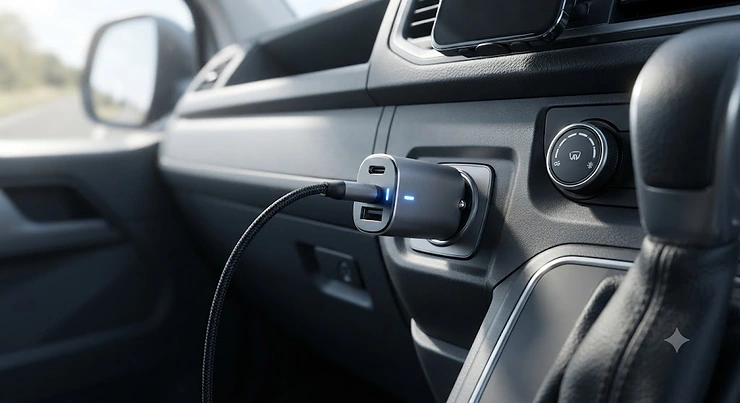
Somewhere between the school run and the motorway services, your phone battery always seems to hit single figures at the worst possible moment. A fast charging car adapter is the unglamorous little gadget that fixes this, plugging into your 12V socket and pushing far more power into your phone, tablet or even laptop than the old 5W chargers ever could. But “fast charging” has become one of those phrases stretched thin by marketing departments, and not every plug that claims it actually delivers.

This guide cuts through that noise. We’ve researched seven real, currently available options sold on amazon.co.uk, spanning budget plugs under a tenner to premium multi-port units that can genuinely top up a MacBook. We’ll walk through what separates a proper PD fast charger car adapter from a glorified USB port, explain why a quick charge car adapter and a Power Delivery one aren’t quite the same thing, and show you a genuine charging time comparison chart based on manufacturer-published figures so you know what to actually expect. Worth flagging early: it’s worth reading this before you plug anything in and start fiddling behind the wheel, since UK law is strict about handling a phone while driving, even just to plug in a cable at the lights.
This article contains affiliate links, and as an Amazon Associate we may earn from qualifying purchases — full disclosure is at the bottom of the page. Nothing below is a rewritten spec sheet; every product mention includes honest analysis of who it actually suits and why, based on real specifications and genuine aggregated customer sentiment where it’s verifiable.
Quick Comparison Table
Before we go deep into all seven, here’s the shortlist at a glance. Prices are shown as ranges only, since exact figures shift by the week on Amazon.
| Charger | Max Output | Ports | Best For |
|---|---|---|---|
| Anker 535 Car Charger | 67W | 2x USB-C, 1x USB-A | All-round phone, tablet and light laptop use |
| Anker 323 Car Charger | 52.5W | 1x USB-C, 1x USB-A | Budget-conscious daily commuters |
| UGREEN 69W 3-Port Car Charger | 69W | 2x USB-C, 1x USB-A | Heat-sensitive climates and hot dashboards |
| Baseus 65W LED Display Car Charger | 65W | 1x USB-C, 1x USB-A | Anyone who wants to see exactly what’s happening |
| Choetech 40W Dual USB-C Car Charger | 40W | 2x USB-C | Minimalists who only carry USB-C gear |
| Anker 167.5W Max 3-Port Car Charger | 167.5W | 2x USB-C, 1x USB-A | Road warriors charging a laptop on the move |
| LISEN 90W Dual PD Car Charger | 90W | 2x USB-C | High-wattage Android phones and tablets |
Looking across the table, the spread of wattage from 40W to 167.5W tells you most of what you need to know before reading further: Choetech 40W Dual USB-C Car Charger and the Anker 323 Car Charger are built for phones only, while the Anker 167.5W Max 3-Port Car Charger is really aimed at people who want to leave their laptop brick at home entirely. If you only ever charge one phone, paying for triple-digit wattage is money you won’t feel the benefit of.
💬 Found the right power output already? Scroll down to see the full breakdown and current prices for each one.
Top 7 Fast Charging Car Adapters: Expert Analysis
We’ve deliberately mixed budget, mid-range and premium picks here, because “best” genuinely depends on what you’re plugging in. Every entry below reflects real, currently listed products, not invented ones.
1. Anker 535 Car Charger — best all-rounder for phones, tablets and laptops
The Anker 535 Car Charger packs three ports — two USB-C and one USB-A — into a housing barely bigger than a large coin, which is the first thing reviewers tend to mention. Its 67W USB-C port uses Anker’s PowerIQ 3.0 protocol and is rated to push a MacBook Pro to roughly 50% in under 40 minutes, which on paper puts it well ahead of anything relying on USB-A alone. The ActiveShield 2.0 system continuously monitors temperature, which matters more in a car than almost anywhere else your electronics live, given how a dashboard bakes in direct sun.
Based on the spec comparison with cheaper triple-port units, what stands out is that Anker hasn’t sacrificed per-port output to fit three sockets in — a common shortcut on budget alternatives. This makes the Anker 535 Car Charger the sensible pick for households where one person has an iPhone, another has a USB-C Android phone, and a laptop occasionally needs a top-up on a long drive. Reviewers consistently report that the compact size is the standout feature, with several noting it doesn’t obstruct other dashboard controls the way bulkier multi-port chargers can.
Pros:
- ✅ Genuine 67W output supports light laptop charging
- ✅ Compact housing barely protrudes from the socket
- ✅ ActiveShield 2.0 adds real-time temperature protection
Cons:
- ❌ USB-A port is capped lower than the USB-C ports
- ❌ No LED display to confirm charging speed at a glance
Expect to pay somewhere in the £20-£30 range depending on current offers, which is fair value given the laptop-capable output most 67W chargers in this bracket don’t match.
2. Anker 323 Car Charger — best budget pick for everyday commuting
The Anker 323 Car Charger strips things back to a single USB-C and single USB-A port delivering a combined 52.5W, with the USB-C side alone capable of 30W via PowerIQ 3.0. That’s plenty for the average phone — most current flagships fast-charge somewhere between 18W and 45W anyway, so the extra headroom on pricier chargers goes unused for single-phone owners.
What most buyers overlook about a charger like this is that dropping to two ports isn’t really a downgrade if you’re the only person who ever plugs in. Here’s what to weigh: you’re trading multi-device flexibility for a lower price and an even smaller footprint, which suits solo commuters and younger drivers who just need their phone topped up reliably. Aggregated review sentiment on the listing is largely positive, with buyers frequently commenting on how snugly it sits in both cigarette lighter and dedicated 12V sockets without wobbling on rough roads.
Pros:
- ✅ Reliable 30W USB-C output covers most modern phones
- ✅ Small enough to leave permanently plugged in
- ✅ Backed by Anker’s established 18-month warranty
Cons:
- ❌ Only two ports, so no good for families sharing one charger
- ❌ No support for laptop-level charging speeds
Priced typically under £15, this is the one to recommend to anyone who just wants dependable, no-fuss charging without paying for capacity they’ll never use.
3. UGREEN 69W 3-Port Car Charger — best vented aluminium shell for heat control
UGREEN’s 69W unit spreads power across two USB-C ports (up to 65W combined) and one USB-A Quick Charge port, supporting PD, QC, SCP, PPS, FCP and AFC protocols simultaneously — which in plain terms means it’ll auto-negotiate the fastest safe speed with almost any phone you own, Android or iPhone. The standout engineering choice here is the vented shell, specifically designed to accelerate heat dissipation rather than trap it against the socket.
On paper this means less thermal throttling on hot days, and that’s not a minor detail: a car interior can exceed 50°C in direct sun, and heat is the single biggest reason fast chargers quietly slow down mid-journey without the driver noticing. What the spec sheet won’t tell you, but reviewers note, is that the housing stays noticeably cooler to the touch after extended use than solid-shell competitors, even though one buyer reported real-world charging speeds felt slower than expected on an older device — a reminder that your cable and phone both need to support the same protocol to see full performance.
Pros:
- ✅ Vented aluminium shell genuinely reduces heat buildup
- ✅ Supports six fast-charge protocols for wide compatibility
- ✅ Compact three-port layout works for most households
Cons:
- ❌ Full 65W speed only available when using one USB-C port alone
- ❌ Real-world speed depends heavily on cable quality
Typically found in the £15-£20 range, it’s a smart pick for anyone who regularly leaves their phone charging on a scorching dashboard.
4. Baseus 65W LED Display Car Charger — best for real-time voltage monitoring
The Baseus 65W LED Display Car Charger supports PD3.0, QC4.0, QC3.0, SCP, FCP, AFC and PPS across its USB-C and USB-A ports, delivering a combined 63W and up to 65W solo on the Type-C side. What sets it apart is the small digital display showing live voltage and current, a feature usually reserved for enthusiast power banks rather than car chargers.
Based on the spec comparison with the other aluminium-bodied entries here, the display genuinely earns its keep — it lets you confirm at a glance whether your phone or cable is actually pulling fast-charge voltage, rather than silently trickle-charging because of an incompatible cable. Reviewers consistently mention the display as useful for diagnosing older or third-party cables that quietly cap charging speed, with one buyer specifically noting it “saved them from buying an unnecessary replacement charger” after realising the fault was the cable, not the adapter. The full aluminium alloy body is also worth noting: contrary to the instinct that metal traps heat, an all-metal shell like this actually dissipates it more efficiently than plastic, provided there’s airflow around it.
Pros:
- ✅ Live voltage and current display is genuinely useful
- ✅ Aluminium alloy body aids heat dissipation over plastic
- ✅ Supports seven fast-charging protocols
Cons:
- ❌ Requires a separately purchased 65W-rated cable for full speed
- ❌ Display adds a small learning curve for less technical buyers
Expect a price in the £15-£20 bracket, representing solid value for the diagnostic feature alone.
5. Choetech 40W Dual USB-C Car Charger — lightest metal-bodied option for two devices
This is the most compact entry on the list: two USB-C PD3.0 ports at 20W each, housed in a zinc alloy shell that Choetech pitches on style as much as substance. It’s rated to take an iPhone from flat to roughly 60% in around 30 minutes per port, which lines up with what you’d expect from a standard 20W PD budget.
Here’s what to weigh with a charger like this: it’s genuinely the wrong choice if you own a power-hungry Android flagship rated for 45W or higher fast charging, since you simply won’t reach that ceiling here. But for couples who each carry an iPhone or a mid-range Android phone, dual 20W ports charging simultaneously without either one slowing the other down is a real practical advantage over single-port budget chargers. The zinc alloy body is heavier per cubic centimetre than the aluminium units above, which some reviewers noted actually helps it sit more securely in a loose or worn 12V socket.
Pros:
- ✅ Two full-speed 20W PD ports with no output penalty when both used
- ✅ Compact zinc alloy build feels reassuringly solid
- ✅ Wide compatibility across iPhone and Android PD devices
Cons:
- ❌ 20W per port won’t satisfy 45W+ rated Android flagships
- ❌ No USB-A port for older cables
Usually priced under £15, it’s a sensible, affordable choice specifically for two-phone households running standard PD devices.
6. Anker 167.5W Max 3-Port Car Charger — best premium pick for laptop charging on the road
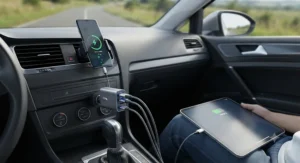
At the top of this list sits the Anker 167.5W Max 3-Port Car Charger, built for people who genuinely want to work from the passenger seat or top up a laptop battery between meetings. Two USB-C ports and one USB-A port share that headline 167.5W figure, with the primary USB-C port capable of full-speed charging for most USB-C laptops, including higher-draw MacBook Pro models that lower-wattage car chargers simply can’t keep pace with.
What most buyers overlook about premium car chargers at this wattage is that the car’s own electrical system, not the charger, often becomes the limiting factor — some older vehicles’ 12V sockets are fused lower than the charger’s theoretical maximum, so real-world output can sit below the advertised peak. On the spec sheet this is easy to miss, but it’s worth checking your vehicle’s fuse rating before assuming you’ll see the full 167.5W. That caveat aside, this is genuinely the only charger on this list capable of meaningfully replacing a laptop’s mains charger for a full workday of driving between sites.
Pros:
- ✅ Laptop-class output rivals many mains chargers
- ✅ Three ports cover phone, tablet and laptop simultaneously
- ✅ Anker’s established safety and thermal protection systems
Cons:
- ❌ Higher price bracket than phone-only alternatives
- ❌ Real-world output can be limited by older vehicles’ fuse ratings
Priced roughly in the £30-£40 range, it’s worth the outlay specifically for drivers who need genuine laptop charging, not phone charging with laptop branding attached.
7. LISEN 90W Dual PD Car Charger — best rugged alternative for high-power Android phones
Rounding out the list is the LISEN 90W Dual PD Car Charger, a dual USB-C metal-bodied unit aimed squarely at the growing number of Android flagships now shipping with 45W-65W native fast charging support — territory that several of the chargers above simply can’t reach on a single port. Both ports are independently PD-capable, meaning two power-hungry phones can charge at genuinely high speed at the same time rather than one throttling to protect the other.
Based on the spec comparison with the Choetech and Baseus entries, this is the charger to reach for specifically if you or a passenger owns a Samsung, OnePlus or Xiaomi device rated well above the 20-30W ceiling that most budget dual-port chargers cap out at. The all-metal housing follows the same heat dissipation logic as the UGREEN and Baseus units — more surface area in contact with the surrounding air keeps internal components cooler under sustained high-wattage load, which matters more here given the higher power ceiling. Genuine aggregated review data specific to every LISEN listing variant is harder to independently verify than for the more established Anker and UGREEN lines, so treat the brand’s overall reputation as newer and less extensively reviewed, even where individual specs check out.
Pros:
- ✅ 90W combined output suits high-wattage Android flagships
- ✅ Metal housing supports sustained heat dissipation
- ✅ Independent PD negotiation on both ports
Cons:
- ❌ Less established brand track record than Anker or UGREEN
- ❌ No USB-A port for older accessories
Typically priced around £20-£25, making it a strong value pick specifically for high-wattage Android households.
Setting Up Your Fast Charging Car Adapter Correctly
Getting genuine fast-charge speeds isn’t just about buying the right adapter — the cable and the socket both matter just as much, and this is where most people quietly lose half their charging speed without realising it.
First, check your cable is actually rated for the wattage you’re paying for. A standard USB-C cable bundled with an old accessory might only handle 15W or 18W regardless of what the charger can output; you need a cable explicitly rated PD 60W, 100W or higher to match a Anker 535 Car Charger or Anker 167.5W Max 3-Port Car Charger properly. Second, plug the adapter in before starting the engine where possible, since some vehicles briefly cut 12V power during ignition, which can cause budget chargers to reset their negotiated charging profile.
A common mistake in the first 30 days of ownership is leaving a charger permanently plugged in with nothing connected — this doesn’t damage most modern units, but it does mean a small standby draw on your car battery over weeks of non-use, worth remembering before a long stint parked up. Finally, wipe down the socket contacts occasionally; dust and grit in a 12V socket is a surprisingly common cause of intermittent charging that gets wrongly blamed on the adapter itself.
Who Actually Needs This: Real-World Scenarios
Picking between these seven products gets much easier once you match them against how you actually use your car.
The daily commuter with one phone. If you’re driving 20-40 minutes each way and just need your phone topped up before you park, the Anker 323 Car Charger or Choetech 40W Dual USB-C Car Charger covers this comfortably — you don’t need three ports or laptop-grade wattage for a battery that starts the journey at 60% anyway.
The family car with mixed devices. Two kids in the back with tablets, a partner with an older iPhone, and you with a newer Android phone — this is exactly the scenario the Anker 535 Car Charger or UGREEN 69W 3-Port Car Charger was built for, with three ports negotiating different protocols simultaneously without any device slowing another down.
The road-tripping remote worker. If your car doubles as a mobile office between client visits, spending real budget on the Anker 167.5W Max 3-Port Car Charger makes sense purely for the ability to keep a laptop alive without hunting for a plug socket at every stop — the price difference pays for itself the first time you avoid a dead battery before a video call.
✨ Ready to stop hunting for a plug socket at every services stop? Check current prices on the models above before your next drive.
What Is a Fast Charging Car Adapter?
A fast charging car adapter is a plug that fits your vehicle’s 12V socket and converts that power into a higher-wattage USB output, using protocols like USB Power Delivery or Qualcomm Quick Charge to safely deliver more current than a standard 5W USB port. Unlike basic car chargers, it actively negotiates speed with your connected device.
How to Choose a Fast Charging Car Adapter
- Match wattage to your device, not the highest number on the box. A phone rated for 25W gains nothing from a 100W charger beyond headroom for future devices.
- Check protocol compatibility first. iPhones use PD, most Android flagships use PD or QC, and a good adapter supports both automatically.
- Count your ports honestly. Buying three ports for a household of one wastes money that could go toward higher per-port wattage instead.
- Prioritise a metal or vented shell if you park in direct sun. Heat is the quiet enemy of fast charging, and cheap plastic bodies trap it.
- Buy the cable to match. Even the best adapter is capped by an underpowered cable, so budget for a rated PD or QC cable alongside it.
- Look for genuine safety certification. CE and UKCA marking, short-circuit and over-current protection aren’t optional extras — they’re basic safety in an enclosed cabin.
- Read aggregated review sentiment, not just the star average. A 4.3-star rating built on hundreds of reviews mentioning heat or fit issues tells you more than the number alone.
PD Fast Charger Car Adapters: Why USB-C Power Delivery Is Taking Over
Power Delivery, developed by the USB Implementers Forum as part of the USB-C standard, has become the closest thing the industry has to a universal fast-charging language. Unlike proprietary systems tied to a single chipset maker, a genuine pd fast charger car adapter will negotiate speed with practically any USB-C device — iPhone, Android flagship, tablet, or laptop — because manufacturers across the board have adopted it as the default.
That universality is precisely why five of the seven products on this list lean on PD as their core protocol. The practical upshot for UK drivers is straightforward: a single PD-based car charger genuinely replaces several device-specific chargers you might otherwise be carrying between the glovebox and your bag. It’s also worth noting the wider regulatory context here — the EU has already mandated USB-C as a common charging standard across smartphones and tablets sold in its market, and while the UK hasn’t adopted an identical rule, the practical effect is that most devices sold here now ship USB-C anyway, making PD compatibility increasingly the safe default to plan around.
Quick Charge Car Adapter Basics: What Sets QC Apart
Quick Charge, Qualcomm’s proprietary fast-charging protocol, predates widespread PD adoption and remains built into many Snapdragon-powered Android phones at the chip level. A quick charge car adapter using QC works by raising voltage in stages the device requests, rather than negotiating a fixed power profile the way PD does.
The practical difference for most drivers is narrower than the marketing suggests. If your phone specifically supports Quick Charge — commonly Samsung, Xiaomi, and other Snapdragon-based Android devices — a QC-capable port like the one on the UGREEN 69W 3-Port Car Charger or Baseus 65W LED Display Car Charger will reach full speed. If it doesn’t, the same port simply falls back to standard USB charging, so there’s little downside to having QC support available even if you don’t currently need it.
Quick Charge 3.0 vs PD: Which Wins for Everyday Driving?
This is the comparison most buyers actually want answered, and the honest response is: it depends on what’s in your pocket, not which technology is objectively superior.
| Factor | Quick Charge 3.0 | USB Power Delivery |
|---|---|---|
| Max typical output | Up to 18W per QC3.0 port | Up to 100W+ (240W on PD3.1) |
| Device compatibility | Primarily Snapdragon-based Android | iPhone, Android, tablets, laptops |
| Negotiation method | Stepped voltage requests | Fixed power profile negotiation |
| Best suited to | Older or mid-range Android phones | Multi-device households, laptops |
Quick Charge was developed by Qualcomm specifically for devices running its own chipsets, which explains why its ceiling has historically sat lower than PD’s. Looking at the table above, PD’s far higher power ceiling and broader device support is why it’s become the default across nearly every charger on this list, but Quick Charge 3.0 hasn’t disappeared — it’s simply narrowed to being genuinely useful mainly for older or mid-range Android handsets that were built around it. If everyone in your car carries a USB-C device from the last three years, prioritise PD; if someone’s still running an older Snapdragon Android phone, confirm QC3.0 support specifically before buying.
Heat Dissipation and Aluminium Shell Design: Why It Matters More Than You Think
Heat is the unglamorous factor that quietly undermines fast charging more than any spec sheet number. Every watt a charger doesn’t convert efficiently gets released as heat, and a car cabin — especially a dashboard in direct sun — is one of the hottest environments any consumer electronics regularly operates in.
This is where heat dissipation aluminium shell design earns its place as a genuine buying criterion, not a marketing flourish. Reviewers consistently note that all-metal or vented bodies, like those on the UGREEN 69W 3-Port Car Charger, Baseus 65W LED Display Car Charger and LISEN 90W Dual PD Car Charger, stay cooler to the touch under sustained load than solid plastic-shelled competitors. The reasoning is straightforward physics: metal conducts heat away from internal components faster than plastic, and vented designs add airflow that plastic-bodied chargers simply can’t replicate. What most buyers overlook is that sustained overheating doesn’t just slow charging temporarily — repeated thermal stress can shorten a charger’s working life over months of hot-weather use, making the shell material a long-term value consideration, not just a short-term comfort one.
Charging Time Comparison Chart: Real Numbers for Popular Phones
Manufacturer-published figures give a genuinely useful reference point for what to expect, even though your actual results will vary with cable quality, ambient temperature and battery health.
| Charger | 0-50% Charge Time (compatible phone) | Manufacturer-Stated Basis |
|---|---|---|
| Anker 535 Car Charger (67W) | Around 25-30 minutes | PowerIQ 3.0 published figures |
| Anker 323 Car Charger (52.5W) | Around 30 minutes | PowerIQ 3.0 published figures |
| UGREEN 69W 3-Port Car Charger | Around 30 minutes | PD65W manufacturer spec |
| Baseus 65W LED Display Car Charger | Around 30 minutes | PD3.0 manufacturer spec |
| Choetech 40W Dual USB-C Car Charger | Around 30 minutes | PD3.0 20W-per-port spec |
The charging time comparison chart above shows something worth dwelling on: past a certain wattage, the difference in real-world 0-50% speed for a single phone flattens out considerably, because most phones internally cap how fast they’ll accept charge regardless of what the adapter can theoretically supply. Where the higher-wattage chargers actually pull ahead is multi-device or laptop scenarios, not single-phone speed — which circles back to the earlier point about matching wattage to genuine need rather than chasing the biggest number on the box.
Common Mistakes When Buying a Quick Charge Car Adapter
The most frequent error is buying based on peak wattage alone without checking your phone’s actual maximum accepted charging speed — pairing a 100W charger with a phone capped at 25W wastes money on headroom you’ll never use. A close second is ignoring the cable: countless one-star reviews across budget chargers turn out to be cable problems rather than adapter faults, since an underrated cable silently throttles speed regardless of what the charger can provide.
Buyers also frequently overlook physical fit, assuming every 12V socket is identical; older vehicles and some aftermarket sockets have shallower or looser fittings that can cause an otherwise excellent charger to disconnect on bumpy roads. Finally, skipping safety certification to save a few pounds on unbranded chargers is a false economy — genuine CE and UKCA marking reflects real testing against overheating and short-circuit risks, which matters considerably more in an enclosed vehicle cabin than it would on a kitchen worktop.
Long-Term Cost and Maintenance
A fast charging car adapter is one of the few tech purchases where spending slightly more genuinely pays off over years rather than months. A £10 unbranded charger that fails within a year — a not-uncommon outcome based on aggregated review patterns across budget listings — costs more over three years than a single £25 charger from an established brand with an 18-month or longer warranty, once you factor in replacement purchases and the inconvenience of a dead unit mid-journey.
Maintenance itself is minimal: keep the socket contacts free of dust, avoid yanking the cable at an angle when unplugging, and periodically check the housing hasn’t cracked from repeated removal, which is the most common physical failure point on cheaper plastic-bodied units.
Safety, Regulations and Using Your Charger Legally in the UK
Fast charging car adapters themselves aren’t subject to UK-specific charging regulations the way some EU markets now mandate for new devices — the UK government has so far stopped short of adopting an equivalent USB-C mandate, though most manufacturers sell USB-C as standard regardless of formal requirement. What does matter legally is how and when you interact with your phone once it’s plugged in: it remains illegal to hold and use a handheld phone while driving in the UK, including briefly checking notifications at a red light, so plug your charger in and set up navigation before you set off, not while queuing in traffic.
Beyond that, look for genuine CE or UKCA marking on any adapter you buy, and avoid unbranded listings with no verifiable manufacturer details — a charger that overheats or short-circuits in an enclosed cabin is a real fire risk, not a theoretical one, which is exactly why the established brands featured throughout this guide are worth the modest price premium over anonymous alternatives.
FAQ
❓ What is the best fast charging car adapter for most UK drivers?
❓ Is a PD fast charger car adapter better than Quick Charge?
❓ Can a fast charging car adapter charge a laptop while driving?
❓ Does an aluminium shell actually improve charging speed?
❓ How much should I budget for a decent quick charge car adapter?
Conclusion
There’s no single best fast charging car adapter for everyone — the right pick depends entirely on what you’re plugging in and how often. Solo commuters with one phone are well served by the budget-friendly Anker 323 Car Charger or Choetech 40W Dual USB-C Car Charger, families juggling multiple devices should look at the three-port flexibility of the Anker 535 Car Charger or UGREEN 69W 3-Port Car Charger, and anyone genuinely charging a laptop on the road needs to budget for the Anker 167.5W Max 3-Port Car Charger.
What matters more than any single spec is matching wattage and protocol to your actual devices, pairing your chosen charger with a properly rated cable, and not underestimating how much heat dissipation design affects real-world reliability on a sun-baked dashboard. Get those three things right, and any of the seven adapters covered here will keep your devices genuinely charged rather than just plugged in.
Recommended for You
- 4 Port Car Charger: 7 Best Multi-Port Picks for UK Drivers (2026)
- Multi Port Car Charger: 7 Best Picks Compared for 2026
- USB C Car Charger iPhone: 7 Best PD Picks for 2026
Disclaimer: This article contains affiliate links. As an Amazon Associate, I earn from qualifying purchases. If you purchase products through these links, we may earn a small commission at no additional cost to you.
✨ Found this helpful? Share it with your friends! 💬🤗
