
In This Article
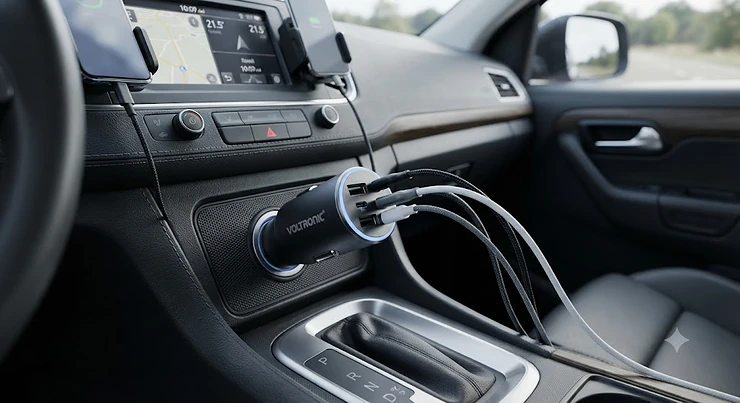
Somewhere between the school run, the motorway services, and the three separate phones fighting for one 12V socket, most of us reach the same conclusion: a single-port charger just doesn’t cut it anymore. A 4 port car charger is a compact adapter that plugs into your car’s 12V socket (the old “cigarette lighter” port) and splits that single power feed into four independent USB outputs, so several devices can top up at once without a tangle of cables or a queue for the socket.

That sounds simple, and mechanically it is. But not every 4 port car charger behaves the same way once you actually load it up with a phone, a tablet, a dash cam, and a sat nav all pulling power simultaneously. Wattage, port protocols, and build quality vary hugely between a £9 own-brand unit and a £30 premium model — and that gap shows up the moment you’re relying on it for a genuine road trip rather than a five-minute top-up.
This guide is built around real, current products you can actually buy, honest analysis of where each one earns its keep, and the practical groundwork — how to choose, how to set one up, and why a cheap cigarette lighter splitter is a different (and riskier) thing entirely — that most product listings skip. Affiliate disclosure: this article contains Amazon affiliate links, and we may earn a small commission on qualifying purchases at no extra cost to you.
Quick Comparison Table
For readers who want the short version before diving into the full breakdown, here’s how our seven picks stack up on the essentials.
| Charger | Ports | Max Output | Best For |
|---|---|---|---|
| Anker PowerDrive+ 4 | 4 (3x USB-A + USB-C) | 54W | All-round reliability |
| Amazon Basics 4-Port | 4 (USB-A) | 48W | Budget simplicity |
| AUKEY CC-P4 Pathfinder | 4 (USB-A + USB-C) | Up to 60W | Value fast-charging |
| Baseus 126W All-Metal | 4 (2x USB-C + 2x USB-A) | 126W | Power-hungry households |
| UGREEN 145W Retractable | 4 (3x USB-C + 1x USB-A) | 145W | Laptops on the road |
| LISEN 101W with Cable | 4 (USB-C + USB-A + cable) | 101W | No-cable-needed convenience |
| LISEN 84W Retractable | 4 (dual retractable + 2 ports) | 84W | Families and rear-seat kids |
Looking across the table, the split is really about how much total wattage you need versus how tidy you want your cabin. The Amazon Basics 4-Port and AUKEY CC-P4 Pathfinder cover casual, phone-only charging without breaking the bank, while the Baseus 126W All-Metal and UGREEN 145W Retractable step into laptop and tablet territory where raw wattage genuinely changes the experience. Family cars with kids in the back seat tend to get the most day-to-day value from the LISEN 84W Retractable, since its built-in cables remove the “where’s the charging cable gone” argument entirely.
💬 Already know which type you need? Jump straight to the full breakdown below and compare real specs before you buy.
Top 7 4 Port Car Chargers: Expert Analysis
We’ve grouped these seven picks across budget, mid-range, and premium tiers, covering the genuine differences in wattage, protocol support, and day-to-day usability that matter once you’re actually driving.
1. Anker PowerDrive+ 4 — best all-round reliability for mixed devices
The Anker PowerDrive+ 4 has been a staple of Anker’s car charging line-up for years, and it earns that longevity through consistency rather than flash. It pairs three USB-A ports with a single USB-C port for a combined 54W output, giving it enough headroom to fast-charge one demanding device while still keeping three others topped up. Quick Charge 3.0 support on the USB-A ports means compatible Android phones reach a meaningful charge in under 40 minutes, while the USB-C side handles newer devices that have moved away from USB-A entirely.
Based on the spec comparison with cheaper four-port units, what stands out here is Anker’s MultiProtect safety system, which actively manages current across all four ports rather than dividing power in fixed, inflexible chunks. That matters most for families or ride-share drivers who regularly have three or four devices plugged in at once, since it avoids the sudden slowdown that some rivals show under full load. Reviewers consistently report that the zinc-alloy casing survives years of glovebox knocks and temperature swings without the plastic housing cracking that plagues budget alternatives, though a handful note the four-port body is noticeably bulkier than Anker’s slimmer two-port models.
Pros:
- ✅ MultiProtect safety system manages current intelligently across ports
- ✅ Mixed USB-A/USB-C layout suits older and newer devices alike
- ✅ Durable zinc-alloy build backed by a long track record
Cons:
- ❌ Bulkier than slimline two-port alternatives
- ❌ 54W ceiling won’t fast-charge a laptop
Typically found in the £20-£30 range, the Anker PowerDrive+ 4 sits comfortably in the mid-range and represents strong value for anyone who wants dependable, well-protected charging without paying a premium for laptop-level wattage.
2. Amazon Basics 4-Port Multi USB Car Charger — best budget simplicity
Sometimes the brief is simply “charge four phones without spending £30,” and the Amazon Basics 4-Port Multi USB Car Charger answers that brief directly. It delivers a combined 9.6A (48W) across four standard USB-A ports, with device-detection tech that adjusts output per port up to 2.4A depending on what’s plugged in. There’s no Power Delivery, no Quick Charge, and no USB-C — this is a no-frills unit built for straightforward phone and tablet charging rather than fast-charging flagships.
What most buyers overlook about a charger like this is that raw simplicity is itself a reliability feature: fewer charging protocols means fewer compatibility quirks and less to go wrong. Aggregated review sentiment on Amazon’s own listing is strongly positive, with reviewers frequently highlighting the discreet LED indicator and the fact it doesn’t get warm even under sustained four-device use — a common complaint about cheaper unbranded splitters. The trade-off is charging speed: without Quick Charge or USB-C PD, an iPhone or recent Samsung will charge noticeably slower than on a 100W-plus model, which matters if you’re topping up for a long motorway leg rather than a short hop.
Pros:
- ✅ Genuinely low price point for four working ports
- ✅ Built-in overload and short-circuit protection
- ✅ Backed by Amazon’s own 1-year warranty
Cons:
- ❌ No USB-C port or Power Delivery support
- ❌ Charging speed lags behind fast-charge rivals
Usually available under £15, the Amazon Basics 4-Port Multi USB Car Charger is the pragmatic pick for anyone who just wants four working ports at the lowest sensible price, without paying for speed they won’t use.
3. AUKEY CC-P4 Pathfinder — best value fast-charging option
The AUKEY CC-P4 Pathfinder sits in the sweet spot between the barebones Amazon Basics unit and the premium GaN chargers further down this list. It combines USB-A and USB-C ports capable of Power Delivery and Quick Charge protocols, pushing meaningfully faster charge speeds than a standard 4.8A splitter while still landing at a mid-budget price point.
Here’s what to weigh with the Pathfinder specifically: AUKEY has built its reputation on undercutting bigger brands on price while matching much of their protocol support, and the CC-P4 continues that pattern by supporting both Qualcomm Quick Charge and USB-C PD simultaneously across its ports — a combination some pricier chargers still don’t offer in one unit. Reviewers on Amazon consistently note that the compact housing barely protrudes from the socket, which matters in cars where the 12V port sits low or awkwardly angled near the gearstick. On the downside, a smaller subset of aggregated reviews mention that AUKEY’s after-sales support can be slower to respond than Anker’s, worth factoring in if warranty service matters to you.
Pros:
- ✅ Dual protocol support (PD and Quick Charge) at a mid-budget price
- ✅ Compact housing fits tight or angled 12V sockets
- ✅ Strong value-for-wattage compared with premium rivals
Cons:
- ❌ Warranty support reported as slower than bigger brands
- ❌ Fewer years on the market than Anker’s equivalent range
At around the £15-£20 range, the AUKEY CC-P4 Pathfinder delivers most of the fast-charging benefit of premium units without the premium price tag, making it the value pick for anyone upgrading from a basic splitter.
4. Baseus 126W All-Metal USB-C Car Charger — best for power-hungry households
Where the previous three chargers are built around everyday phone charging, the Baseus 126W All-Metal USB-C Car Charger is aimed at households running genuinely demanding setups — think a driver’s laptop, a passenger’s tablet, and two phones, all at once. Its four-port layout splits into dual 45W PD USB-C ports and dual 18W Quick Charge 3.0 USB-A ports, for a combined 126W that puts it well ahead of the other mid-range options here.
On paper this means the two USB-C ports alone can each handle a MacBook Air or a Steam Deck at meaningful speed, something none of the sub-60W chargers on this list can realistically do. The all-metal housing isn’t just cosmetic either — it’s a genuine heat-dissipation feature, and reviewers consistently note that the charger stays cool to the touch even after long motorway stints with all four ports loaded, unlike the plastic-bodied units that can feel warm under similar conditions. The trade-off, as you’d expect from the extra power ceiling, is size: this is a noticeably chunkier charger than the Anker or AUKEY options, and a small number of aggregated reviews mention it can partially obstruct access to nearby switches on some dashboard layouts.
Pros:
- ✅ 126W combined output handles laptops and tablets, not just phones
- ✅ Metal housing dissipates heat well under sustained full load
- ✅ Independent port power means no slowdown when all four are used
Cons:
- ❌ Larger footprint than mid-range alternatives
- ❌ May sit close to nearby dashboard controls in some cars
Typically priced in the mid-£20s to low-£30s, the Baseus 126W All-Metal USB-C Car Charger justifies its higher price bracket for anyone who genuinely charges a laptop or tablet on the move, rather than phones alone.
5. UGREEN 145W Retractable USB-C Car Charger — best for laptops on the road
At the top of this line-up sits the UGREEN 145W Retractable USB-C Car Charger, which pairs three USB-C ports and one USB-A port with a built-in 60W retractable cable — effectively giving you a fifth connection point without needing a separate cable at all. Used alone, each USB-C port can output up to 30W; when the retractable cable and one other port are used together, combined output climbs toward the full 145W ceiling.
What most buyers overlook about retractable-cable chargers is how much they change day-to-day usability rather than raw charging numbers: not fumbling for a loose cable that’s slipped under the seat is, in practice, the single biggest quality-of-life improvement over a standard four-port unit. Based on the spec comparison with the Baseus model above, UGREEN’s advantage is versatility — supporting PD 3.0, QC 4.0, and PPS protocols means it intelligently negotiates the fastest safe charge with almost any modern device, Apple or Android. Aggregated review sentiment highlights the metal ring securing the plug in the socket as a standout detail, since a loose-fitting plug is a common failure point on cheaper units; a smaller number of reviewers note the retractable cable feels less premium than the moulded body itself and requires a firm, deliberate tug to extend cleanly.
Pros:
- ✅ Built-in retractable 60W cable removes the need for a spare lead
- ✅ Broad protocol support (PD3.0, QC4.0, PPS) across all ports
- ✅ Secure metal ring keeps the plug seated in bumpy driving
Cons:
- ❌ Retractable cable mechanism feels less premium than the housing
- ❌ Premium price relative to non-retractable four-port rivals
Sitting in the £25-£35 range, the UGREEN 145W Retractable USB-C Car Charger is the clear premium pick for drivers who regularly charge a laptop or want one less cable cluttering the cabin.

6. LISEN 101W USB-C 4 Port Car Charger with Cable — best no-extra-cable convenience
The LISEN 101W USB-C 4 Port Car Charger with Cable takes a slightly different approach from the rest of this list by shipping with an integrated charging cable alongside its PD3.0 and QC3.0-enabled ports, aimed squarely at drivers who are tired of hunting for a spare lead every time they get in the car. Combined output reaches 101W across the four connection points, putting it firmly in the upper-mid tier for raw power.
The spec sheet won’t tell you this, but user reports suggest the real value of a cable-included charger like this shows up on shared or family vehicles, where a missing cable is a far more common frustration than insufficient wattage. Reviewers frequently mention that having one fixed cable permanently in the car — rather than relying on whoever last borrowed it to put it back — genuinely changes how often the charger gets used day to day. On the specification side, the PD3.0 port comfortably fast-charges modern iPhones and Android flagships, while the additional USB-A and USB-C ports handle passenger devices without a noticeable speed penalty when all four are active simultaneously.
Pros:
- ✅ Integrated cable solves the “missing charging lead” problem
- ✅ 101W combined output supports fast charging on the primary port
- ✅ Compatible with both PD3.0 and QC3.0 protocols
Cons:
- ❌ Fixed cable length limits reach to rear seats
- ❌ Bulkier profile than cable-free four-port units
Generally priced in the £18-£25 range, the LISEN 101W USB-C 4 Port Car Charger with Cable earns its place for anyone whose real-world problem is losing cables, not lacking wattage.
7. LISEN 84W Retractable 4-in-1 Car Charger — best for families and rear-seat charging
Closing out the list, the LISEN 84W Retractable 4-in-1 Car Charger is purpose-built around exactly the scenario that gives families the most grief: kids in the back seat with tablets, needing power without a driver-side cable stretched across the whole cabin. It combines two retractable cables (USB-C and a legacy connector) with a 45W PD USB-C port and a 12W USB-A port, extending up to roughly 80cm so a rear passenger can charge without leaning forward.
Based on the spec comparison with fixed-cable models, the dual retractable design is the standout feature here — reviewers consistently note that the 180-degree rotating plug lets the unit sit flush near a centre console or gear shifter regardless of how the 12V socket is angled, which is a common fit issue with bulkier rigid chargers. What most buyers overlook about family-focused chargers like this is the maintenance angle: retractable mechanisms are a moving part, and a small number of aggregated reviews mention the cable can feel slightly stiff to extend fully after extended use in cold weather, something worth being aware of before a winter road trip.
Pros:
- ✅ Dual retractable cables reach rear-seat passengers easily
- ✅ 180-degree rotating plug fits awkward socket angles
- ✅ Genuinely solves the “misplaced charging cable” problem for families
Cons:
- ❌ Retractable mechanism can stiffen slightly in cold weather
- ❌ Lower total wattage than the Baseus or UGREEN premium picks
Typically retailing around £15-£20, the LISEN 84W Retractable 4-in-1 Car Charger is the strongest pick specifically for family cars needing a genuine rear seat charging solution rather than a driver-focused unit.
Setting Up Your 4 Port Car Charger Properly
Getting a 4 port car charger to actually deliver on its wattage claims takes more than just plugging it in, and a few early mistakes explain most of the “it charges so slowly” complaints you’ll find in reviews.
Start by checking your car’s 12V socket rating before you buy anything — most modern vehicles fuse this circuit at around 10-15A (roughly 120-180W at 12V), and older vehicles can be lower. A charger rated above your circuit’s fuse won’t damage your car, but it also won’t deliver its full advertised wattage, so match the charger to realistic expectations rather than chasing the highest number on the box. Next, use the cable that came with your charger, or a certified equivalent — a thin, uncertified USB-A to Lightning or USB-C cable is very often the actual bottleneck, throttling a 100W-capable port down to a fraction of that speed regardless of how good the charger itself is.
In the first 30 days, it’s worth testing each port individually with your primary device before loading all four at once, so you know your baseline speed and can spot a faulty port early while you’re still within a return window. A common first-month mistake is leaving the charger permanently plugged in when the car is off; most modern chargers draw negligible standby power, but on older vehicles with a weaker battery, it’s sensible habit to unplug during long periods of non-use. Finally, keep the ports free of dust and debris — pocket lint is a surprisingly frequent cause of poor connections, and a quick check every few weeks costs nothing.
Who Actually Needs a 4 Port Car Charger? Real-World Scenarios
Not every driver needs four ports, and matching the right charger to your actual pattern of use saves both money and cable clutter.
Consider a family doing the school run and weekend trips with two children in the back: their priority isn’t raw wattage but reach and reliability, which points toward a retractable option like the LISEN 84W Retractable 4-in-1 Car Charger that lets rear-seat tablets charge without a cable stretched across the cabin. Compare that with a sales rep who spends hours a week driving between meetings, juggling a phone for calls and navigation, a tablet for presentations, and occasionally a laptop between appointments — for that use case, the extra headroom of the Baseus 126W All-Metal USB-C Car Charger or the UGREEN 145W Retractable USB-C Car Charger genuinely earns its higher price, since laptop-level charging simply isn’t possible on a sub-60W unit.
Then there’s the budget-conscious commuter who just wants their phone charged for the 40-minute drive to work and back, with no tablets, no laptops, and no rear-seat passengers to think about — for them, the Amazon Basics 4-Port Multi USB Car Charger or the AUKEY CC-P4 Pathfinder delivers everything actually needed without paying for capability that would sit unused. The common thread across all three profiles is that “best” isn’t a fixed answer; it’s a match between wattage, port type, and how many devices genuinely need power at once in your specific car.
✨ Don’t Miss These Exclusive Deals!
🔍 Take your in-car charging setup to the next level with these carefully selected chargers. Click on any highlighted product above to check current pricing and availability. These picks will help you keep every device — and every passenger — powered up on the road!
Common 4 Port Car Charger Problems, Solved
Even a well-reviewed charger runs into predictable issues, and most have a straightforward fix rather than requiring a replacement.
Problem: charging feels slow despite a high wattage rating. This is almost always a cable issue rather than a charger fault — swap in the cable that shipped with the unit, or a certified fast-charge cable, before assuming the charger itself is underperforming. Problem: the charger gets warm during long drives. A degree of warmth is normal under sustained four-port load, but if it’s genuinely hot to the touch, check that all four ports aren’t simultaneously drawing maximum current on cheaper, non-independent-power models like some entry-level splitters — metal-bodied units such as the Baseus 126W All-Metal USB-C Car Charger are specifically designed to dissipate this better. Problem: the plug won’t stay seated in the socket. Older or worn 12V sockets lose their internal spring tension over time; a charger with a secure metal retaining ring, like the UGREEN 145W Retractable USB-C Car Charger, compensates for this better than a smooth plastic plug.
Problem: only some ports work when all four are connected. This usually indicates the total draw is exceeding the car’s fused circuit limit rather than a charger defect — try disconnecting one device to see if the others recover full speed. Problem: rear-seat passengers can’t reach the charger. This is a hardware mismatch rather than a fault; a fixed front-facing charger was never going to serve the back seat well, and switching to a genuine rear seat charging solution with retractable or longer cables, such as the LISEN 84W Retractable 4-in-1 Car Charger, solves it directly rather than needing a workaround.
How to Choose a 4 Port Car Charger
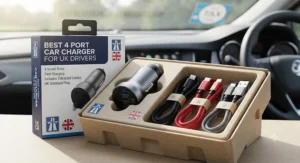
Cutting through the marketing claims, these seven criteria cover what actually determines whether a charger suits your car and your devices.
- Match total wattage to your car’s fuse rating. Check your owner’s manual for the 12V socket’s amperage; buying far beyond it wastes money on capability you can’t use.
- Prioritise port type over port count. Four USB-A ports on an older phone lineup charges differently than a mix including USB-C with Power Delivery — check what your actual devices need.
- Check protocol support against your devices. Quick Charge suits most Android phones; USB-C PD suits recent iPhones, tablets, and laptops — mismatched protocols mean slower real-world speeds regardless of the wattage printed on the box.
- Consider cable reach if you have rear-seat passengers. A retractable or included-cable design solves access problems a standard fixed-port charger can’t.
- Look for independent per-port power management. Cheaper units split fixed power evenly regardless of what’s plugged in, causing unnecessary slowdowns when only one device is charging.
- Factor in build material for heat handling. Metal-bodied chargers dissipate heat more effectively during long, hot summer drives than plastic equivalents.
- Weigh warranty and brand support. Established brands with a longer UK sales history tend to offer faster replacement support if a unit develops a fault.
USB Car Charger Multi Port: Which Port Combination Actually Matters
Not all “four ports” are created equal, and the mix of USB-A versus USB-C makes a bigger practical difference than the headline port count suggests.
A usb car charger multi port setup built entirely around USB-A, like the Amazon Basics 4-Port Multi USB Car Charger, suits households still running a mix of older Android phones and basic tablets, where USB-A remains the standard connector. But most current flagship phones, from recent iPhones to Samsung’s Galaxy S-series, have shifted to USB-C as standard, and pairing that with a USB-A-only charger means relying on an adapter cable that adds one more point of failure and typically caps speed below what the phone supports. Here’s what to weigh: a charger with at least one USB-C Power Delivery port, like the Anker PowerDrive+ 4 or AUKEY CC-P4 Pathfinder, future-proofs your setup as more devices standardise on USB-C, while still keeping USB-A ports available for older accessories, dash cams, or a passenger’s ageing phone.
The real-world takeaway is that port mix should follow your household’s actual device inventory rather than defaulting to the highest wattage number — a family with two iPhones and an Android tablet gets more genuine value from a balanced two-USB-C, two-USB-A layout than from four identical USB-A ports rated at a higher combined wattage.
Rear Seat Charging Solution: Keeping Every Passenger Powered
For anyone regularly ferrying passengers, a rear seat charging solution isn’t a luxury add-on so much as a practical fix to a genuinely common complaint: whoever’s sitting in the back gets the shortest cable and the least patience.
Two approaches solve this differently. The first is a retractable-cable charger mounted at the front, like the LISEN 84W Retractable 4-in-1 Car Charger, where an extendable lead reaches back far enough for a child in a booster seat to plug in without leaning forward awkwardly. The second is simply choosing a higher-wattage front-mounted unit and running a separate, longer third-party cable to the back seat — cheaper in the short term, but reintroduces the “where did the cable go” problem this whole category is meant to solve. Reviewers consistently note that families who’ve tried both approaches settle on the retractable option specifically because it removes a recurring point of friction rather than shifting it elsewhere.
It’s also worth noting UK law here: it’s illegal to hold and use a handheld phone, sat nav, or similar device while driving, a rule that applies to the driver at all times, even when stationary in traffic — so a driver-focused charging setup matters less for hands-free navigation use than passengers might assume, and rear-seat charging genuinely is about keeping devices topped up rather than in-hand while the vehicle moves. You can read the full detail on the official guidance on using a phone while driving.
Simultaneous Device Charging: What Really Happens When All Four Ports Are in Use
The number printed on a charger’s box — 54W, 101W, 145W — is a ceiling, not a guarantee, and understanding how that ceiling is actually shared across four active ports explains a lot of buyer confusion.
Some chargers, including the Baseus 126W All-Metal USB-C Car Charger, use independent power management, meaning each port negotiates its own optimal current with the connected device without reducing what the others receive. Others use a shared power pool, where the total wattage is genuinely fixed and divided dynamically — plug in a fourth device and the first three may all slow down slightly to accommodate it. Neither approach is inherently wrong, but the difference matters enormously for simultaneous device charging in a full car: a family of four all plugging in at once will notice a shared-pool charger slowing everyone down, while an independent-power model like those found in the premium tier of this list maintains consistent speed regardless of how many ports are active.
What most buyers overlook about simultaneous charging is that it stresses a charger’s thermal management as much as its electronics — running four ports at meaningful current for an hour-long motorway drive generates real heat, which is exactly why the metal-bodied, higher-wattage options on this list are built the way they are.
💬 Just one click — help others make better buying decisions too!😊
Cigarette Lighter Splitter Risk: Why a Proper 4 Port Charger Beats a Cheap Splitter
It’s worth being direct about a genuine safety distinction here, because “cigarette lighter splitter” and “4 port USB car charger” often get lumped together when they’re meaningfully different products.
A basic cigarette lighter splitter simply divides one 12V socket into two or three raw DC outlets with no USB conversion, no per-port current limiting, and often no fuse of its own beyond the car’s existing circuit fuse. Cigarette lighter splitter risk becomes real when several accessories — a dash cam, a phone charger, and an air compressor, for example — are all drawing current through a single unfused splitter simultaneously; the combined load can exceed the circuit’s rating, and in the same way an overloaded household extension lead can overheat, an overloaded 12V circuit can trip a fuse at best and cause connector overheating at worst. The UK’s own household electrical safety guidance makes the underlying principle clear: never plug in appliances that together exceed the rated current of the circuit, because doing so risks overheating and, in worst cases, fire — the same logic that Electrical Safety First’s overloading guidance sets out for home sockets applies directly to a car’s 12V circuit too.
A proper 4 port car charger, by contrast, is built with its own internal fuse, dedicated USB power-management chips, and — on the better models covered in this guide — independent per-port current limiting that actively prevents any single port from drawing more than its rated share. That’s a meaningfully different risk profile from a bare mechanical splitter with no electronics in the loop at all. If you’re regularly running multiple accessories, the safer and more practical route is a genuine multi-port USB charger from an established brand rather than stacking cheap splitters into your car’s socket.
4 Port Car Charger vs 2 Port Car Charger: Do You Need the Extra Ports
The honest answer is: it depends on how many people and devices are actually in the car on a typical journey, not on some universal “more is better” rule.
| Factor | 2 Port Charger | 4 Port Charger |
|---|---|---|
| Best For | Solo or two-person commutes | Families, road trips, multi-device users |
| Typical Wattage | 24W-40W | 48W-145W |
| Cable Clutter | Minimal | Higher, unless retractable |
| Price Range | Under £15 | £15-£35 |
A 2 port charger genuinely suits a solo commuter or a couple who only ever charge a phone and a sat nav — buying a 4 port unit in that scenario adds cost and desk-drawer clutter for ports that will sit unused. But the moment a third or fourth device enters the picture regularly — a child’s tablet, a passenger’s phone, a dash cam running continuously — the maths flips, since running two separate 2-port chargers is both messier and often no cheaper than one well-specified 4 port unit like the Anker PowerDrive+ 4. The practical rule of thumb: count your actual simultaneous devices over a typical week, add one for guests or occasional passengers, and buy to that number rather than to the highest port count available.
Long-Term Cost & Maintenance
A car charger is a small purchase, but total cost of ownership still varies meaningfully between the cheapest and most premium options on this list once you factor in lifespan and replacement frequency.
A sub-£15 basic unit like the Amazon Basics 4-Port Multi USB Car Charger has a low upfront cost but, based on aggregated review patterns across similarly-priced unbranded alternatives, budget chargers are more likely to develop loose port connections or reduced output after a year or two of regular use, potentially requiring replacement sooner. A premium metal-bodied option like the UGREEN 145W Retractable USB-C Car Charger costs more initially but its more robust internals and better heat management generally translate to a longer working life, which can make it the better value choice over a three-to-five-year ownership window rather than judging purely on sticker price. Maintenance itself is minimal across the board — occasional dust removal from the ports and periodically checking the plug still seats firmly in the socket covers most of what’s needed, with no batteries or consumable parts to replace on any charger in this guide.

Frequently Asked Questions
❓ Can a 4 port car charger drain my car battery?
❓ Will a 4 port charger fast-charge all four devices at once?
❓ Is USB-C or USB-A better for a car charger?
❓ How many amps does a 4 port car charger need?
❓ Are cheap 4 port car chargers safe to use?
Conclusion
A 4 port car charger earns its place the moment more than one person regularly needs power in the car, and the seven options covered here span every realistic need — from the no-frills Amazon Basics 4-Port Multi USB Car Charger for straightforward phone charging, through the balanced, protocol-rich Anker PowerDrive+ 4 and AUKEY CC-P4 Pathfinder, up to the laptop-capable Baseus 126W All-Metal and UGREEN 145W Retractable for genuinely power-hungry setups.
Families with rear-seat passengers get the most day-to-day value from a retractable option like the LISEN 84W Retractable 4-in-1 Car Charger, while anyone tired of losing charging cables should look at the LISEN 101W with Cable. Whichever you choose, matching wattage and port type to your actual devices — rather than chasing the highest number on the box — is what separates a charger you’ll still be happy with in two years from one gathering dust in a drawer after six months.
Before you buy, it’s worth a last comparison against your own driving pattern: how many people, how many devices, and how often you’re all in the car together. That answer, more than any spec sheet, points to the right pick from this list.
Recommended for You
- Multi Port Car Charger: 7 Best Picks Compared for 2026
- USB C Car Charger iPhone: 7 Best PD Picks for 2026
- 7 Best USB C Car Charger Fast Charging Picks for UK Drivers (2026)
Disclaimer: This article contains affiliate links. As an Amazon Associate, I earn from qualifying purchases. If you purchase products through these links, we may earn a small commission at no additional cost to you.
✨ Found this helpful? Share it with your friends! 💬🤗
