
In This Article
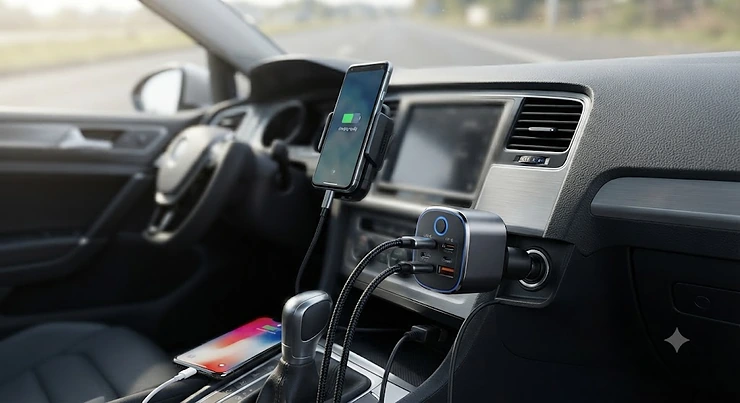
Anyone who has ever driven three kids to a football match while their phone dies on the sat nav app knows the problem with a single-socket car. One cigarette lighter port, one lucky winner, and a lot of “can I use it next” negotiations from the back seat. A multi port car charger solves that squabble in one small plug, letting a driver, a front-seat passenger, and a couple of tablet-wielding children all top up at once without anyone unplugging anyone else mid-journey.

This guide has done the digging so you don’t have to trawl a hundred near-identical Amazon listings. We’ve pulled real specifications, aggregated genuine customer sentiment where it’s verifiable, and worked out which chargers genuinely deliver on their wattage claims versus which ones quietly throttle the moment a second device joins the party. You’ll find budget dual USB car charger options, premium laptop-capable hubs, and at least one pick built specifically for family road trip charging.
So, what is a multi port car charger? It’s a compact adapter that plugs into your car’s 12V socket and splits the output across two or more USB-A or USB-C connections, letting several devices draw power simultaneously rather than queueing for one. Modern versions add Power Delivery, Quick Charge, and sometimes an LED display voltage indicator so you can glance at your car’s electrical health while you charge. We’ll cover exactly how that shared amperage output behaves under real load, because it isn’t always as simple as the box suggests.
Whether you’re commuting solo, running a taxi service for the school run, or planning a genuine family road trip charging setup for the summer holidays, there’s a sensible option below — and a few you’d do well to avoid.
Quick Comparison Table
| Charger | Ports | Total Output | Best For | Price Range |
|---|---|---|---|---|
| Anker 335 Car Charger | 2x USB-C, 1x USB-A | 67W | Best all-rounder | Around £25-£35 |
| UGREEN 130W Car Charger | 2x USB-C, 1x USB-A | 130W (100W PD) | Charging a laptop on the move | Around £30-£40 |
| Baseus 65W Digital Display Charger | 1x USB-C, 1x USB-A | 65W | Voltage monitoring on a budget | Around £15-£20 |
| AINOPE 108W 6-Port Car Charger | 6 ports (front + rear) | 108W | Family road trip charging | Around £25-£35 |
| Anker 323 Car Charger | 1x USB-C, 1x USB-A | 52.5W | Compact daily driver | Under £20 |
| UGREEN 145W Retractable Charger | 3x USB-C, 1x USB-A | 145W (60W cable) | Cable-free convenience | Around £25-£35 |
| Belkin BoostCharge Dual Port | 1x USB-C, 1x USB-A | 42W | Lightweight budget backup | Under £20 |
Looking across the table, wattage alone doesn’t tell the full story — the UGREEN 130W Car Charger and UGREEN 145W Retractable Charger both advertise big headline numbers, but that power is shared, not multiplied, once you plug in more than one device. Budget picks like the Baseus 65W Digital Display Charger and Belkin BoostCharge Dual Port are perfectly capable for phones but will bottleneck if you try to fast-charge a tablet and a phone simultaneously. If your priority is simply keeping everyone’s phone alive on a long drive rather than laptop charging, the AINOPE 108W 6-Port Car Charger solves a different problem entirely: physical port count for a car full of people.
💬 Just one click — help others make better buying decisions too!😊
Top 7 Multi Port Car Chargers: Expert Analysis
Real specs, real aggregated review sentiment, and honest commentary on who each charger genuinely suits — not just a rewritten spec sheet.
1. Anker 335 Car Charger — best balanced all-rounder
The Anker 335 Car Charger packs two USB-C ports and one USB-A port into a housing barely bigger than a large thumb, and that compactness is the standout feature buyers notice first. Each USB-C port can hit 35W individually via PD and PPS, with the USB-A port capped around 22.5W, for a genuine 67W shared across the three when all are active. In practice this means a phone on USB-C fast-charges properly even with a second device plugged in, something budget dual-port units often can’t manage without one port slowing to a crawl.
Anker built in ActiveShield 2.0 temperature monitoring and a Power Tuner Chip, which continuously adjusts output rather than just cutting power when things get warm — a detail that matters more on long summer motorway drives than the spec sheet lets on. This is the charger for someone who wants one sensible unit that handles a phone, a passenger’s phone, and an occasional tablet without drama, rather than a specialist family or laptop solution.
Reviewers consistently report the compact size disappearing neatly into the socket and praise consistent charging speed across all three ports simultaneously, with the main recurring gripe being that the bundled cable (on some bundle variants) is shorter than expected for rear-seat use.
Pros:
- ✅ Genuinely fast USB-C charging even with all ports in use
- ✅ Compact housing barely protrudes from the socket
- ✅ ActiveShield 2.0 keeps output stable on long drives
Cons:
- ❌ No dedicated cable included on the base version
- ❌ USB-A port noticeably slower than either USB-C port
At around £25-£35, the Anker 335 Car Charger sits comfortably in the mid-range and represents strong value for anyone who wants dependable multi-device charging without paying for laptop-grade wattage they won’t use.

2. UGREEN 130W Car Charger — best for charging a laptop on the move
The UGREEN 130W Car Charger is aimed squarely at people who need more than a phone topped up — think a work laptop on a long client drive. Its headline 100W PD output on the primary USB-C port is enough to keep a MacBook Pro or Dell XPS ticking over, while the second USB-C and single USB-A port handle a phone and a set of earbuds simultaneously. It ships with a 3.3ft 100W USB-C cable, which is a genuinely useful inclusion most competitors skip.
What most buyers overlook about this model is that hitting the full 130W figure typically requires a car with a robust electrical system and fuse rating — smaller city cars may not sustain the peak draw for laptop charging, so it’s worth checking your vehicle’s fuse box first. The blue LED ring around the port also earns a mention in aggregated reviews as a small but appreciated touch for finding the socket after dark without fumbling.
Aggregated customer sentiment is largely positive on build quality, with the scratch-resistant aluminium housing and secure metal ring holding up well after thousands of plug-and-pull cycles; a smaller number of reviewers note that the 130W figure is best-case and single-device charging speed for phones is closer to what a 30-45W charger would deliver.
Pros:
- ✅ Genuinely capable of trickle-charging a laptop in the car
- ✅ Includes a full 100W-rated USB-C cable
- ✅ Blue LED ring makes the socket easy to find at night
Cons:
- ❌ Peak wattage depends on your car’s electrical capacity
- ❌ Bulkier than dual-port rivals
Priced around £30-£40, the UGREEN 130W Car Charger earns its premium position for genuine laptop-adjacent power, though families needing more ports should look further down this list.
3. Baseus 65W Digital Display Charger — best for voltage monitoring
The Baseus 65W Digital Display Charger stands out for one specific feature: a live digital screen showing your car’s battery voltage and charging current, refreshing roughly every five seconds. It’s a genuinely useful early-warning system for an ageing battery, since a resting voltage that’s noticeably below the expected range can flag a problem before you’re stranded in a car park.
On the charging side, the single USB-C port delivers up to 45W via PD3.0 and PPS, with the USB-A port adding 18W, for 63W combined when both are drawing power — solid for a phone-plus-earbuds combination, though it won’t touch laptop charging like the UGREEN 130W above. The full aluminium alloy body carries UL, CE, and FCC safety certification, and a soft LED strip lights the ports without being distracting after dark.
Based on the spec comparison with rivals in this price bracket, the genuine differentiator here isn’t raw wattage — it’s the voltage readout. Reviewers consistently mention finding it reassuring to glance at the display and see the car’s electrical system reading normally, particularly during winter mornings when batteries are under more strain.
Pros:
- ✅ Live voltage and current display updates every few seconds
- ✅ Full metal body with recognised safety certifications
- ✅ 63W combined output covers two devices comfortably
Cons:
- ❌ Single USB-C port limits use to two devices max
- ❌ Display adds a small learning curve for first-time users
At around £15-£20, the Baseus 65W Digital Display Charger is the pick for anyone who wants a genuine LED display voltage indicator without paying premium prices, and pairs well with basic checks like those covered in RAC’s guide to car battery voltage.
4. AINOPE 108W 6-Port Car Charger — best for family road trip charging
If the school-run negotiation over “whose turn it is to charge” sounds familiar, the AINOPE 108W 6-Port Car Charger is built to end it. The front unit plugs into the cigarette lighter socket with a 36W USB-C PD port and an 18W USB-A QC3.0 port for the driver and front passenger, while a 5ft coiled extension cable runs a second unit with four further ports back to the rear seats, giving every child their own dedicated socket.
Total combined output sits at 108W, though — and this matters — that figure is spread across six ports rather than delivered to each simultaneously, so don’t expect every device to fast-charge at once under maximum load. What it does deliver is the end of backseat squabbling: each port charges independently, so unplugging one device doesn’t interrupt another, which is the single most common complaint about cheaper splitter-style multi-device chargers.
Aggregated reviews frequently describe long car journeys with tablets, phones, and a Nintendo Switch all charging without anyone losing power mid-film, and the rear unit’s clip attaches to a seatback pocket rather than dangling loose. A minority of reviews note the rear cable, while generous at 5ft, adds bulk that some drivers prefer to tuck away when not travelling with passengers.
Pros:
- ✅ Six independent ports end backseat charging arguments
- ✅ 5ft rear cable reaches second and third row seats
- ✅ Front and rear ports work independently of each other
Cons:
- ❌ Per-port speed drops when several ports draw power together
- ❌ Bulkier setup than a simple dual-port unit
Priced around £25-£35, the AINOPE 108W 6-Port Car Charger is the clearest “buy this if you have a car full of people” recommendation on this list.
5. Anker 323 Car Charger — best compact budget pick
The Anker 323 Car Charger trims things back to a single USB-C and single USB-A port totalling 52.5W, and the standout feature is just how little space it takes up while still delivering genuinely fast charging. Anker’s own testing found it can take an iPhone 14 Pro to 50% in around 25 minutes on the 30W USB-C port, which is respectable for a charger at this price point.
What the spec sheet won’t tell you, but reviewers note, is that the soft LED indicator ring is bright enough to locate in the dark without being distracting against the windscreen — a small detail that larger, flashier chargers sometimes get wrong. This is a sensible pick for someone who mostly charges their own phone and occasionally a passenger’s, rather than someone chasing maximum port count.
Reviewers consistently highlight the compact footprint and describe it as the sort of charger you forget is even plugged in, alongside praise for Anker’s ActiveShield safety system limiting heat build-up on longer journeys. A smaller number of buyers note that, being a genuine dual-port unit rather than a multi-port hub, it isn’t the right fit for families needing more simultaneous connections.
Pros:
- ✅ Genuinely fast 30W USB-C charging for the price
- ✅ Compact design barely visible once plugged in
- ✅ ActiveShield safety system limits heat build-up
Cons:
- ❌ Only two ports total, unsuitable for larger families
- ❌ No cable included
Under £20 in most listings, the Anker 323 Car Charger is the sensible entry point into a trusted dual usb car charger from a brand with a strong safety track record.
6. UGREEN 145W Retractable Charger — best for cable-free convenience
The UGREEN 145W Retractable Charger solves a very specific annoyance: the tangle of loose cables in the footwell. It houses a 60W retractable USB-C cable that extends and locks at any length up to around 70cm, alongside three further USB-C ports and one USB-A port for a combined 145W across the unit.
Based on the spec comparison with fixed-cable rivals, the retractable design means you’re never hunting for a compatible cable in the glovebox — plug the built-in cable directly into your phone, tablet, or MacBook, and use the remaining ports for passengers. This makes it a genuinely different proposition to the UGREEN 130W above despite the similar branding: this one prioritises cable convenience across four total ports, where the 130W model prioritises raw single-port power with an included separate cable.
Aggregated review sentiment praises the retractable mechanism holding its lock reliably after months of daily use, with the compact rear clip design earning particular mention for backseat mounting. A smaller number of reviewers note that reaching the full 145W figure across all ports simultaneously isn’t realistic, which lines up with how shared amperage output works on virtually every multi-port charger on the market.
Pros:
- ✅ Built-in retractable cable removes cable-hunting entirely
- ✅ Four total ports cover most family charging needs
- ✅ Rear clip design suits backseat mounting
Cons:
- ❌ Retractable cable can’t be swapped if it wears out
- ❌ Combined wattage figure is a shared maximum, not per-port
Typically priced in the mid-£20s to mid-£30s, the UGREEN 145W Retractable Charger rewards anyone tired of loose cables more than it rewards raw power-seekers.
7. Belkin BoostCharge Dual Port — best lesser-known reliable alternative
The Belkin BoostCharge Dual Port doesn’t shout about itself the way some rivals do, but Belkin’s decades of accessory manufacturing show in the build quality. It pairs a 30W USB-C PD port with a 12W USB-A port for 42W combined — modest next to the UGREEN and AINOPE entries above, but entirely sufficient for a phone and a set of wireless earbuds or a smartwatch.
Here’s what to weigh with this one: it’s not trying to be a family hub or a laptop charger, and buyers expecting either will be disappointed. What it does well is straightforward, no-fuss dual-device charging from a brand with a long enough track record that spare parts and warranty support are rarely an issue, which matters more than most marketing copy admits when a charger fails two years into ownership.
Aggregated customer sentiment tends to focus on reliability over raw speed, with reviewers noting it simply works, journey after journey, without the port degradation some cheaper unbranded alternatives develop. Fewer reviews are available for this specific model compared with the higher-volume Anker and UGREEN options, so treat the sentiment here as a smaller but consistent sample.
Pros:
- ✅ Backed by an established, long-standing accessory brand
- ✅ Reliable everyday performance without early degradation
- ✅ Compact and unobtrusive in any car interior
Cons:
- ❌ Lower total wattage than most rivals on this list
- ❌ Smaller review sample than bigger-name competitors
Usually found under £20, the Belkin BoostCharge Dual Port is worth considering for buyers who value brand reliability over headline wattage figures.
Practical Usage Guide: Setting Up Your Charger the Right Way
Getting a multi port car charger working properly takes more than shoving it into the socket. Start by checking your vehicle’s fuse rating before buying anything above 100W — higher-output chargers like the UGREEN 130W Car Charger need a socket circuit rated to sustain that draw, and an underpowered fuse will simply trip rather than deliver full speed. Most modern cars handle up to 120W without issue, but it’s a five-minute check worth doing.
During the first week, avoid daisy-chaining every device at once to “test” maximum output; instead, add one device at a time and note how charging speed changes as more ports activate. This tells you the charger’s real-world shared amperage output behaviour rather than its marketing figure. Keep the unit dry — condensation from a cold morning start is a surprisingly common cause of early failure.
A common first-30-days mistake is leaving a charger permanently plugged in with the ignition off; most modern chargers draw negligible standby power, but older or faulty units can very slowly drain a battery over several unused weeks. If you’re mounting a phone to glance at directions, remember it’s illegal to hold a handheld device while driving under UK law, so pair any charger with a proper dashboard mount rather than juggling a cable and a screen — RAC’s guide to mobile phone driving laws sets out exactly what’s permitted.
Real-World Scenarios: Which Charger Suits Your Journey?
The daily commuter: A single driver making a 40-minute commute doesn’t need six ports or 145W. The Anker 323 Car Charger or Belkin BoostCharge Dual Port covers a phone and maybe a smartwatch without wasting money on capacity that never gets used.
The family road trip: Two adults and three children on a six-hour motorway drive is exactly the scenario the AINOPE 108W 6-Port Car Charger was designed for. Independent front and rear ports mean nobody has to unplug a sibling’s tablet to charge their own, and the 5ft rear cable keeps devices reachable from every seat.
The frequent business traveller: Someone regularly working from the car between meetings, laptop included, needs genuine power rather than port count. The UGREEN 130W Car Charger, paired with checking the car’s fuse rating first, is the only option on this list that meaningfully supports laptop charging alongside a phone.
The budget-conscious second car: For an older or second vehicle used occasionally, there’s little sense spending £30+ on a charger that will sit idle most of the year — the Baseus 65W Digital Display Charger adds genuine value here through its voltage monitoring, doubling as a basic battery health check for a car that doesn’t get driven daily.
Common Problems With Multi Port Car Chargers (Solved)
Problem: One port charges noticeably slower than another. This is usually shared amperage output at work rather than a fault — most multi-port chargers allocate power dynamically, favouring whichever port negotiated the fastest protocol first. Plugging your priority device in first, before a second device joins, usually resolves it.
Problem: The charger gets warm on long drives. Some heat is normal under sustained load, but persistent excessive warmth points to a charger without proper thermal management. Models like the Anker 335 Car Charger with ActiveShield 2.0 are built specifically to throttle gracefully rather than overheat.
Problem: A device shows “not charging” despite being plugged in. This is typically a cable issue rather than the charger itself — cheap cables often can’t carry the current the charger is capable of delivering. Pairing a high-output charger with a basic 1A-rated cable will bottleneck everything regardless of the unit’s wattage.
Problem: The charger disconnects when driving over bumps. A loose-fitting cigarette lighter socket connection, common in older vehicles, causes this more often than the charger being faulty. Metal-bodied units with a secure locking ring, such as the UGREEN 130W Car Charger, tend to hold their connection better than plastic alternatives.
Problem: The car battery seems to drain faster since fitting the charger. Genuine multi-port chargers draw minimal standby current, but very cheap unbranded units sometimes don’t switch off properly with the ignition. If you’re concerned, a charger with a voltage display like the Baseus 65W Digital Display Charger lets you actually monitor this rather than guess.
How to Choose a Multi Port Car Charger
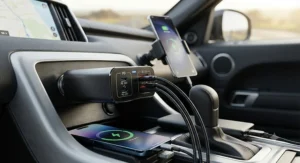
- Count your actual devices, not your aspirational ones. Two people commuting need two solid ports; a family of five needs the port count the AINOPE 108W 6-Port Car Charger offers, not a premium dual-port unit stretched thin.
- Match wattage to what you’ll realistically charge. A phone-only household doesn’t need 130W; someone charging a laptop in the car absolutely does.
- Check for Power Delivery and Quick Charge support. These protocols negotiate faster charging speeds with compatible devices rather than defaulting to slow, generic output.
- Look for genuine safety certification. UL, CE, or UKCA marking on the packaging indicates independent verification of basic electrical safety standards.
- Consider build material. Aluminium and metal-bodied chargers dissipate heat more effectively than plastic equivalents over sustained use.
- Decide if a built-in cable matters to you. Retractable or included-cable models remove a common point of failure — a mismatched or damaged separate cable.
- Factor in your car’s fuse rating for anything above 100W. Higher-output chargers need a socket circuit that can actually sustain the claimed draw.
Common Mistakes When Buying a Multi Port Car Charger
The most frequent mistake is buying purely on headline wattage without checking how that power is distributed across ports — a 145W-branded charger sharing that figure across four ports behaves very differently to a 65W charger delivering nearly all of it to a single port. Buyers also regularly skip checking their own vehicle’s fuse rating, then wonder why a premium charger underperforms.
Another common error is assuming any USB-C port means Power Delivery support; some cheaper “USB-C” ports are simply the connector shape without the PD negotiation chip behind it, meaning charging speeds barely beat a standard USB-A port. Finally, many buyers overlook cable quality entirely, pairing an excellent charger with a bargain-bin cable that caps the whole system’s performance regardless of the unit’s real capability.
Multi Port Car Charger vs Single Port Car Charger
A single port charger seems like the simpler, cheaper choice, and for a solo driver it often is — there’s less to go wrong and typically a lower price. The moment a second person or device enters the equation, though, a dual usb car charger or multi-port unit becomes the only sensible option, since passengers otherwise resort to unplugging and swapping mid-journey.
| Factor | Single Port Charger | Multi Port Car Charger |
|---|---|---|
| Devices charged at once | 1 | 2-6 depending on model |
| Typical price | Under £10 | £15-£40 |
| Shared amperage concerns | None | Yes, varies by model |
| Best for | Solo drivers | Families, couples, business travel |
The trade-off is straightforward: a single port charger guarantees full, undiluted output to one device every time, while a multi port car charger spreads capacity based on demand, meaning individual port speed can dip under full load. For most households running more than one device on any given journey, the convenience of not fighting over a socket outweighs the marginal charging-speed cost of shared amperage output.
Shared Amperage Output: What Really Happens With Multiple Devices
Shared amperage output is the single most misunderstood spec on any multi port car charger listing. A charger advertised at “108W total” is not delivering 108W to every port simultaneously — it’s the maximum the internal circuitry can distribute across however many ports happen to be active at once, prioritised by whichever charging protocol each connected device negotiates.
In practice, this means plugging in one device typically gets close to that port’s maximum rated speed, but adding a second, third, or fourth device causes the charger’s controller to reallocate power, often slowing earlier connections slightly to accommodate the newcomer. The USB Power Delivery standard governing most modern fast-charging ports was specifically designed to negotiate these dynamic power levels between charger and device, which is why compatible chargers and cables matter as much as the wattage figure printed on the box — see the USB Power Delivery specification for how this negotiation actually works at a protocol level.
What most buyers overlook is that this isn’t a flaw — it’s the entire point of shared amperage design, keeping a charger compact and affordable rather than building dedicated full-power circuitry for every single port, which would be prohibitively expensive and bulky for a car accessory.
Long-Term Cost & Maintenance
A £15 budget charger and a £35 premium unit rarely differ much in day-one performance, but the gap widens over years of use. Premium builds like the UGREEN 130W Car Charger and Anker 335 Car Charger use metal housings and active thermal management that resist the heat cycling of daily car use, meaning they typically outlast cheaper plastic equivalents by a significant margin.
| Consideration | Budget (£10-£20) | Mid-Range (£20-£30) | Premium (£30+) |
|---|---|---|---|
| Expected lifespan | 1-2 years typical | 2-4 years typical | 3-5+ years typical |
| Build material | Mostly plastic | Mixed plastic/metal | Aluminium/metal |
| Best For | Occasional use, second car | Daily commuters | Families, laptop charging |
Factoring in cost-per-year rather than upfront price often flips the value equation: a £15 charger replaced twice over four years costs more than a single £30 unit that lasts the full period, without even accounting for the inconvenience of a mid-trip failure. Maintenance itself is minimal — occasionally wiping down the port with a dry cloth and avoiding leaving the charger in direct summer sun on the dashboard when not plugged in both meaningfully extend lifespan.
✨ Don’t Miss These Exclusive Deals!
🔍 Take your in-car charging setup to the next level with these carefully selected multi port car charger options. Click on any highlighted item to check current pricing and availability. These picks will help you keep every device — and every passenger — charged and happy on the road!
Safety, Regulations & Compliance Guide
Any electrical accessory sold in the UK, including a multi port car charger, should carry evidence of conformity assessment — historically CE marking, and increasingly UKCA marking following the UK’s post-Brexit regulatory framework. This isn’t just a sticker; it represents a manufacturer’s declaration that the product meets electrical safety standards covering overcurrent, overheating, and short-circuit protection. You can read the official position on which marking currently applies to products sold in Great Britain via gov.uk’s guidance on UKCA and CE marking.
Beyond formal marking, practical safety features to look for include automatic thermal cutoff, overcurrent protection, and a secure mechanical fit that won’t work loose while driving. Every product featured in this guide includes at least basic overcurrent and overheating protection, though premium metal-bodied options like the UGREEN 130W Car Charger and Baseus 65W Digital Display Charger add more sophisticated monitoring on top of the baseline requirements.
One safety point rarely covered in product listings: never let a phone charging cable create a trailing hazard across the footwell where it could interfere with pedals, and always mount devices securely rather than balancing them on a lap while driving.
Frequently Asked Questions
❓ Do multi port car chargers drain the car battery when not in use?
❓ Can a multi port car charger really charge a laptop?
❓ Why does one port charge slower when multiple devices are plugged in?
❓ Is a dual usb car charger enough for a family car?
❓ What does the LED display voltage indicator actually show?
Conclusion
Choosing the right multi port car charger comes down to being honest about how your car is actually used, not how it might theoretically be used one day. A solo commuter gains nothing from six ports and 145W they’ll never touch, while a family running a full car of devices on every journey will find a basic dual-port unit frustrating within a week.
Across this list, the Anker 335 Car Charger remains the sensible middle-ground pick for most households, the AINOPE 108W 6-Port Car Charger solves genuine family road trip charging headaches, and the UGREEN 130W Car Charger earns its higher price for anyone genuinely charging a laptop between meetings. Budget options like the Baseus 65W Digital Display Charger, Anker 323 Car Charger, and Belkin BoostCharge Dual Port all deliver solid value without unnecessary extras, while the UGREEN 145W Retractable Charger suits anyone who’s simply tired of loose cables.
Whichever you choose, check your car’s fuse rating before buying anything above 100W, and remember that shared amperage output is normal behaviour rather than a fault to complain about. A little research now saves a lot of backseat arguments later.
Recommended for You
- USB C Car Charger iPhone: 7 Best PD Picks for 2026
- 7 Best USB C Car Charger Fast Charging Picks for UK Drivers (2026)
- Fast Wireless Charging Car Mount: 7 Best Picks for 2026
Disclaimer: This article contains affiliate links. As an Amazon Associate, I earn from qualifying purchases. If you purchase products through these links, we may earn a small commission at no additional cost to you.
✨ Found this helpful? Share it with your friends! 💬🤗
