
In This Article
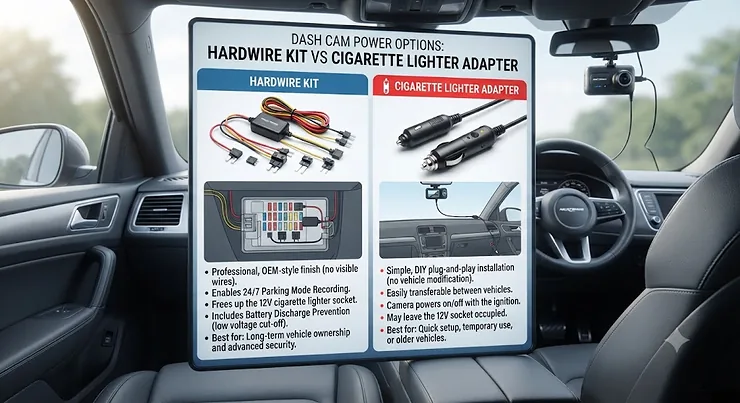
Somewhere in a Tesco car park right now, someone’s dash cam is quietly dying of neglect. Not because it’s broken — because it was never actually recording. It was plugged into the 12V socket, which switches off the moment the ignition does, which means the exact ten minutes someone reversed into the wing mirror went completely unrecorded. That’s the whole argument, in one soggy car park anecdote: hardwire kit vs cigarette lighter dash cam power isn’t a matter of taste, it’s a matter of what your camera can actually see when you’re not in the car.
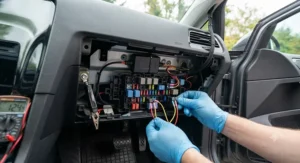
Here’s the short version. A cigarette lighter (12V socket) setup is quick, cheap, and reversible — plug it in, camera works, job done, but only while the engine’s running. A hardwire kit taps into your fuse box, runs power permanently (with a safety cut-off), and unlocks 24/7 parking mode — at the cost of £20-£30 and half an hour with a trim tool. Neither is “wrong”. One is convenience wired for driving. The other is protection wired for standing still.
This guide walks through both approaches properly — the wiring, the risks, the cable-routing reality, the OBD-versus-fuse-box debate — and then puts seven real dash cams and hardwire kits under the microscope so you can see exactly which setup fits your car, your budget, and how paranoid you are about car parks.
Quick Comparison: Hardwire Kit vs Cigarette Lighter Dash Cam
| Factor | Cigarette Lighter (12V Socket) | Hardwire Kit |
|---|---|---|
| Setup time | 2 minutes | 20-40 minutes |
| Parking mode | No (ignition-off = no power) | Yes, with voltage cut-off |
| Cost | £0 (often included) | £20-£30 kit, or £60-£100 fitted |
| Cable tidiness | Dangles or trails to the socket | Hidden in trim, no visible cable |
| Reversibility | Fully reversible, no tools | Semi-permanent, fuse tap stays in |
| Best for | Renters, lease cars, occasional use | Owned cars, street parking, daily commuters |
Reading the row that actually matters — parking mode — decides most of this argument on its own. If your car spends any real time parked somewhere you don’t fully trust, the socket route can’t protect it, full stop. But the cigarette lighter method isn’t a compromise for everyone: if you lease your car for two years, or you’re testing whether you even like having a dash cam, ripping into the fuse box on a car you don’t own outright is arguably the bigger risk. Cost tells its own story too — a hardwire kit is cheap on paper, but professional fitting roughly triples that outlay, so DIY confidence matters more than the sticker price.
💬 Which setup matches your driving? Skip to the picks below and find your fit.
What Is a Hardwire Kit for a Dash Cam?
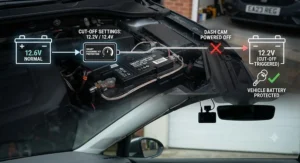
A dash cam hardwire kit is a wiring loom, usually with an inline fuse tap and a voltage-sensing module, that connects your camera directly to your car’s fuse box instead of the 12V socket — giving it permanent power (with an automatic low-battery cut-off) so it can record while parked and unattended.
That “voltage-sensing module” bit is the part most first-time buyers skip past, and it’s the part that actually matters. A cheap kit is genuinely just a wire with a fuse tap on the end — <cite index=”8-1″>kits under roughly £15 with no listed voltage cutoff are essentially glorified wires with a fuse tap, and they will drain a battery</cite>. A proper kit monitors your battery voltage and switches the camera off before it can leave you stranded. That distinction is worth more than every other spec on the box combined.
Top 7 Dash Cam Power Setups: Expert Analysis
We’ve mixed complete dash cams (some hardwire-ready, some socket-only out of the box) with dedicated hardwire kits, so you can see both halves of the “hardwire kit vs 12v socket dash cam” decision side by side — budget, mid-range and premium, across cameras and the kits that power them properly.
1. Nextbase 622GW — flagship 4K camera built for hardwire parking mode
The 622GW is Nextbase’s best-known model, and its case for hardwiring is baked into the spec sheet rather than bolted on as an afterthought. Recording in 4K at 30fps with a wide f/1.3 aperture, this camera is genuinely one of the better performers after dark, and it pairs with What3words location tech that can flag your exact position to emergency services. The magnetic mount is a small but clever touch — it snaps off in seconds if you swap cars or want to take it inside overnight.
What most buyers overlook is that the headline features — voice control via Alexa, GPS tagging, the emergency SOS system — are all somewhat wasted without proper parking mode, and parking mode itself needs a hardwire kit to function reliably. <cite index=”9-1″>Parking mode works well with an optional hardwiring kit, and at around £180 it represents real value given how well-rounded the package is</cite>. Reviewers consistently rate the night footage highly for this price bracket, though some note the companion app can be sluggish over Wi-Fi transfer.
Pros:
- ✅ Excellent low-light footage from the f/1.3 aperture
- ✅ What3words SOS location for emergencies
- ✅ Magnetic mount makes swapping between cars simple
Cons:
- ❌ Hardwire kit sold separately, not bundled
- ❌ App transfer speeds can lag on larger files
Expect a price in the £160-£200 range depending on bundle. As a standalone camera it’s excellent value; add the hardwire kit and you’re looking at the most complete “own it and forget it” setup on this list.
2. Viofo A129 Plus Duo — best mid-range pick for genuine dual-channel coverage
The A129 Plus Duo pairs a 1440p (QHD) front camera with a dedicated rear unit, and unlike some “4K” rivals that upscale a smaller sensor, Viofo has leaned into sensor quality over raw pixel count. That decision matters more than it sounds: a genuine 1440p camera reads number plates further out at night than a budget unit boasting a bigger number on the box.
Rear-end shunts are the most commonly disputed accident type on UK roads, so dual-channel coverage isn’t a luxury — it’s arguably the single most useful upgrade over a front-only camera. The A129 Plus supports Viofo’s own hardwire kit (the HK3-C, reviewed below) for parking mode, and its Sony STARVIS sensor holds up respectably in typical British winter gloom. Aggregated owner feedback across enthusiast forums and retailer review sections consistently flags the app’s GPS speed overlay as accurate, with occasional complaints about the supplied SD card being on the small side for daily 1440p recording.
Pros:
- ✅ Genuine 1440p resolution reads plates further at night
- ✅ Rear-end collision coverage as standard
- ✅ Compatible with Viofo’s own reliable hardwire kit
Cons:
- ❌ Supplied SD card is undersized for daily driving
- ❌ No built-in screen, setup relies on the app
Prices typically sit in the £150-£190 range for the dual-camera bundle. It’s a smart mid-range choice for anyone who wants rear protection without stretching to premium four-figure-review flagship pricing.
3.70mai A810S — best value all-rounder with GPS and Wi-Fi as standard
The A810S is the camera most likely to appear on a “best for most people” list, and for good reason: 4K front footage, rear coverage, GPS, and Wi-Fi arrive without pushing the price into premium territory. <cite index=”6-1″>it delivers 4K front footage, rear coverage, GPS, and Wi-Fi at a price that is easy to justify as basic protection</cite>.
Where this camera earns its “value” tag is in what it doesn’t skimp on: the GPS module tags speed and location without needing a paid subscription, and the app connects over Wi-Fi rather than requiring the SD card to be pulled every time you want footage. Based on the spec comparison with pricier rivals, the A810S’s main limitation isn’t image quality — it’s the absence of a dedicated screen, which makes on-the-fly menu changes slightly more fiddly than camera-mounted-display rivals. It ships socket-ready, but 70mai’s hardwire accessory is a straightforward add-on for anyone wanting full parking protection.
Pros:
- ✅ 4K front and rear footage at a genuinely accessible price
- ✅ GPS and Wi-Fi included with no subscription
- ✅ Straightforward hardwire accessory available separately
Cons:
- ❌ No built-in screen slows down menu navigation
- ❌ Wi-Fi transfer noticeably slower than SD-card copying
At around £120-£150, this is the camera to point budget-conscious buyers toward first, with the caveat that the hardwire kit is a genuinely worthwhile £25-£30 add-on rather than an optional extra.
4. Nextbase 3 Fuse Tap Hardwire Kit — best OEM-matched hardwire kit for Nextbase owners
This is a dedicated hardwire kit rather than a camera, and it solves one specific, common problem: getting factory-matched, plug-and-play wiring for a Nextbase camera without adapting a universal kit. <cite index=”5-1″>It’s designed to fit the Nextbase 622GW, 522, 422, 322, 222 and 122 dash cams directly, with a triple-fuse-tap connector</cite>, meaning no cutting, no soldering, and no guessing which fuse slot to use.
What the box doesn’t tell you is how much of the “clean install” outcome depends on which fuse you tap. Plugging into a fuse that’s live even with the ignition off (a permanent-live circuit) defeats the point of a voltage cut-off entirely, while an ignition-switched fuse won’t power parking mode at all — you specifically want a fuse that’s switched but also monitored by the kit’s own cut-off circuit. This kit’s inline fuse-tap connectors make that selection straightforward with a simple test light, and its voltage sensor cuts power at a safe threshold to protect your battery.
Pros:
- ✅ Purpose-built connector for six Nextbase camera models
- ✅ Triple fuse taps simplify finding the right circuit
- ✅ Built-in voltage cut-off protects the car battery
Cons:
- ❌ Only compatible with Nextbase’s own camera connector
- ❌ Doesn’t include a rear-camera power splitter
Priced around £25, this is the obvious pick if you already own a compatible Nextbase camera and want a kit engineered specifically for it rather than a universal adapter.
5. Viofo HK3-C Hardwire Kit — best universal hardwire kit for reliability
<cite index=”8-1″>Described by installers as a genuine workhorse, the HK3-C is Viofo’s flagship hardwire kit</cite>, and it’s built around the same principle as the Nextbase kit above — safe fuse-box power with an automatic cut-off — but with universal mini-USB output that works across most camera brands, not just Viofo’s own range.
Here’s what actually separates a good universal kit from a bad one: the cut-off voltage needs to be adjustable, because a fixed threshold that suits a healthy new battery can strand you next to a five-year-old one. The HK3-C’s adjustable low-voltage cut-off (rather than a fixed factory setting) is the feature worth paying the small premium for, and it’s precisely the feature that separates it from the sub-£15 “wire with a fuse tap” kits reviewers warn against. Owner discussions on car electronics forums consistently note reliable long-term performance with minimal parasitic drain when installed correctly, though the ATO/ATC fuse-tap style connectors mean older or unusual fuse boxes may need an adapter.
Pros:
- ✅ Adjustable voltage cut-off suits older batteries too
- ✅ Universal mini-USB output fits most camera brands
- ✅ Reputation for reliability over years, not just months
Cons:
- ❌ ATO/ATC fuse-tap style may need an adapter on some cars
- ❌ Slightly pricier than basic own-brand kits
At roughly £25-£30, it earns its “best overall” reputation among independent installers precisely because the adjustable cut-off removes the single biggest risk of hardwiring — a flat battery on a cold Monday morning.
6. BlackVue Power Magic Pro — best premium option for battery-conscious drivers
Where the kits above tap the fuse box only, the Power Magic Pro adds a genuinely different trick: it can draw supplemental power from a second connection to extend how long parking mode can run before the cut-off kicks in, which matters if you leave your car sitting for several days at a time. <cite index=”8-1″>It’s positioned as the best option for advanced protection</cite>, and that framing holds up — this is the kit for people who’ve already had one hardwire kit drain a battery and don’t want a repeat.
On paper this means longer real-world parking mode coverage without the anxiety-inducing guesswork of “will it still start tomorrow”. The trade-off is straightforward: it costs meaningfully more than a standard fuse-tap kit, and the installation is a notch more involved because it typically routes to the battery directly rather than a single fuse slot. For anyone parking on a street with a known history of scrapes and dings, that extra layer of protection is arguably cheap insurance against a much larger repair bill.
Pros:
- ✅ Extended parking-mode runtime versus standard kits
- ✅ Purpose-built for battery-conscious long-stay parking
- ✅ Trusted brand among dedicated parking-mode users
Cons:
- ❌ Higher price than a standard fuse-tap kit
- ❌ Installation is more involved (often battery-direct)
Sitting around £35-£45, it’s not the kit for a casual commuter — it’s the kit for someone who’s decided parking mode is the entire point of owning a dash cam.
7. Road Angel Halo Pro Deluxe — best complete bundle with hardwire kit included
The Halo Pro Deluxe answers a fair criticism of several cameras on this list: why is the hardwire kit almost always sold separately? This bundle ships with a 2K dual-channel (front and rear) camera, a 64GB SD card, and a hardwire kit included in the box, which removes the “now go and buy a second thing” step entirely.
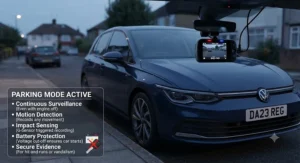
Genuine 24/7 True 3-Tier Parking Mode is the headline feature here, and it’s worth unpacking rather than taking at face value. <cite index=”10-1″>The three tiers combine impact and motion-triggered recording, time-lapse recording to reduce SD card wear, and continuous real-time recording for the most complete coverage, with all tiers including built-in battery protection to prevent the vehicle battery running flat</cite>. That layered approach — rather than a single all-or-nothing parking mode — is the kind of detail that separates a considered system from a box-ticking feature list. Wi-Fi links to the Road Angel app for downloading clips straight to your phone, which is genuinely useful the one time you need footage in a hurry and don’t have a laptop handy.
Pros:
- ✅ Hardwire kit and 64GB SD card included in the box
- ✅ Three-tier parking mode with built-in battery protection
- ✅ Front and rear dual-channel coverage as standard
Cons:
- ❌ 2K resolution, not 4K, on the front camera
- ❌ Bundle price sits above single-camera-only rivals
Expect a price in the £150-£200 range for the complete bundle. For anyone who wants to skip the “which hardwire kit do I need” research entirely, this is the simplest single-box answer.
Comparison Table: Top 7 at a Glance
| Product | Type | Power Method | Best For |
|---|---|---|---|
| Nextbase 622GW | Camera | Socket, hardwire optional | Night driving and SOS features |
| Viofo A129 Plus Duo | Camera | Socket, hardwire optional | Rear-end collision coverage |
| 70mai A810S | Camera | Socket, hardwire optional | Best value all-rounder |
| Nextbase 3 Fuse Tap Kit | Hardwire kit | Fuse box | Existing Nextbase camera owners |
| Viofo HK3-C | Hardwire kit | Fuse box (adjustable cut-off) | Universal reliability |
| BlackVue Power Magic Pro | Hardwire kit | Fuse box + battery | Long-stay street parking |
| Road Angel Halo Pro Deluxe | Camera + kit bundle | Hardwire included | All-in-one, no extra shopping |
Look closely and a pattern emerges: three of the four “just a camera” entries treat the hardwire kit as an accessory, while the dedicated kits differ mainly in how gracefully they handle battery protection. If you already own a compatible camera, a standalone kit like the Viofo HK3-C is the cheaper route; if you’re starting from scratch, the Road Angel Halo Pro Deluxe removes a decision point by bundling everything together.
💬 Just one click — help others make better buying decisions too!😊
Benefits vs Traditional Alternatives
| Setup | Records While Parked | Battery Safety | Install Effort |
|---|---|---|---|
| 12V Cigarette Lighter | No | N/A (ignition-dependent) | None |
| Basic Hardwire Kit (no cut-off) | Yes | Poor — risk of flat battery | Moderate |
| Quality Hardwire Kit (adjustable cut-off) | Yes | Strong | Moderate |
The middle row exists as a warning as much as a comparison point. A no-name hardwire kit without a genuine voltage cut-off gives you parking mode, technically, right up until the morning your car won’t start. The real choice isn’t “hardwire or not” — it’s “hardwire properly, with a cut-off, or don’t bother at all.”
Hardwire Kit vs Cigarette Lighter Dash Cam: The Full Breakdown
Reduced to a sentence: a cigarette lighter setup gives you a dash cam that works while you’re driving, and a hardwire kit gives you one that works while you’re not. That sounds like a small distinction until you remember that a huge share of the incidents people actually want footage of — a car park scrape, a keying, someone reversing into a bumper — happen precisely when the ignition is off and the socket has gone dead.
The 12V socket has real advantages that shouldn’t be dismissed. It’s instant, it needs zero technical confidence, and it leaves the car exactly as you found it — which matters enormously if you’re in a lease, a company car, or a rental. It also means you can move the whole setup to another car in the time it takes to unclip a mount. The trade-off is that it only powers the camera off the accessory circuit, which is, by design, dead the second you take the key out. No power in, no recording, no matter how good the camera itself is.
Hardwiring flips that equation. By tapping a fuse (or occasionally the battery directly, as with the BlackVue Power Magic Pro), the camera gets constant, low-current power that a quality kit monitors and cuts before it can hurt your battery. <cite index=”4-1″>Hardwired cameras, ideally fitted properly, record 24/7 with a safe battery cut-off, and if you want parking protection, hardwiring isn’t optional</cite>. The cost isn’t trivial in effort — you’re pulling trim, tapping a fuse, routing cable — but the financial cost is modest: <cite index=”4-1″>hardwire kits typically run £20-£30 plus around 30 minutes of fitting</cite>.
There’s a safety-focused case for hardwiring too, beyond parking mode. <cite index=”11-1″>Hardwiring is generally considered the superior method for a clean, secure installation — it’s safer than relying on the 12V socket, frees the socket up for other devices, and is essential for features like automatic parking mode</cite>. A cable permanently dangling to the socket is also, in itself, a minor safety issue — it can catch on your knee reaching for the gear stick, and a loose lead is exactly the kind of thing an MOT tester might flag if it strays anywhere near the pedals or steering column.
Practical Usage Guide: Installing and Living With a Hardwired Dash Cam
Before you start: Identify a switched fuse — one that’s only live with the ignition on — using the kit’s supplied test light or a multimeter. This is the single most common mistake in the first week of ownership: tapping a permanently-live fuse defeats the whole point of a cut-off circuit, because the camera never actually powers down to let the cut-off engage.
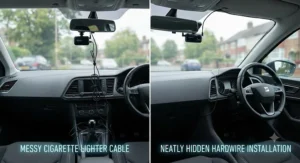
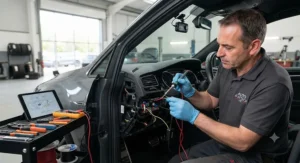
Cable routing that actually stays clean: Run the power cable from the camera down the A-pillar, tucking it behind the rubber trim seal rather than laying it on top. Continue it under the dashboard trim to the fuse box, and resist the temptation to leave slack loops visible — a taut, trim-hidden cable is what separates a “professional-looking” install from one that looks like a spider’s been at it. This is genuinely the difference cable management makes to how the whole job looks once it’s buttoned back up.
First 30 days — common mistakes to avoid: Don’t set the cut-off voltage too low if your battery is older than three years; a tired battery can sag under parking-mode load even when it starts the car fine every morning. Don’t forget to test parking mode by locking the car and tapping the bonnet gently to trigger the G-sensor — many owners install a kit and never actually confirm it’s recording while parked until the one time they need it, which is exactly the wrong moment to find out it isn’t.
Maintenance: Check the SD card every couple of months for card-health warnings (most dash cam apps flag this automatically), and reformat rather than just deleting old clips — fragmented cards are a leading cause of dropped or corrupted parking-mode footage.
Real-World Scenarios: Matching the Setup to the Driver
The daily commuter with a driveway. Parks off-street every night, drives 20 miles each way on mixed roads. A cigarette lighter setup genuinely covers most of this person’s risk, since the car is rarely vulnerable while parked. If budget allows, though, a basic hardwire kit like the Nextbase 3 Fuse Tap Hardwire Kit still adds a layer of protection for the odd supermarket car park trip.
The city dweller on permanent street parking. This is the clearest case for hardwiring, full stop. A car parked on a public street overnight, every night, is statistically far more exposed to scrapes, break-ins, and hit-and-runs than one on a driveway. Pairing something like the Viofo A129 Plus Duo with the Viofo HK3-C hardwire kit gives both drive-time and parked-time coverage without over-spending.
The lease or company car driver. Someone who doesn’t own the car outright and needs to hand it back in the same condition they received it. A hardwire kit involves tapping into the fuse box — reversible, but not something every lease agreement or company fleet policy will welcome without asking first. The 12V socket route, paired with something like the 70mai A810S, sidesteps that question entirely.
How to Choose Between Hardwire and Cigarette Lighter Power
- Work out where the car actually sleeps. Driveway or garage tips the scales toward the socket; street parking tips it firmly toward hardwiring.
- Check who owns the car. Leased or company vehicles complicate hardwiring — always confirm before pulling trim.
- Be honest about your DIY comfort. A confident amateur can fit a kit in 30-40 minutes; if fuse boxes make you nervous, budget for professional fitting instead.
- Decide if parking mode actually matters to you. If you’ve never once wondered who dinged your car in a car park, the socket may genuinely be enough.
- Factor in the battery age. An ageing battery pairs better with an adjustable-cut-off kit like the Viofo HK3-C than a fixed-threshold budget option.
- Consider resale. A hardwired install is easy enough to remove and doesn’t damage anything, but budget a few minutes at trade-in time to tidy the fuse box back to stock.
- Match the kit to the camera, not the other way round. Buying a camera-specific kit like the Nextbase 3 Fuse Tap Hardwire Kit is simpler than adapting a universal one.
OBD Port vs Fuse Box Power: Which Is Actually Better?
The OBD-II diagnostic port sits right there under the dashboard, and it’s tempting as a power source because there’s no trim to pull and no fuse to identify — you just plug in an OBD-to-USB adapter. The catch is that OBD power draws are often less predictable than a fuse tap, and on some vehicles the OBD port stays live even with the car fully locked, which can cause a steady parasitic drain that’s harder to diagnose than a single tapped fuse. It’s also the port your mechanic needs clear access to at every service and MOT, so a permanently plugged-in adapter is a minor but recurring inconvenience.
A proper fuse-box hardwire kit, by contrast, taps a single identified circuit with its own dedicated cut-off logic, and it doesn’t compete with any other in-car function for access. For most UK installations, fuse-box hardwiring remains the more predictable, more diagnosable, and ultimately more reliable route — OBD power is better reserved for temporary or trial setups than a permanent parking-mode solution.
Common Mistakes When Choosing Dash Cam Power
Buying a hardwire kit with no listed voltage cut-off is the single costliest mistake on this list, because the failure mode isn’t “the dash cam stops working” — it’s “the car won’t start”. Equally common is tapping the wrong fuse: always-live circuits defeat the cut-off’s purpose, while some ignition-switched circuits aren’t actually monitored by the kit at all, so double-check the kit’s instructions rather than assuming. A third mistake is skipping the test entirely — fitting a kit, closing up the trim, and never confirming parking mode actually triggers until the day it matters and doesn’t.
On the socket side, the main misstep is simply expecting protection the setup was never built to provide. A cigarette-lighter camera isn’t faulty if it doesn’t record a car park incident — it’s working exactly as designed, which is the point buyers often miss until it’s too late to matter.
Long-Term Cost and Maintenance: Is a Hardwire Kit Worth It?
Is a hardwire kit worth it, in pounds and pence? A quality kit costs £20-£30 DIY, or £60-£100 professionally fitted alongside the camera. <cite index=”8-1″>Set against that, the cost of a proper hardwire kit is a fraction of what a replacement battery costs</cite> — and a flat battery from a badly chosen budget kit is the realistic downside risk being insured against here. Compare that to the alternative: a single unrecorded car park incident, with no footage to support an insurance claim, can easily cost more in excess and no-claims impact than a decade of hardwire kits.
There’s an upside on the insurance side too. Several major UK insurers offer modest discounts for cars fitted with a dash cam, and unedited, GPS-tagged footage strengthens a claim regardless of which power method captured it — though only a hardwired, parking-mode-enabled camera can capture footage from incidents that happen while you’re not in the car at all.
Maintenance costs are close to zero either way. A hardwire kit’s fuse tap and cut-off module have no moving parts and effectively last the life of the car; the only real “maintenance” is occasionally checking the SD card and, if you’re paranoid, testing the cut-off voltage once a year with a multimeter.
Cable Management: Getting a Clean Install Either Way
Whichever power method you choose, cable management is where a genuinely tidy install lives or dies. For a cigarette-lighter setup, route the cable up the A-pillar and tuck it under the rubber trim seal rather than leaving it draped across the dash — a cheap cable clip strip (sold separately from most cameras) makes this a five-minute job and stops the lead swinging near your knee at every left turn.
For a hardwired install, the ambition is a completely invisible cable run: A-pillar, under the dash trim, down to the fuse box, with zero visible wire anywhere in the cabin. Reviewers and installers agree this is one of the genuine appeal points of hardwiring over the socket route — <cite index=”15-1″>when professionally hardwired, all cables are hidden away, resulting in a tidy, factory-fitted appearance</cite> that a dangling socket cable simply can’t match. If you’re doing it yourself, a plastic trim-removal tool (a few pounds from any car accessory shop) prevents the cracked clips that turn a tidy job into a rattling dashboard.
Safety and Legal Compliance: Where You’re Allowed to Mount It
Power method aside, where you physically place the camera is governed by UK law, and it applies identically whether you’ve hardwired it or plugged it into the socket. <cite index=”13-1″>The Road Vehicles (Construction and Use) Regulations 1986 specify that dash cams must not intrude more than 40mm into the area of the windscreen swept by the wiper blades</cite>, and the safest, most common compliant position is tucked behind the rear-view mirror. For the full detail on the regulations, the UK government’s own guidance is worth a look via legislation.gov.uk’s Road Vehicles Construction and Use Regulations.
Getting the position wrong isn’t just an MOT risk — <cite index=”12-1″>incorrectly positioned dash cams can bring fines of up to £1,000 and three penalty points, and footage recorded from an illegally positioned camera could become inadmissible in insurance or legal proceedings</cite>. Hardwiring doesn’t change any of this, but it does at least remove one variable: a permanently-fixed cable is less likely to have shifted the camera’s position than one that gets unplugged and replotted every time you swap it between cars.
Features That Actually Matter (And Those That Don’t)
An adjustable voltage cut-off matters. A branded, camera-specific fuse-tap connector matters, because it removes guesswork. Genuine dual-channel coverage matters more than a marketing “4K” badge on a single front lens, since <cite index=”4-1″>a genuine 1440p QHD camera reads number plates further out than a budget “4K” unit that’s simply upscaling a smaller sensor</cite>.
What doesn’t matter nearly as much as the marketing suggests: voice control gimmicks, elaborate on-screen animations, and headline resolution numbers divorced from sensor quality. Reviewers are consistent on this point — image clarity, especially at night, depends far more on aperture and sensor than on the number printed on the box.
FAQ
❓ Is a hardwire kit worth it for a dash cam?
❓ Can I install a hardwire kit myself?
❓ Does a hardwire kit drain my car battery?
❓ Is OBD port power better than a fuse box for a dash cam?
❓ Do I need a hardwire kit for parking mode to work?
Conclusion
The hardwire kit vs cigarette lighter dash cam question really comes down to one honest question: does your car spend meaningful time parked somewhere you can’t watch it? If the answer’s no, a socket setup on something like the 70mai A810S will serve you perfectly well, cost nothing extra, and take two minutes to fit. If the answer’s yes — street parking, shared car parks, a history of scrapes you never got to the bottom of — a proper hardwire kit with an adjustable voltage cut-off, like the Viofo HK3-C or the kit bundled into the Road Angel Halo Pro Deluxe, earns its £20-£30 asking price the very first time it catches something the socket setup would have missed entirely.
Either way, the camera itself matters just as much as how you power it. Pick real spec quality — genuine resolution, a decent sensor, dual-channel coverage where it matters — and match the power method to how and where you actually park, not to whichever option happened to be cheapest on the shelf.
✨ Ready to sort your setup once and for all? Check current prices on today’s picks and get your dash cam properly protected before the next car park close call.
Recommended for You
- How to Hardwire a Dash Cam: 7 Kits That Actually Work (2026)
- Hardwire Kit for Dash Cam 2026: 7 Best Options Ranked
- Best Dash Cam Motion Detection Parked 2026: Top 7 UK Picks
Disclaimer: This article contains affiliate links. As an Amazon Associate, I earn from qualifying purchases. If you purchase products through these links, we may earn a small commission at no additional cost to you.
✨ Found this helpful? Share it with your friends! 💬🤗
