
In This Article
Picture this. Someone clips your car on a roundabout near a retail park, drives off, and you’re left with a dent, a rapidly rising blood pressure, and — if you’re unlucky — footage so blurry the number plate looks like an abstract painting. Sound familiar? It shouldn’t have to be.
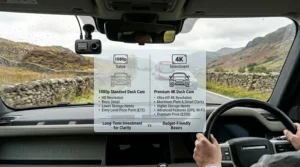
The debate around 4K vs 1080p dash cam quality is no longer academic. In 2026, it’s the difference between evidence that closes a case and footage that leaves your insurance company shrugging. A 4K dash cam captures roughly four times the pixels of a standard 1080p model — 3,840 × 2,160 versus 1,920 × 1,080 — which in plain English means the difference between reading a number plate clearly at motorway speeds and squinting at a pixelated smear. That said, resolution alone isn’t the whole story, and blindly buying the most expensive 4K model won’t guarantee brilliant footage either.
Britain’s roads present some genuinely specific challenges. We drive on the left, our motorways are among the busiest in Europe, and the weather oscillates between drizzle and more drizzle from October through to April. Overcast skies, spray from lorries, and the peculiar glare of a low winter sun at 3pm are all forces working against your dash cam’s image sensor. What matters, then, isn’t just the headline resolution — it’s the sensor quality, the aperture, the bitrate, and yes, the placement relative to your wiper arc.
In this guide, we’ve done the research so you don’t have to. We’ve identified seven real products currently available on Amazon.co.uk — from budget-friendly 1080p workhorses to sophisticated multi-channel 4K systems — and given each one the kind of honest commentary you won’t find on a product listing page.
Quick Comparison: 4K vs 1080p Dash Cam at a Glance
| Feature | 4K (2160p) | 1080p (Full HD) |
|---|---|---|
| Pixel count | 8.3 megapixels/frame | 2.1 megapixels/frame |
| Number plate clarity (30mph+) | Excellent | Adequate–Poor at distance |
| Night performance | Superior (with STARVIS 2) | Good (with quality sensor) |
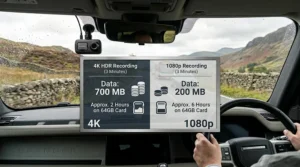
| File size per hour | ~7–12GB | ~2–4GB |
| Price range (UK) | £70–£300+ | £30–£120 |
| SD card needed | 128GB+ recommended | 64GB sufficient |
| Best for | Evidence, motorways, insurance | Budget, urban, low-speed driving |
The table above tells a clear story, but the nuance is worth noting. A budget 4K model using interpolated (i.e. digitally upscaled) resolution will not outperform a quality 1080p camera with a Sony STARVIS 2 sensor. The sensor generation, bitrate, and aperture width are at least as important as the resolution figure printed on the box. The good news: in 2026, the price gap between decent 4K and decent 1080p has narrowed significantly, making the upgrade more accessible than ever.
✨ Don’t Miss These Exclusive Deals!
🔍 Take your dash cam setup to the next level with these carefully selected products. Click on any highlighted item to check current pricing and availability on Amazon.co.uk. These picks will help you find exactly what you need!
💬 Just one click — help others make better buying decisions too! 😊
Top 7 Dash Cams Available on Amazon.co.uk: Expert Analysis
1. Viofo A229 Pro — Best 4K Dash Cam Overall
The Viofo A229 Pro is the one that changed the conversation. Where most 4K dash cams record at 30 frames per second, this model offers 60fps — and on a British motorway at 70mph, that extra smoothness is the difference between a readable number plate and a motion-blurred blur.
Under the bonnet: the A229 Pro sports dual Sony STARVIS 2 IMX678 sensors across both front and rear channels. That’s not marketing fluff — STARVIS 2 is the current gold standard in dash cam sensor technology, delivering roughly 8dB better dynamic range than its predecessor. In practice, it handles the tricky conditions that plague UK roads: the long shadow of an overpass, the blinding glare of low sun on the A3, the wash of headlights on an unlit country B-road at night. The front records in true native 4K; the rear in 2K (1440p) — a meaningful step above the 1080p rear cameras on most rivals.
For the majority of UK buyers who actually need their dash cam to do something when they need it most — read a plate, timestamp an incident, prove fault in a roundabout dispute — this is the camera that consistently comes through. Auto Express named it the best choice if “the ultimate in footage quality” is your priority. The app is functional if slightly clunky, which is a small gripe for what is otherwise a remarkably capable piece of kit.
UK reviewers note its discreet adhesive mount keeps the footprint small behind the rear-view mirror — particularly useful given the increasingly cluttered A-pillars on modern right-hand drive vehicles. A supercapacitor power system (rather than a battery) means it handles the heat inside a parked car in summer without degrading.
✅ True native 4K at 60fps — unique in this price bracket
✅ Dual STARVIS 2 sensors front and rear
✅ 2K rear camera (better than the 1080p rear cameras on rivals)
❌ App interface less intuitive than some competitors
❌ Hardwire kit for parking mode sold separately
Price range: Mid-to-upper range on Amazon.co.uk. Excellent value for the sensor and resolution combination on offer.
2. 70mai A800SE — Best 4K Dash Cam for Value
The 70mai A800SE is the camera that repeatedly turns up on shortlists when UK buyers ask “is 4K worth it?” at a sensible price. And it is, largely, worth it — with a few caveats worth understanding before you click buy.
Specification highlights: 4K UHD front (3840 × 2160), 1080p rear, a fast f/1.55 aperture that lets in considerably more light than the f/1.8 aperture common on cheaper models, and a 3-inch IPS display for playback without reaching for your phone. The HDR processing is genuine rather than cosmetic — the camera adjusts exposure dynamically as you move from shadow to sunlight, which is a practical boon on tree-lined A-roads.
Where it earns its place for UK commuters particularly is the ADAS (Advanced Driver Assistance System) package — lane departure warnings, forward collision alerts. These features are standard on premium cars costing thirty times the price; having them on a dash cam under £120 is quite something. For drivers navigating congestion zones in London or the M25 at rush hour, the forward collision alert alone is worth the slight price premium over a basic 1080p model.
UK reviewers note that the wide field of vision can make the footage look slightly distorted — a trade-off for covering more of the road — and the rear camera quality is noticeably a step below the front. But as a standalone front camera for daily use on British roads, it punches well above its weight. Free 128GB SD card included, which saves a separate purchase of around £10–£15.
✅ Genuine 4K with f/1.55 aperture for strong night performance
✅ ADAS driver alerts included
✅ Ships with 128GB SD card
❌ Rear camera quality not as sharp as the front
❌ Wide-angle distortion can be distracting on footage playback
Price range: Around the £100–£130 mark on Amazon.co.uk — one of the stronger value propositions in the 4K category.
3. Nextbase 622GW — Best British Brand 4K Cam
There’s something reassuringly local about the Nextbase 622GW. Nextbase is a British brand — they pioneered the National Dash Cam Safety Portal, which lets drivers submit footage directly to the police — and the 622GW is their flagship. In 2026 it remains available on Amazon.co.uk and still holds its own against the newer wave of Chinese-manufactured competitors.
The sensor is an Omnivision OS08A10 paired with an Ambarella H22 chipset, recording true 4K at 30fps (or 1080p at 120fps for super slow-motion playback — invaluable for reviewing exactly what happened in a complex multi-vehicle incident). The built-in adjustable polarising filter is the feature that most UK owners mention first: rotate the bezel slightly and glare from a wet windscreen or low sun disappears almost entirely. Given that we experience roughly 150+ overcast and rain-affected days per year, this is not a gimmick — it’s a practical necessity.
The Emergency SOS integration with what3words is a world-first for dash cams and genuinely useful: in the event of an accident where the driver is incapacitated, the camera can alert emergency services with precise coordinates. The 12-month UK warranty and Nextbase’s dedicated UK customer support team are a genuine advantage over rival brands where after-sales involves emailing a warehouse in Shenzhen.
The 622GW is on the larger side for a dash cam, and the Alexa integration has attracted mixed reviews — it works, but not always when you want it to. No SD card is included, which at this price point feels like a mild oversight. The rear module camera (sold separately) records only at 1080p, which is fine but below what the main unit is capable of.
✅ Adjustable polarising filter — excellent for UK weather and glare
✅ Emergency SOS + what3words location (UK-specific benefit)
✅ British brand with UK warranty and local support
❌ Larger form factor than most rivals
❌ No SD card included; rear module sold separately
Price range: Upper range on Amazon.co.uk — premium features justify the price if UK emergency services integration matters to you.
4. REDTIGER F7NP — Best Budget 4K Dash Cam
The REDTIGER F7NP is the camera you reach for when the budget is tight but you still want 4K written on the box — and, mostly, what you get is close to what’s promised. It’s worth being transparent here: the F7NP uses a Sony STARVIS first-generation IMX335 sensor rather than the newer STARVIS 2, which is a step below the Viofo and 70mai options. The “4K” front recording is upscaled from 5MP rather than natively captured. In daylight at close range, the difference is marginal. At distance, or at night, a STARVIS 2 camera will outperform it.
That said: the REDTIGER F7NP is one of the highest-rated dash cams on Amazon.co.uk by sheer volume of UK reviews — over 24,000 at the time of writing — and the overwhelming sentiment is that it does what it says. The 5.8GHz Wi-Fi 6 connection means downloading footage to your phone is genuinely fast (20MB/s versus the sluggish 2.4GHz speeds of older models). The 170° wide-angle front coverage is among the broadest available. The 128GB SD card is included.
For someone driving within city speed limits — urban commuting in Birmingham, school runs, supermarket trips — where number plate legibility at motorway distances isn’t the primary concern, the F7NP delivers perfectly acceptable 4K-adjacent footage at a price that makes the more expensive options feel hard to justify. The suction cup mount also means it swaps between vehicles easily — handy if you share a car with a partner.
✅ Extremely well reviewed by UK buyers (24,000+ reviews)
✅ Fast Wi-Fi 6 for quick footage downloads
✅ Includes 128GB SD card
❌ Upscaled rather than native 4K — sensor is first-gen STARVIS
❌ Suction mount less stable on temperature extremes than adhesive
Price range: Budget to mid-range — one of the most competitive 4K offerings on Amazon.co.uk.
5. Miofive S1 — Best 4K Dash Cam for Features per Pound
Auto Express named the Miofive S1 their “Best Buy” in recent testing — high praise from a publication that has been testing cars and accessories since before most current dash cam manufacturers existed. The reasoning is sound: the S1 packs GPS speed tracking, a 32GB SD card, clear 4K footage, a well-designed menu interface, and audible speed camera warnings into a package that undercuts much of the established competition.
The Sony sensor handles daytime footage particularly well, with colours that feel natural rather than the slightly over-saturated processing common on budget rivals. The dedicated app receives notably better reviews than the Viofo or Nextbase equivalents — “quick to connect, easy to navigate” appears in numerous UK customer reviews. GPS tracking means every piece of footage has timestamped location and speed data embedded, which is enormously useful if you need to present evidence to an insurer or the police.
For UK drivers who do significant motorway mileage — sales reps covering the M1 corridor, families doing regular long-distance runs up to Scotland — the Miofive S1 makes a compelling case. It’s not the most advanced sensor, and night performance at distance falls short of the Viofo A229 Pro, but the overall package at its price point is difficult to match. The build quality feels solid — less plasticky than some rivals at similar prices.
✅ Named Auto Express Best Buy 2026
✅ GPS with speed camera alerts included
✅ Strong app experience with clean interface
❌ Night-time footage at distance falls behind STARVIS 2 rivals
❌ Limited parking mode without separate hardwire kit
Price range: Mid-range on Amazon.co.uk — a strong all-rounder that rarely disappoints.
6. Vantrue N4 Pro — Best 3-Channel 4K Dash Cam
If you drive for Uber, work as a minicab driver, or simply want the kind of comprehensive coverage that covers every angle of your vehicle, the Vantrue N4 Pro is the option that makes everything else look a bit one-dimensional. Three channels. Front at 4K (3840 × 2160), interior cabin at 1080P with infrared night vision, and rear at 1080P — all recording simultaneously, all with GPS tracking.
The Sony STARVIS 2 IMX678 front sensor means the 4K footage is genuinely native rather than upscaled. Vantrue’s proprietary PlatePix technology processes the front footage with a specific focus on number plate clarity — particularly useful at motorway speeds where the plate represents just a handful of pixels in the overall frame. In independent testing, it consistently outperformed rivals at reading plates beyond 30 metres in bright conditions.
The supercapacitor power system is worth noting for UK buyers: capacitors outlast batteries significantly and — critically — don’t deteriorate in cold temperatures the way lithium batteries do. After a particularly cold night parked on a driveway in January, a battery-powered dash cam may take several seconds to initialise. A capacitor-powered model like the N4 Pro is ready to record the moment the ignition fires.
For professional drivers in the UK — people who need to protect themselves from false claims, document passenger behaviour, and have solid evidence from every angle — this is the right tool. It’s bulkier than a single-channel unit and requires careful installation of the rear cable (20 feet, which fits most vehicles), but the protection it offers is proportionally more comprehensive.
✅ True 4K 3-channel recording: front, interior, rear
✅ STARVIS 2 + PlatePix for best-in-class plate clarity
✅ Supercapacitor for reliable cold-weather performance
❌ Bulkier installation than single or dual-channel alternatives
❌ G-sensor sensitivity can trigger too many locked clips — worth adjusting in settings
Price range: Premium range on Amazon.co.uk — justifiable for professional drivers or those wanting maximum coverage.
7. Garmin Dash Cam Mini 3 — Best 1080p Dash Cam for Simplicity
Not everyone needs 4K. If you drive locally, rarely exceed 40mph, and simply want an honest record of what happens within a few car lengths of your bumper, the Garmin Dash Cam Mini 3 is the most refined 1080p option on the market. It’s smaller than your thumb, hides completely behind the rear-view mirror, and Garmin’s reliability reputation means it just quietly gets on with recording without demanding attention.
The 1080p full HD recording at 140° field of view is genuinely good — clean, well-processed, with Garmin’s built-in Clarity polariser reducing windscreen reflections effectively. Voice control (“OK Garmin, save video”) means you never need to fiddle with buttons while driving. The Garmin Drive app is one of the best in the category for usability: straightforward pairing, clean layout, and no subscription fees required for basic functionality.
Where the Mini 3 falls short is the gap that 2026 has made more obvious: 4K models are now so close in price that spending £110–£120 on a 1080p camera feels harder to justify than it did two years ago. Vantrue’s E1 Pro offers 4K for a similar outlay. The Mini 3 has no screen and no GPS, which simplifies it considerably but removes features that prove genuinely useful when presenting evidence. For someone who genuinely values discretion and simplicity above all else — perhaps an older driver, someone who just wants peace of mind without a complicated setup — it remains excellent. For everyone else, seriously consider stepping up.
✅ Genuinely tiny — invisible behind the rear-view mirror
✅ Superb app and voice control experience
✅ Garmin build quality and reliability
❌ 1080p in a world rapidly standardising on 4K
❌ No GPS, no screen — limited evidence metadata
Price range: Upper end for a 1080p model on Amazon.co.uk — the premium reflects Garmin’s brand and software quality, not the resolution.
How to Set Up Your Dash Cam Correctly: A Practical UK Guide
Buying the right camera is only half the job. Even a Viofo A229 Pro will produce blurry, useless footage if it’s mounted in the wrong position or connected to the wrong SD card. Here’s what UK installers and experienced owners consistently flag as the most important setup considerations.
Position within the wiper arc. This is, remarkably, something a significant proportion of dash cam owners get wrong. If your camera sits outside the area swept by your windscreen wipers, every rainy drive — and given the British climate, that’s a substantial portion of your annual mileage — will result in footage obscured by water droplets. Position the camera so the lens sits squarely within the wiper arc. In right-hand drive vehicles, this typically means slightly right of centre behind the rear-view mirror.
Use the right SD card. A dash cam writing continuously to a cheap Class 4 or Class 6 card will corrupt footage, freeze during recording, or fail entirely within months. For 4K cameras, use a minimum U3/Class 10 card rated for continuous write — Nextbase’s own U3 cards, Samsung Pro Endurance, or SanDisk High Endurance are reliable choices widely available on Amazon.co.uk. For 1080p models, a good-quality 64GB U1 card is sufficient. Replace the card annually or every 40,000–50,000 km to avoid write failures.
Consider hardwiring for parking mode. The standard 12V cigarette lighter cable only powers the camera when the ignition is on. If you park in a city — anywhere near congestion zones, on-street parking, supermarket car parks — connecting via a hardwire kit (available from around £15–£25 on Amazon.co.uk) powers the camera from the fuse box and enables parking mode, which records when the vehicle is stationary and detects motion or impact. In urban areas where minor scrapes in car parks are a routine nuisance, this is one of the most useful investments you can make.
Adjust G-sensor sensitivity. Most UK owners receive their camera and leave the G-sensor at default sensitivity — and then discover that speed bumps, potholes (of which British roads have no shortage), and sharp braking trigger constant “emergency” clips that fill the protected folder. Drop the sensitivity to low or medium to reduce false triggers while still catching genuine impacts.
Real-World UK Buyer Scenarios: Which Cam Fits Your Life?
The London Commuter
Sarah drives into Zone 2 from Bromley five days a week. She parks on the street outside her office. Her concerns: scrapes in the car park, being rear-ended in traffic, and having evidence if someone clips her wing mirror on a tight one-way street. The 70mai A800SE suits her well — the ADAS forward collision alerts are genuinely useful in stop-start traffic, the 4K front camera captures everything clearly, and parking mode with the hardwire kit (essential, given the street parking) keeps an eye on the car overnight. Budget: around the £120–£150 range including hardwire kit.
The Yorkshire Motorway Driver
James covers around 35,000 miles a year on the M62 and A1 for a manufacturer’s rep role. His primary concern is number plate legibility at motorway speeds — he’s had one near-miss where footage from his old 1080p camera couldn’t definitively identify the vehicle. The Viofo A229 Pro is the clear recommendation: native 4K at 60fps, STARVIS 2 sensor front and rear, and evidence quality that would hold up to any insurance query. The A229 Pro’s supercapacitor also means it starts immediately on cold Yorkshire mornings rather than waiting for a battery to warm up.
The Uber Driver in Manchester
Fatima drives Uber shifts in central Manchester — inner-city roads, frequent passengers, the need to document both the road ahead and the cabin for her own protection. The Vantrue N4 Pro is the only realistic choice: three-channel recording covers front, rear, and the interior simultaneously, the IR cabin camera works in complete darkness, and the GPS and speed log create an unimpeachable record of every journey. More setup effort, but for professional drivers, the protection it offers is worth every minute.
4K vs 1080p Dash Cam: The Evidence Question
Here’s the uncomfortable truth that most product pages won’t tell you directly. The moment most people actually care about their dash cam’s resolution is the worst moment of their driving life — after an accident. At that point, there’s no going back and upgrading.
A 1080p camera may struggle to capture identifiable number plates when a vehicle is more than a car or two’s distance away and moving at speed — leaving you with footage of the incident but not the identity of the other party. The spec sheet won’t tell you this in those terms, but it’s the practical reality that insurance companies and the police encounter regularly.
Standard 1080p cameras can fail to capture legible number plate digits at speeds over 30mph, making 4K resolution and higher bit rates increasingly important for modern UK roads — particularly on dual carriageways and motorways where the distances involved are larger. There’s a useful analogy here: think of the optician’s eye chart. With 1080p, you can read the large letters. With 4K, you can read the bottom line.
That said, resolution is only one variable. A high-quality 2K (1440p) camera with a dedicated Sony STARVIS sensor will outperform a fake 4K camera that’s upscaling a lower-resolution image. Bitrate matters too: a 4K camera recording at 20 Mbps and a 1080p camera recording at 20 Mbps will produce different quality results despite the resolution difference — because the 4K camera is compressing far more information into the same data budget. For genuine 4K performance, look for cameras recording at 40–60 Mbps minimum.
Night performance adds another dimension. Night footage quality is primarily determined by sensor generation, aperture, and bitrate — not resolution. A 2K STARVIS 2 camera will outperform a 4K camera with a lesser sensor in dark conditions. This is why the Viofo A229 Pro’s dual STARVIS 2 sensors matter more than the 4K badge alone — the sensor is doing the heavy lifting when the sun goes down.
Common Mistakes When Buying a Dash Cam in the UK
Buying “4K” without checking if it’s native or upscaled
As noted above, some manufacturers advertise 4K recording that is algorithmically upscaled from a lower-resolution sensor. The REDTIGER F7NP, for example, uses a 5MP sensor — technically capable of 4K output, but not equivalent to the true 8MP native 4K of the Viofo A229 Pro or Vantrue N4 Pro. If 4K evidence quality is the goal, check the sensor specifications: Sony STARVIS 2 IMX678 is the benchmark in 2026.
Ignoring the importance of SD card quality
A dash cam is only as reliable as the card it’s writing to. UK buyers frequently report dash cam failures that turn out to be card failures. Use a card designed for sustained write operations — “High Endurance” or “Pro Endurance” variants from Samsung, SanDisk, or the camera manufacturer. Budget cards from unfamiliar brands are a false economy.
Forgetting the wiper arc (again — it bears repeating)
Given that the UK receives substantial rainfall year-round, mounting your camera outside the wiper sweep renders it unreliable in the conditions when you need it most. This is the single most common installation error.
Assuming a higher-priced camera automatically means better footage
The Garmin Dash Cam Mini 3 costs more than several 4K alternatives, primarily because you’re paying for brand reputation, app quality, and design refinement — not resolution. Conversely, a £70 dash cam with a STARVIS 2 sensor will outperform a £200 model with a mediocre sensor in challenging conditions. Research the sensor first; the brand name second.
Ignoring parking mode — particularly in urban areas
A dash cam that only records when the engine is running misses the scrapes, bumps, and vandalism that happen in your absence. The National Dash Cam Safety Portal, established by Nextbase and supported by police forces across the UK, accepts parking mode footage as valid evidence. If you park on the street or in shared car parks, a hardwire kit is a genuinely worthwhile addition.
✨ Don’t Miss These Exclusive Deals!
🔍 These carefully chosen picks are all available to check right now on Amazon.co.uk. Click any highlighted product to view current pricing, specifications, and customer reviews. Amazon Prime members benefit from free next-day delivery on eligible items.
What to Expect: Real-World 4K vs 1080p Performance in British Conditions
Daytime on a Dry Motorway
This is where the 4K vs 1080p dash cam gap is most visible. At 70mph, a vehicle one or two lanes over represents a relatively small portion of the frame. In 4K footage, at 60fps, number plates are consistently legible even when zooming in post-incident. In 1080p at 30fps, motion blur at those speeds can reduce a moving plate to an unreadable smear. Native 4K with Sony STARVIS 2 captures licence plates and road detail that a 1080p camera misses.
Overcast British Winter Afternoon
Grey skies, ambient light dropping by 3:30pm, wet roads reflecting headlights. This is where the sensor quality matters more than the resolution. Both the 70mai A800SE (f/1.55 aperture) and the Viofo A229 Pro (STARVIS 2) handle these conditions appreciably better than budget 1080p models. The aperture figure is the key number: lower f-stops (f/1.5, f/1.6) admit more light and produce cleaner low-light footage.
Urban Stop-Start Traffic
Here, the 4K advantage narrows somewhat. At 10–20mph, 1080p cameras produce perfectly legible footage of nearby vehicles. For urban-only drivers who never venture onto the motorway, a quality 1080p camera like the Garmin Dash Cam Mini 3 — or a mid-range 1080p unit — will handle every credible incident scenario adequately. The argument for 4K is more compelling the faster and further you drive.
Wet Road and Rain
Spray from lorries on the M6, rain sheeting across the A30 in Cornwall, a November morning on the M8 in Glasgow. Water on the windscreen degrades footage quality regardless of resolution. This is the core reason why polarising filters (Nextbase 622GW, Garmin Mini 3’s Clarity polariser) earn disproportionate praise from UK buyers — they reduce the distorting effect of reflected light and water glare in ways that additional pixels alone cannot.
How to Choose a Dash Cam in the UK: 6 Essential Criteria
- Determine your primary use case. Motorway commuter or school run driver? Evidence-focused professional or casual peace-of-mind user? Your answer drives every other decision.
- Set a realistic budget. In 2026, a quality single-channel 4K dash cam starts at around £70–£100 on Amazon.co.uk. A dual-channel 4K setup sits at £100–£170. A three-channel professional setup like the Vantrue N4 Pro is in the £200–£300 range. There’s a workable option at every level.
- Check whether the 4K is native or upscaled. Look for Sony STARVIS 2 (IMX678 or IMX675) for genuine high-performance sensors. STARVIS first-generation (IMX335) is adequate but a step behind.
- Decide whether you need a rear camera. A rear camera adds meaningful protection for the third of UK accidents that are rear-end collisions. Most 4K front cameras offer a 1080p rear option. The Viofo A229 Pro’s 2K rear is an upgrade worth considering.
- Consider parking mode from the start. If you’re likely to want it, budget for the hardwire kit now. Retrofitting cable management later is significantly more awkward.
- Check Amazon.co.uk Prime eligibility. Prime members receive free next-day delivery on most dash cams in this guide — useful if you want the camera installed before a long journey.
Long-Term Cost and Maintenance: What UK Buyers Should Know
A dash cam isn’t quite a fit-and-forget device. Here’s what to budget for over a two-to-three year ownership period in the UK.
SD card replacement: Budget £10–£20 per year for a quality replacement card, particularly if you use 4K recording. Write cycles degrade cards over time; annual replacement prevents reliability issues. The Consumer Rights Act 2015 provides UK buyers with recourse if a card fails within expected lifespan.
Hardwire kit: A one-off cost of £15–£25 on Amazon.co.uk that unlocks parking mode and eliminates the slightly awkward cable management of the cigarette lighter lead. Well worth doing properly during initial installation.
Storage costs for 4K: A 4K camera recording continuously uses roughly 7–12GB per hour of footage. On a 128GB card (the standard recommendation), that gives you approximately 10–18 hours before loop recording begins overwriting older files. For most commuters, this is more than sufficient. If you frequently drive long distances and want to retain more footage, a 256GB card (around £25–£35 on Amazon.co.uk) is a sensible upgrade.
Warranty and support: UK buyers benefit from the Consumer Rights Act 2015, which provides protection beyond the manufacturer warranty if a product fails within a reasonable timeframe. Nextbase’s 12-month UK warranty with domestic customer support is worth something concrete; for less established brands, Amazon’s own returns process (14-day cooling-off period under Consumer Contracts Regulations) provides reassurance.
Post-Brexit note: Some European dash cam brands carry slightly adjusted UK pricing due to import considerations, but you benefit from UK consumer protections and Amazon.co.uk’s hassle-free returns. UKCA marking requirements apply to electronic devices sold in the UK; all products in this guide are available through verified Amazon.co.uk listings.
FAQ: 4K vs 1080p Dash Cam — UK Buyers’ Questions Answered
❓ Is a 4K dash cam worth it for UK roads in 2026?
❓ Will a dash cam work in heavy British rain?
❓ Do I need a separate SD card for my dash cam in the UK?
❓ Can dash cam footage be used as evidence with UK police or insurers?
❓ What storage card do I need for a 4K dash cam on Amazon.co.uk?
Conclusion: Should You Buy a 4K or 1080p Dash Cam?
For most UK drivers in 2026, the honest answer is: buy 4K, if the budget allows. The price gap has narrowed substantially. Models like the 70mai A800SE and Miofive S1 deliver genuine 4K recording at prices that would have bought a mid-range 1080p camera just two years ago.
That said, resolution is not the whole story. The sensor generation, the aperture, the bitrate, and the placement on your windscreen matter at least as much as the headline pixel count. A quality 1080p camera like the Garmin Dash Cam Mini 3 will serve a low-mileage urban driver admirably. A budget 4K model with an interpolated sensor and a mediocre bitrate will not perform as its box implies.
The decision framework is straightforward: if you regularly drive on dual carriageways or motorways, carry passengers professionally, or want the strongest possible evidence in the event of a disputed incident, step up to 4K — specifically, native 4K with a STARVIS 2 sensor. If your driving is predominantly urban at lower speeds and budget is a genuine constraint, a good 1080p camera does the job.
Whatever you choose, mount it correctly, use the right SD card, and seriously consider a hardwire kit. The best dash cam in the world is useless if it’s positioned outside the wiper arc in a British November.
✨ Don’t Miss These Exclusive Deals!
🔍 Ready to upgrade? Click any highlighted product in this guide to check current pricing and availability on Amazon.co.uk. Prime members get free next-day delivery on most eligible items — you could have it fitted before the weekend.
Recommended for You
- Best 4K Dash Cam UK 2026: 7 Sharpest Picks Tested
- Front and Rear Dash Cam vs Front Only: 7 Best UK Picks 2026
- Best Front and Rear Dash Cam UK 2026: 7 Expert Picks
Disclaimer: This article contains affiliate links. As an Amazon Associate, I earn from qualifying purchases. If you purchase products through these links, we may earn a small commission at no additional cost to you.
✨ Found this helpful? Share it with your mates! 💬🤗
